Posts

Discover how Augmentir’s AI transforms the connected worker journey—boosting training, productivity, and continuous improvement across operations.

In an era defined by digital transformation and workforce disruption, industrial companies are reimagining how they support their frontline teams. At the heart of this shift is the Connected Worker—a worker empowered by technology to perform safely, efficiently, and with confidence.

But enabling a connected workforce requires more than just digitizing procedures or implementing standalone tools. It demands intelligence embedded throughout the entire worker lifecycle.
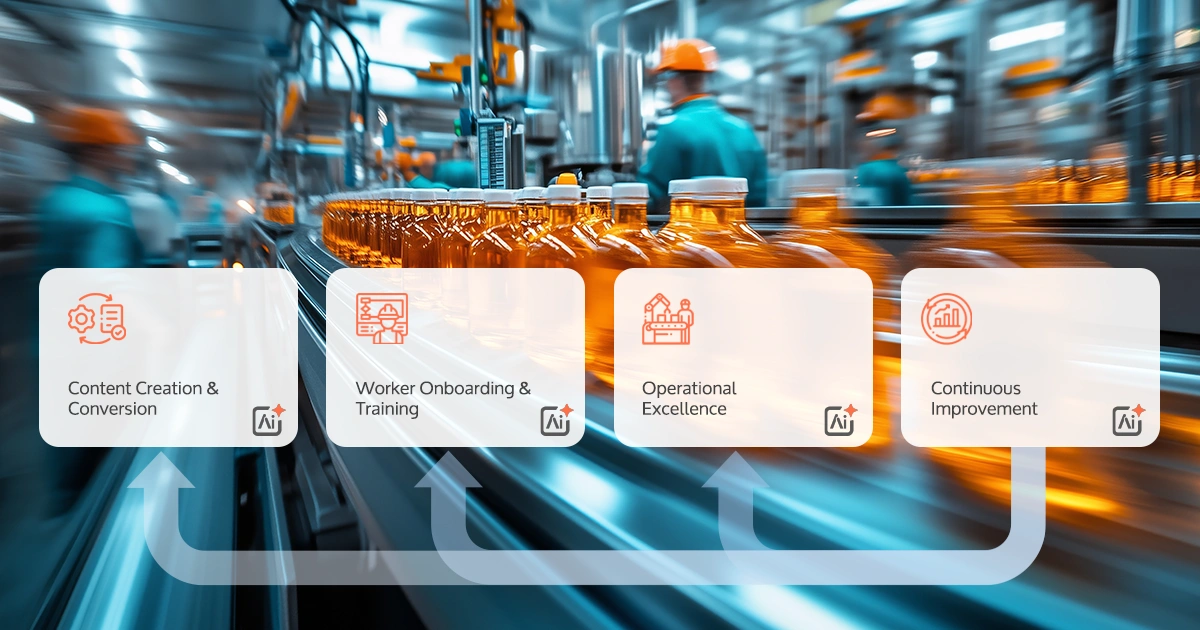
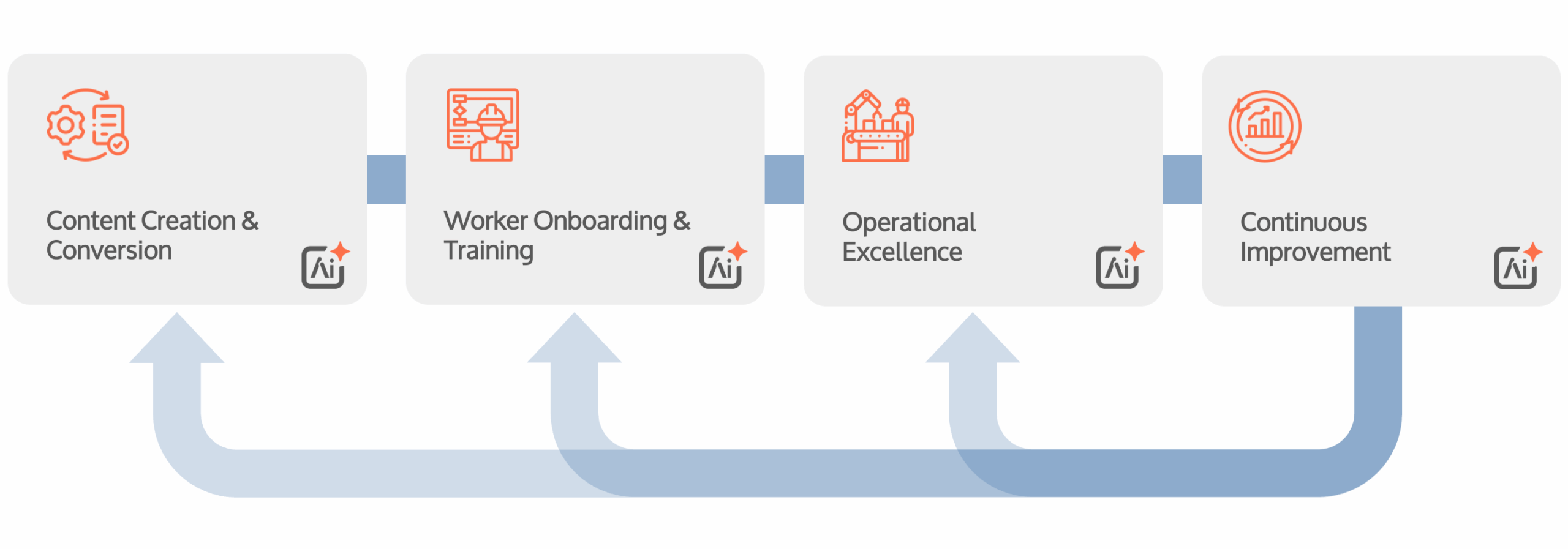
the connected worker journey - powered by augmentir ai

That’s where Augmentir’s AI-powered Connected Worker platform shines. By infusing intelligence into every phase of the connected worker journey—from content creation to onboarding, daily operations, and continuous improvement—Augmentir delivers measurable gains in productivity, safety, and workforce engagement.

A Framework for Transformation: The Connected Worker Journey

The Connected Worker Journey consists of four critical, interrelated stages:

  1. Content Conversion & Creation
  2. Worker Onboarding & Training
  3. Operational Excellence
  4. Continuous Improvement

connected worker journey

At each phase, Augmentir’s embedded AI transforms outdated processes into intelligent workflows—helping organizations streamline deployment, scale training, and drive continuous value.

Let’s explore how.

1. Content Conversion & Creation

Laying the Foundation for Frontline Intelligence

Deploying modern Connected Worker software delivers ROI through a combination of features that support data collection, compliance, auditability, and data visibility for enabling continuous improvement.

For all companies, the Connected Worker journey begins with transforming legacy documents—SOPs, work instructions, training manuals, checklists, videos, and more—into structured, digital-ready formats that support the requirements above.

This means converting thousands (to tens of thousands) of legacy documents trapped in PDFs, Word docs, Excel files, Powerpoints, videos, and proprietary systems, all while trying to preserve their structure, intent, and compliance relevance. In the past, this process was typically manual, becoming one of the costliest and longest phases in the Connected Worker journey.

Augmentir, even prior to Generative AI (GenAI) era, has been a pioneer in providing tools to significantly reduce this effort even while meeting the three fundamental requirements of conversion:

  • Maintain the integrity of the form design: the format of legacy documents did not arrive by chance, rather they were the result of serious considerations for human factors. Arbitrarily changing these designs results in significant retraining of the frontline workforce, loss of usability, and potentially, significant operational qualification costs in regulated use cases.
  • Simplify the addition of data collection: make incorporating data collection throughout the form simple, efficient, and smart. Data collection offers the opportunity for smart validation, data driven conditional workflows, escalation, and continuous improvement.
  • Embed granular event tracking: Connected Worker ROI depends on the ability to provide compliance and auditability, which is enabled through granular event tracking. Additionally, continuous improvement relies on AI-optimized data from digital time and motion studies, which is automatically captured and processed through Augmentir’s patented True Productivity™ algorithm.

Today, general purpose GenAI tools offer the tantalizing vision that they can transform this process by accelerating the conversion of legacy digital content into, structured content suitable for Connected Worker use cases. There are examples where GenAI has been demonstrated as a general purpose solution to performing these conversions. Unfortunately, in each of the examples that Augmentir has reviewed, these tools met none of the fundamental conversion requirements.
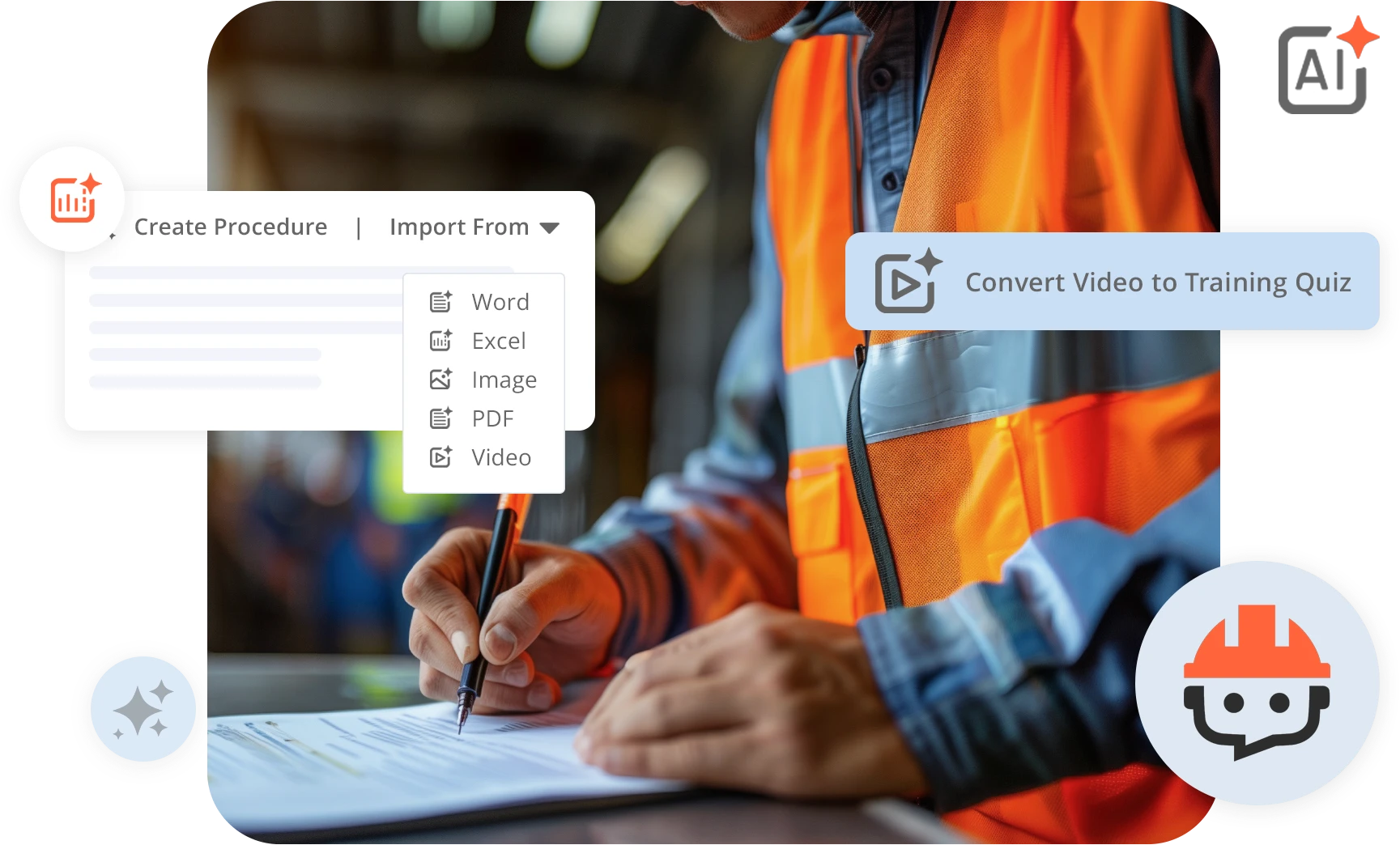
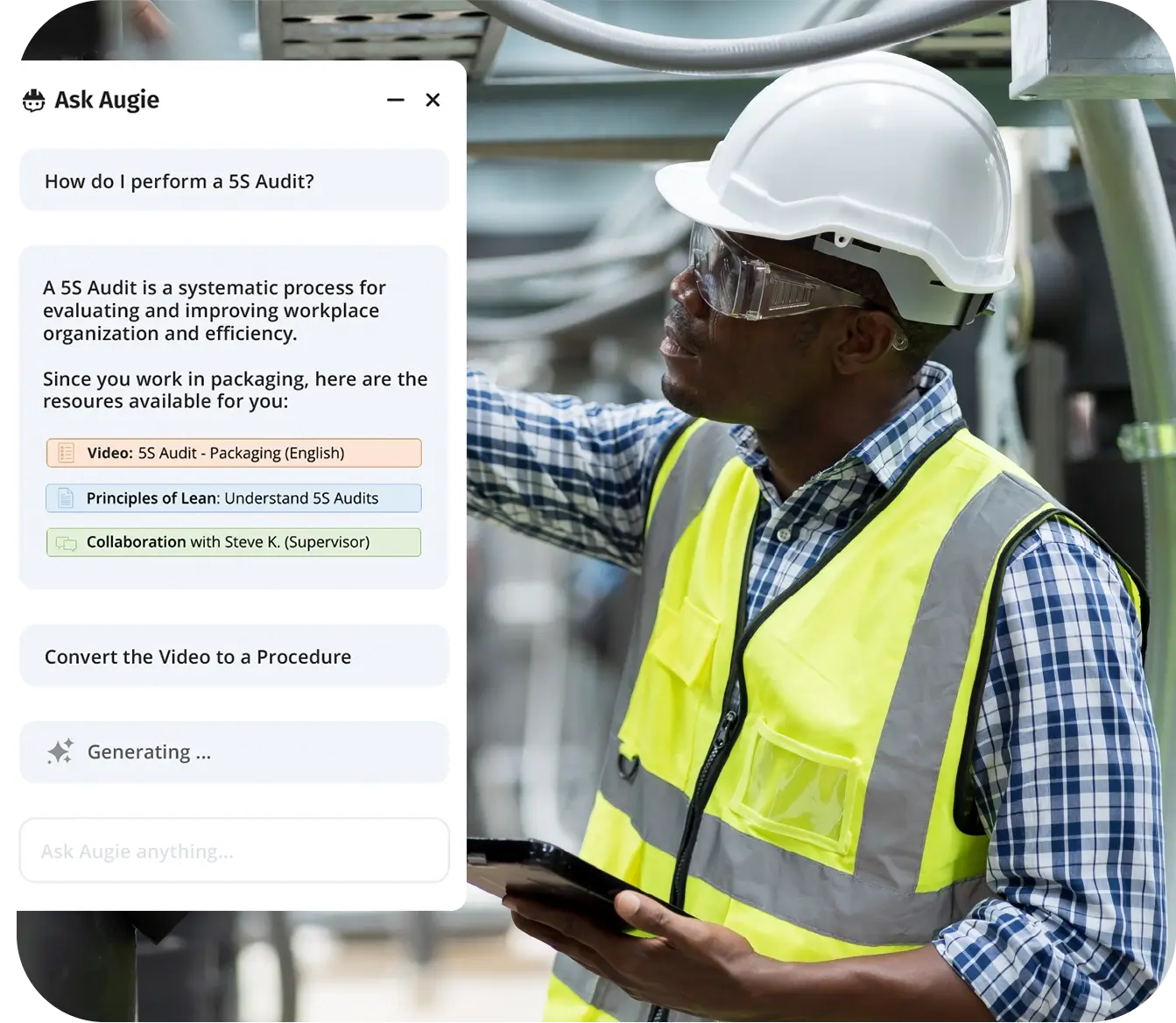
create and convert content with augie as a first step in your connected worker journey

Included in Augmentir’s suite of Industrial GenAI tools, is Augie™ Content Assistant, which is purpose-built for Connected Worker use cases. Augie has been built with domain specific tooling which, when combined with advanced large language models (LLMs), delivers intelligent content that meets the foundational requirements of the Connected Worker space.

With the Augie Content Assistant, Augmentir turns the challenge of content digitization into a fast, AI-driven advantage:

  • 91% faster content conversion: What used to take hours now takes just minutes to convert a single document. When scaled across an organization’s entire repository of SOPs, work instructions, training materials, and more, this reduces the overall content conversion effort from months down to days.
  • Multi-format compatibility: Word, Excel, PowerPoint, PDFs, images, and narrated videos are seamlessly converted into native Augmentir content, complete with data collection and high resolution embedded event tracking.
  • Fidelity preserved: Structure, logic, and intent are maintained through AI-optimized prompts. This ensures that converted content mirrors the original format workers are familiar with—helping reduce change fatigue and making it easier for frontline teams to adopt digital workflows with minimal disruption.
  • Instant translation: Localize content quickly without compromising compliance or clarity.
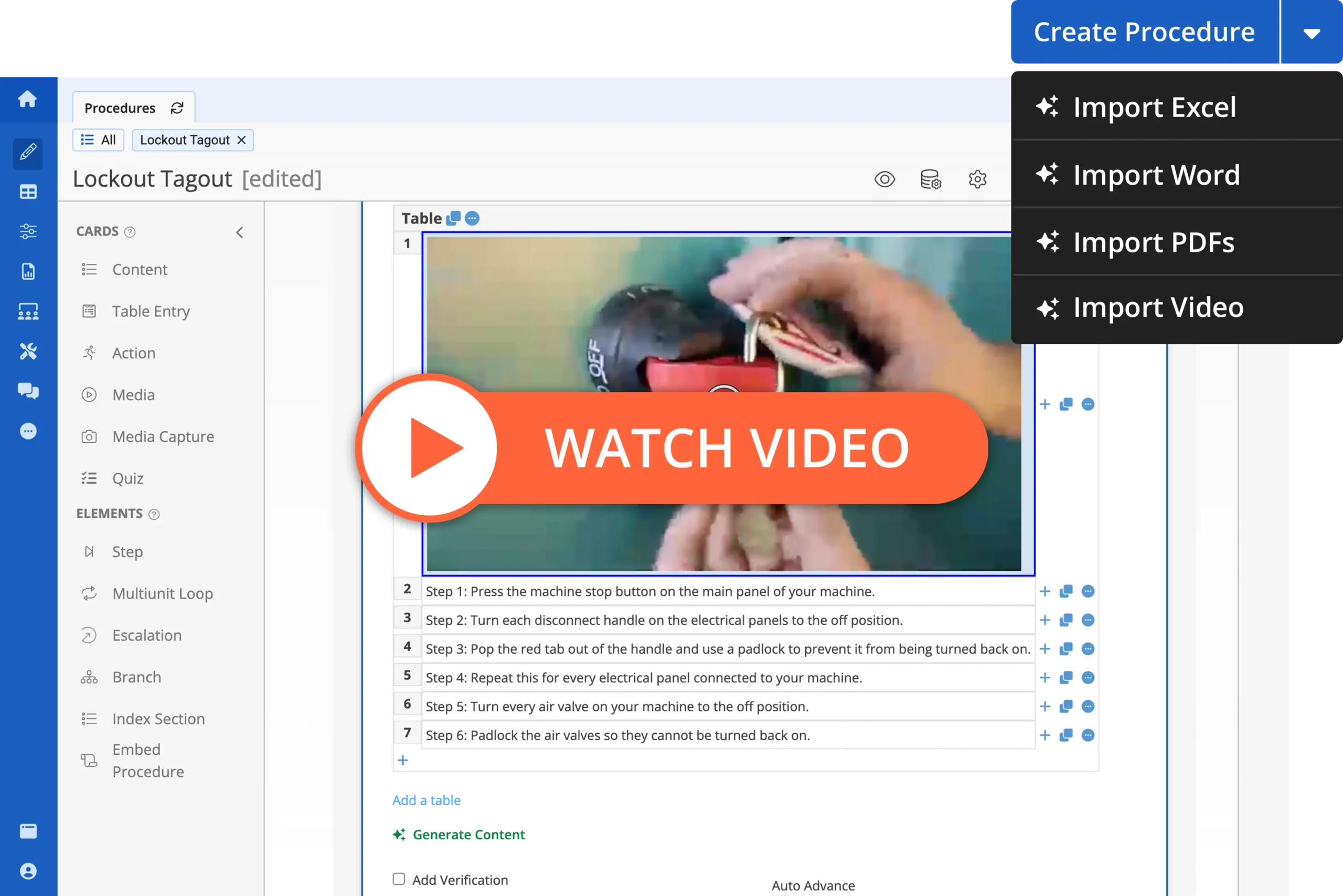
augie gen ai content assistant - convert video to procedure

This is more than digitization—it’s intelligent transformation that enables data collection, auditability, and operational scalability from day one.

2. Worker Onboarding & Training

Adaptive Support That Accelerates Learning

Once your content foundation is in place, the next challenge is onboarding and upskilling your workforce. Traditional methods are static, generic, and fail to reflect real-time needs.

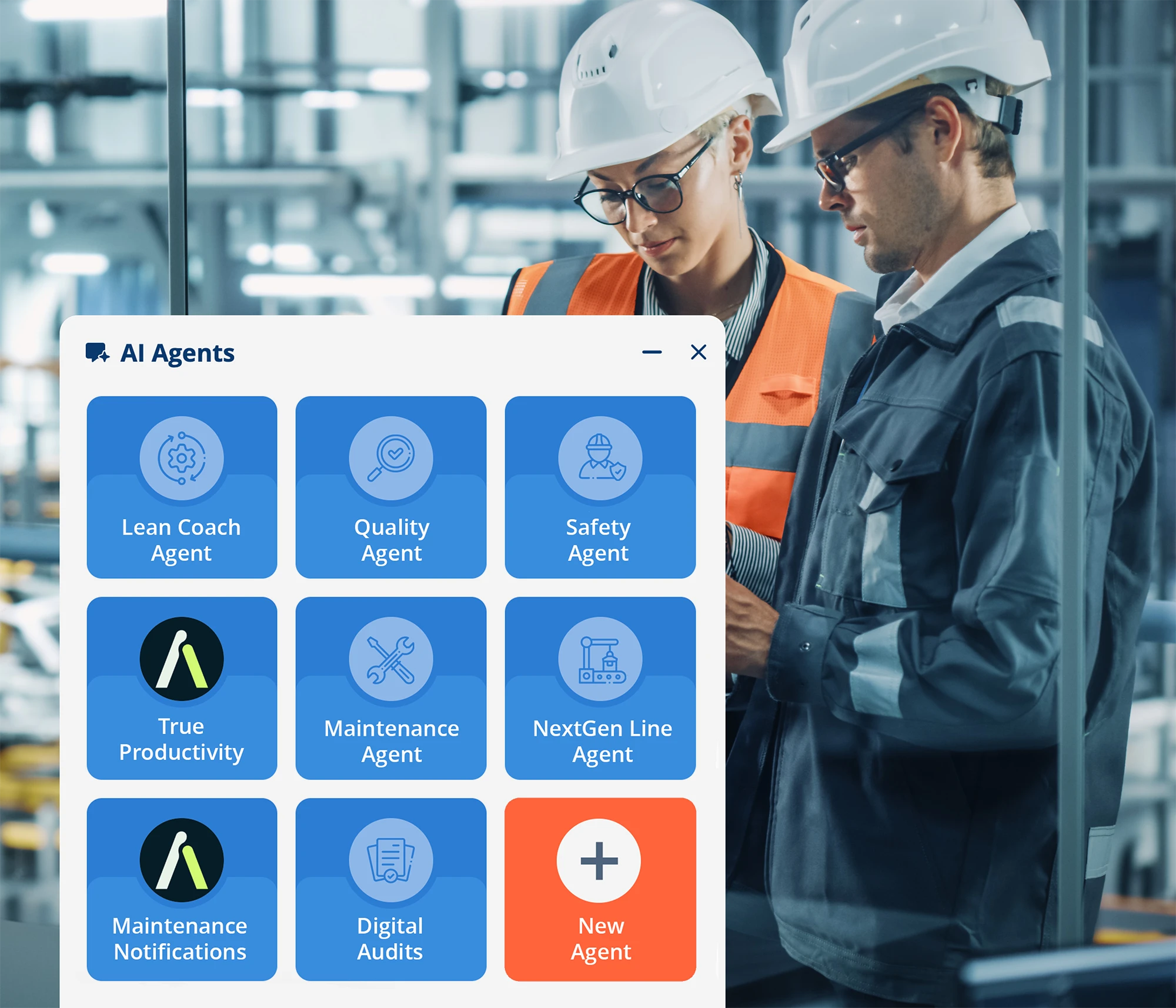
With Augmentir’s Augie Training Assistant and AI Agents, onboarding becomes a personalized, dynamic experience:

  • Tailored workflows: New hires are guided step-by-step based on their role, skill level, and assigned tasks.
  • Training in the flow of work: Instruction happens in real time, with guidance delivered during actual task execution.
  • Digital assistants ensure worker safety and compliance: Workers have natural language access to digital assistants to guide and support them while they work—enforcing safety, quality, and best practices.
  • Continuous adaptation: Augmentir’s True Opportunity™ AI continuously monitors skilling and reskilling performance and adjusts training content based on worker feedback and progression.
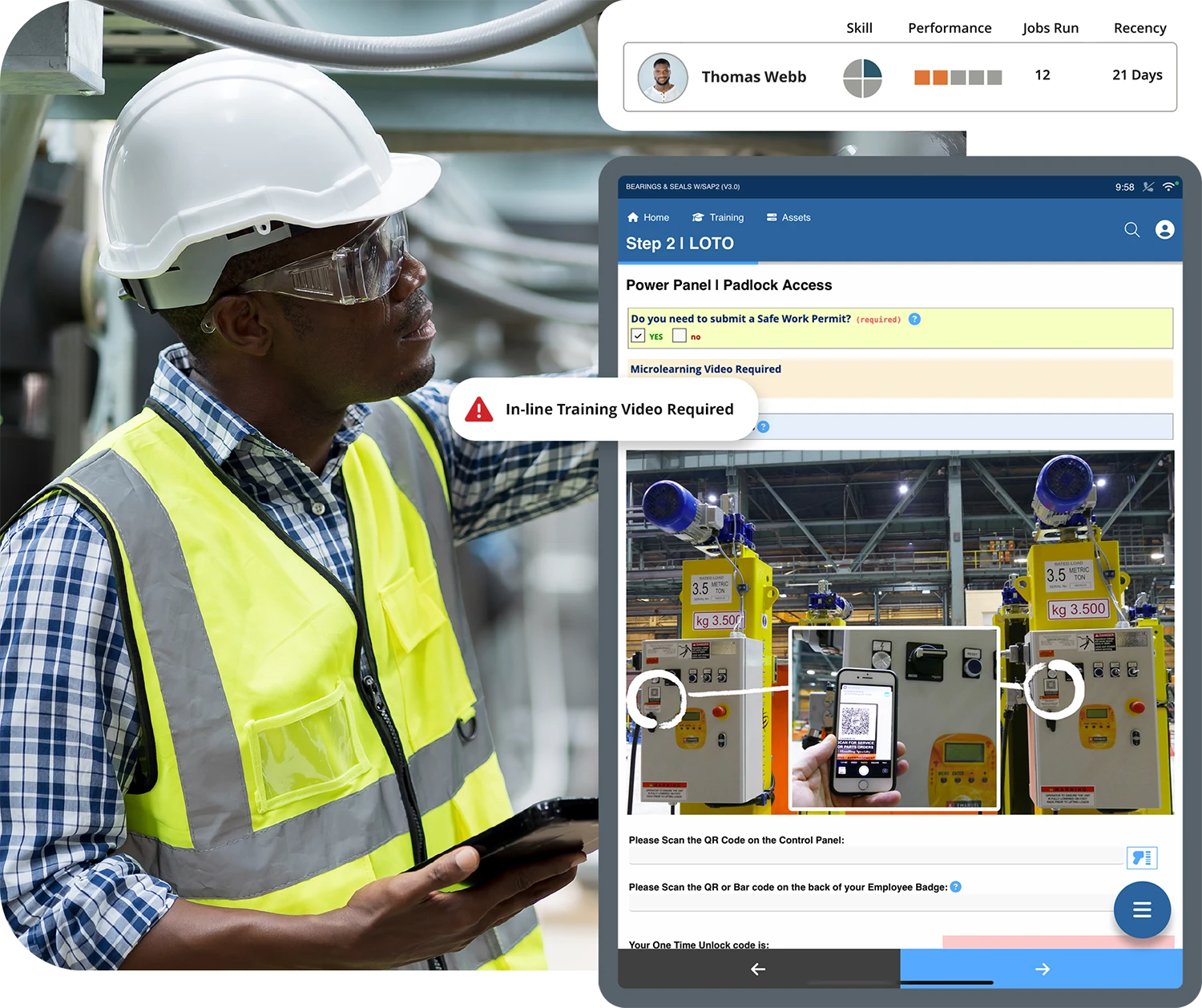
using AI for worker onboarding and training as part of the connected worker journey

This ensures faster ramp-up times, better comprehension, and more confident employees from day one.

3. Operational Excellence

Smarter, Safer, More Productive Frontline Work

With your workforce engaged and trained, the next step is supporting them during everyday operations. Here, Augmentir’s AI becomes a digital copilot—delivering real-time, personalized support in the flow of work.

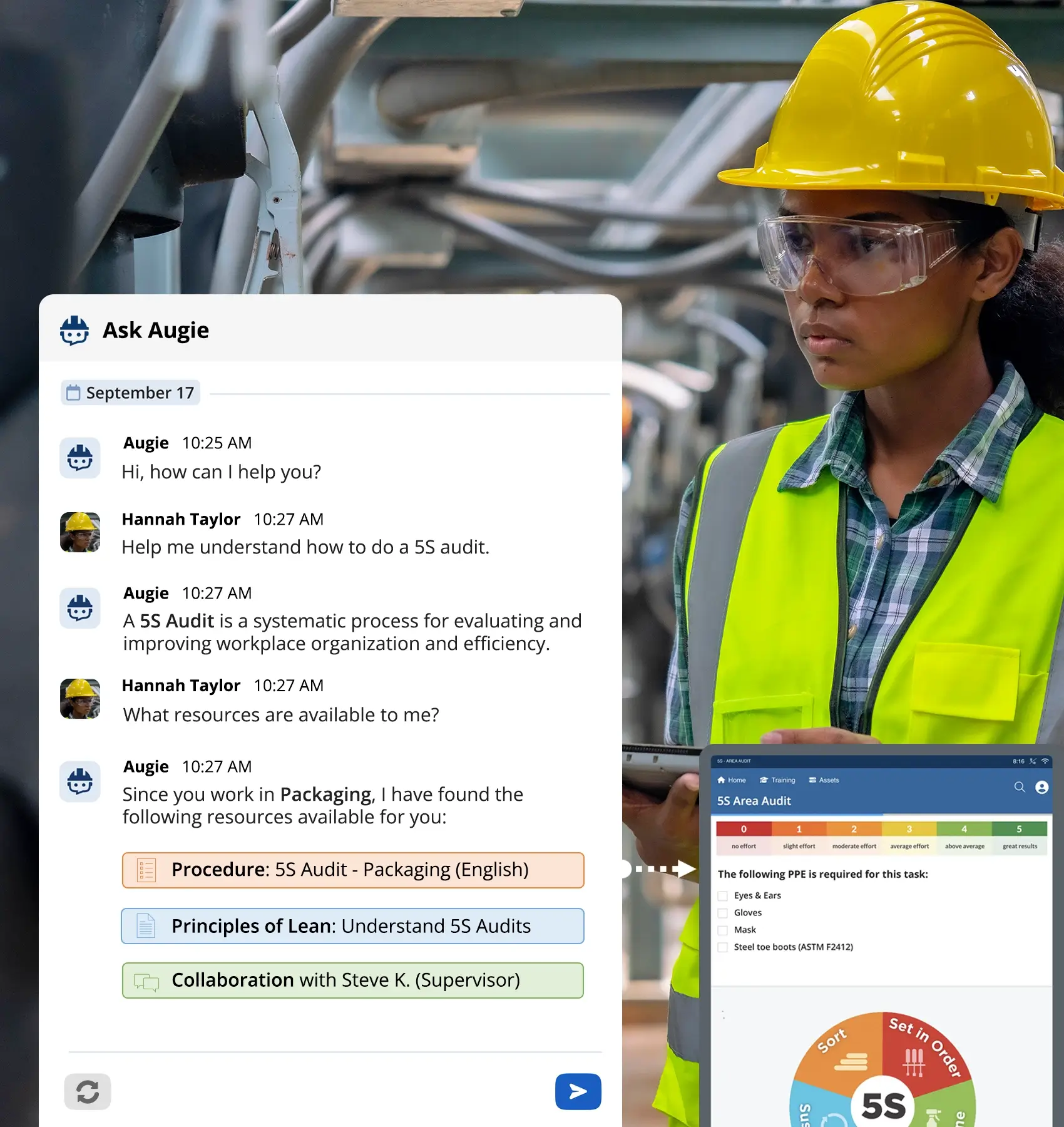
With your workforce engaged and trained, the next step is supporting them during everyday operations. Here, Augie Work Assistant, which is fully customizable and extensible by customers, becomes a role-specific digital copilot—delivering real-time, personalized support in the flow of work.
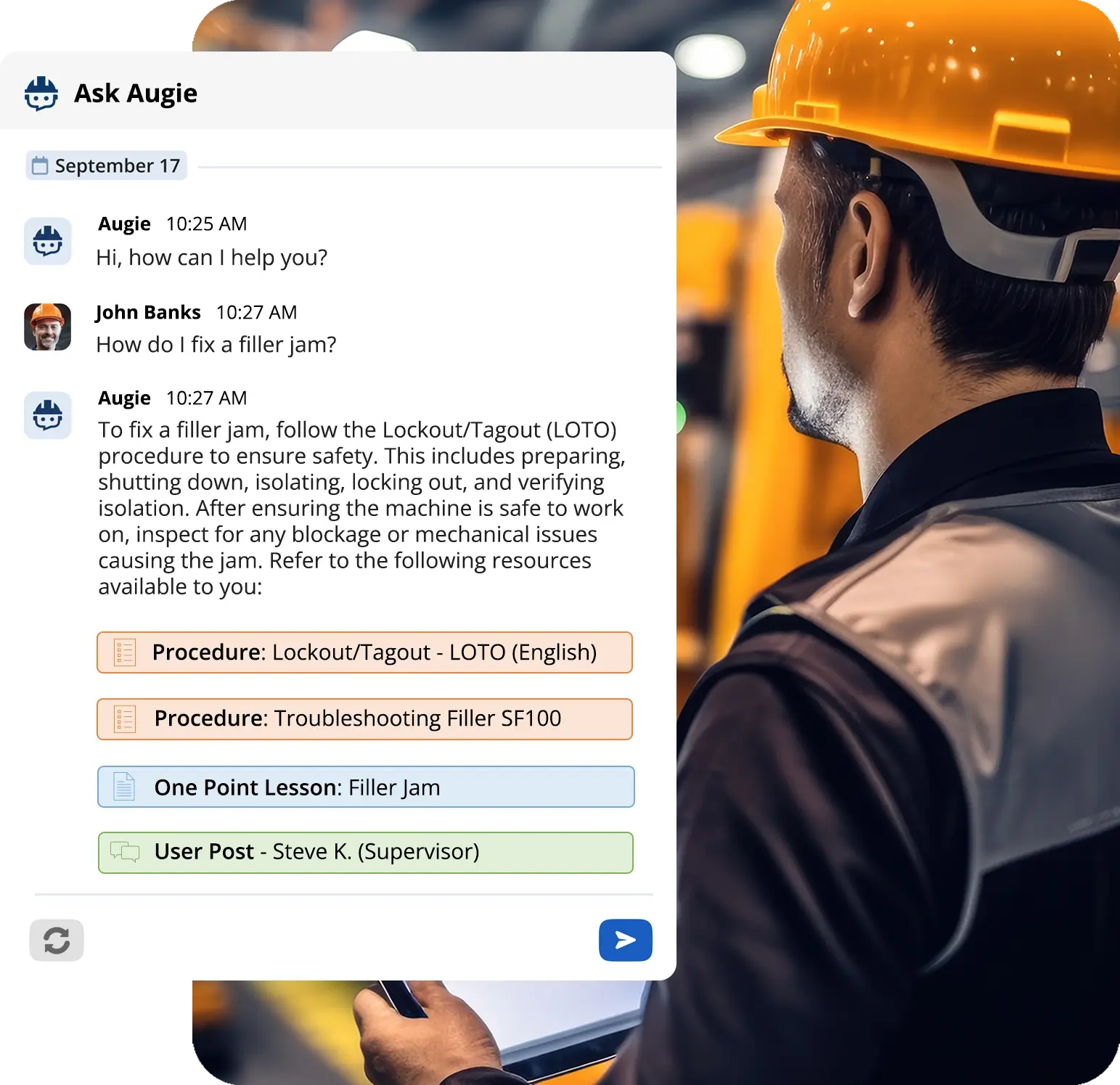
augie industrial generative ai assistant

Key capabilities include:

  • Task-specific guidance: Augie delivers insight tailored to the person, the task, and the real-time conditions.
  • Role-Specific Digital SME: The Augie Work Assistant can be configured at the role level, provides always-on expertise that is tuned to needs to each person in each role—answering questions, flagging issues, and improving accuracy.
  • AI-powered integration: Embedded AI APIs automate documentation, resolve issues in real time, and enable intelligent quality checks.

The result? Fewer errors, faster resolutions, and safer, more confident workers.

4. Continuous Improvement

Closing the Loop with Actionable Insights

Continuous improvement (CI) doesn’t just happen—it requires the right data, insights, and tools to identify what matters most. Augmentir empowers teams to move from guesswork to precision by surfacing opportunities directly from real-world operations.
the difference between skills development and training in manufacturing

AI-powered tools include:

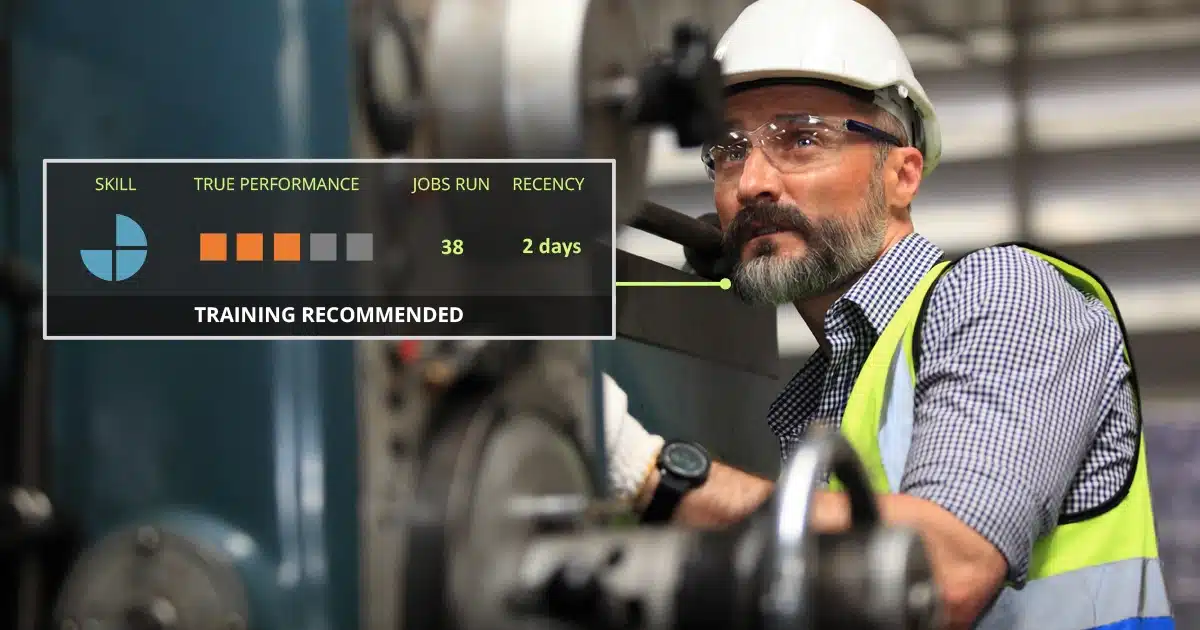
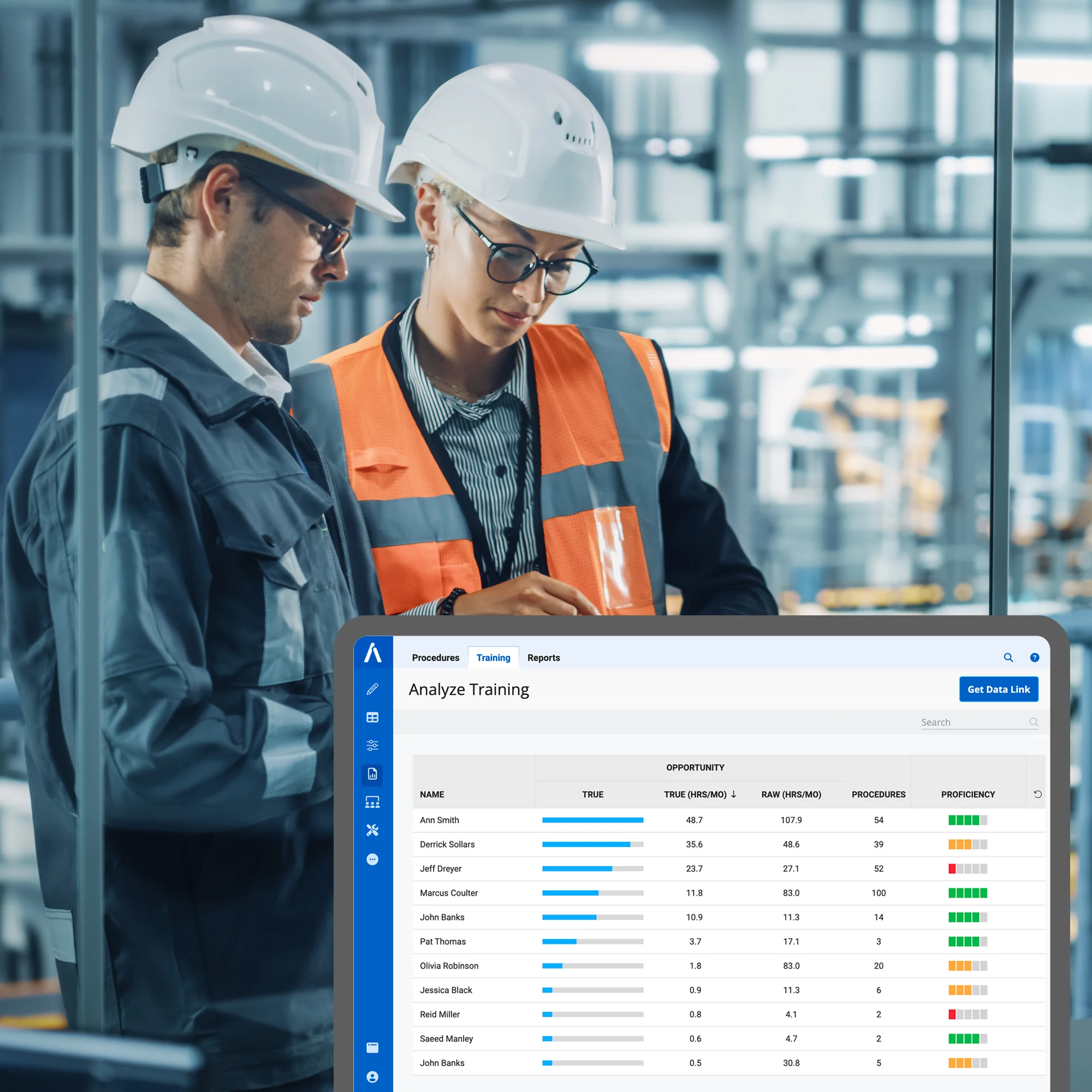
  • True Proficiency: Aligns training and performance data to uncover skill gaps and enhance learning programs.
  • True Opportunity: Pinpoints the highest-impact areas for improving quality, productivity, and safety.
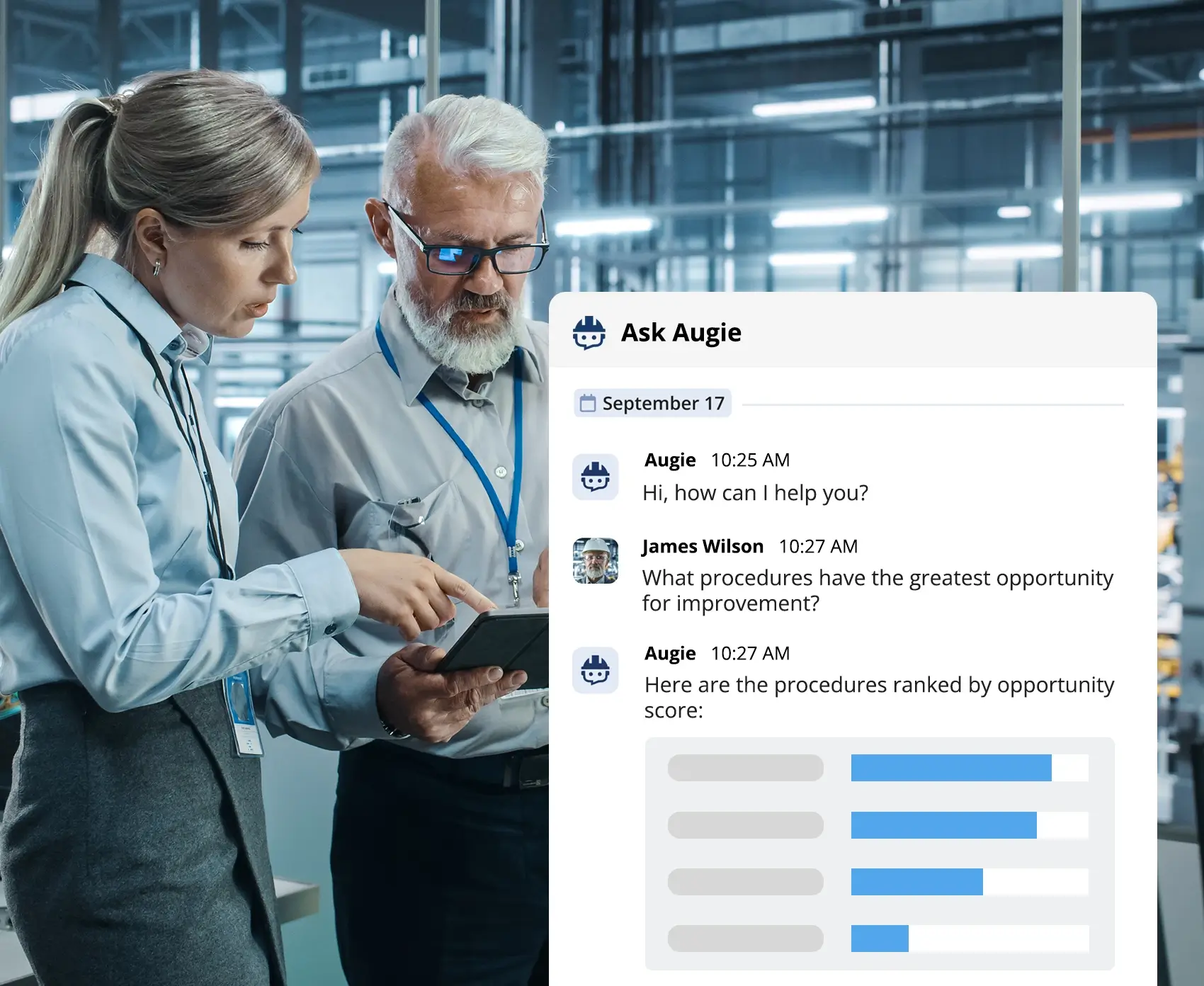
  • Augie Data Assistant: Enables natural-language queries to quickly reveal trends, inefficiencies, or outliers.
  • Augie Content Assistant: Capture & Convert tribal knowledge embedded in informal collaboration into formal, reusable SOPs.
  • Augie Autonomous Agents: Automate repetitive tasks, monitor KPIs, and trigger proactive CI actions.
workforce performance insights with augmentir ai platform

Together, these tools ensure that continuous improvement isn’t a periodic initiative—it’s built into the fabric of daily operations.

AI That Delivers Real-World Value

Augmentir’s AI doesn’t just digitize work—it reimagines it. By embedding intelligence throughout the entire Connected Worker Journey, the platform empowers frontline teams to:

  • Onboard faster
  • Work safer and smarter
  • Learn continuously
  • Drive real business outcomes

With Augmentir, companies move beyond digital transformation toward AI-driven workforce transformation—turning every worker into a connected, empowered, and continuously improving contributor to operational excellence.

 

See Augmentir in Action
Get in Touch for a Personalized Demo

Discover how Augmentir’s Connected Worker platform revolutionizes dairy manufacturing by improving quality, reducing downtime, and empowering frontline workers with AI-driven tools.

As the dairy industry struggles with increasing demand, shifting regulatory landscapes, and a widening skills gap, manufacturers are turning to digital tools to modernize their operations.

connected worker technology used in dairy manufacturing

One solution that stands out in this transformation is Connected Worker software, a category that empowers frontline workers through real-time guidance, remote collaboration, and intelligent insights. And among the leaders in this space is Augmentir, a platform purpose-built to optimize frontline operations across food and beverage manufacturing — including dairy.

The Unique Challenges of Dairy Manufacturing

Dairy processors operate in a high-pressure environment with narrow margins and tight compliance requirements, and uncompromising safety and quality standards. They face:

  • Stringent sanitation and traceability regulations
  • Perishable raw materials and products
  • High variability in production lines and product SKUs
  • An aging workforce and high turnover rates
  • Lack of real-time visibility into frontline work

These factors place immense stress on both the workforce and the systems that support them. Maintaining consistent safety and quality while navigating these challenges is difficult—especially when legacy systems fall short in enabling knowledge transfer, standardizing procedures, and responding quickly to non-conformances or equipment issues.

Addressing Dairy Challenges with Technology

Technology plays a critical role in addressing workforce, compliance, safety, and quality challenges in dairy manufacturing. Connected worker platforms, in particular, enable real-time communication, guided digital workflows, and smart data capture that help ensure procedures are followed consistently and correctly.

connected worker technology

A Connected Worker platform is a digital layer that equips frontline workers with smart tools — often via mobile devices or wearables — to complete tasks more effectively. These platforms empower frontline workers with step-by-step instructions, instant access to support, and automated documentation—improving adherence to safety and quality standards while reducing training time and human error. By digitizing and connecting the workforce, dairy manufacturers can drive greater operational efficiency, accountability, and continuous improvement across their operations.

The result is a safer, more efficient, and more agile workforce — even amidst labor shortages or high variability in operations.

Why Augmentir for Dairy?

Augmentir goes beyond digitizing work — it optimizes it through AI. This means that the platform continuously learns from workforce behavior and system performance to identify where improvements can be made.

Key features that make Augmentir ideal for dairy manufacturers include:

1. Smart Workflows for Sanitation and Quality Control

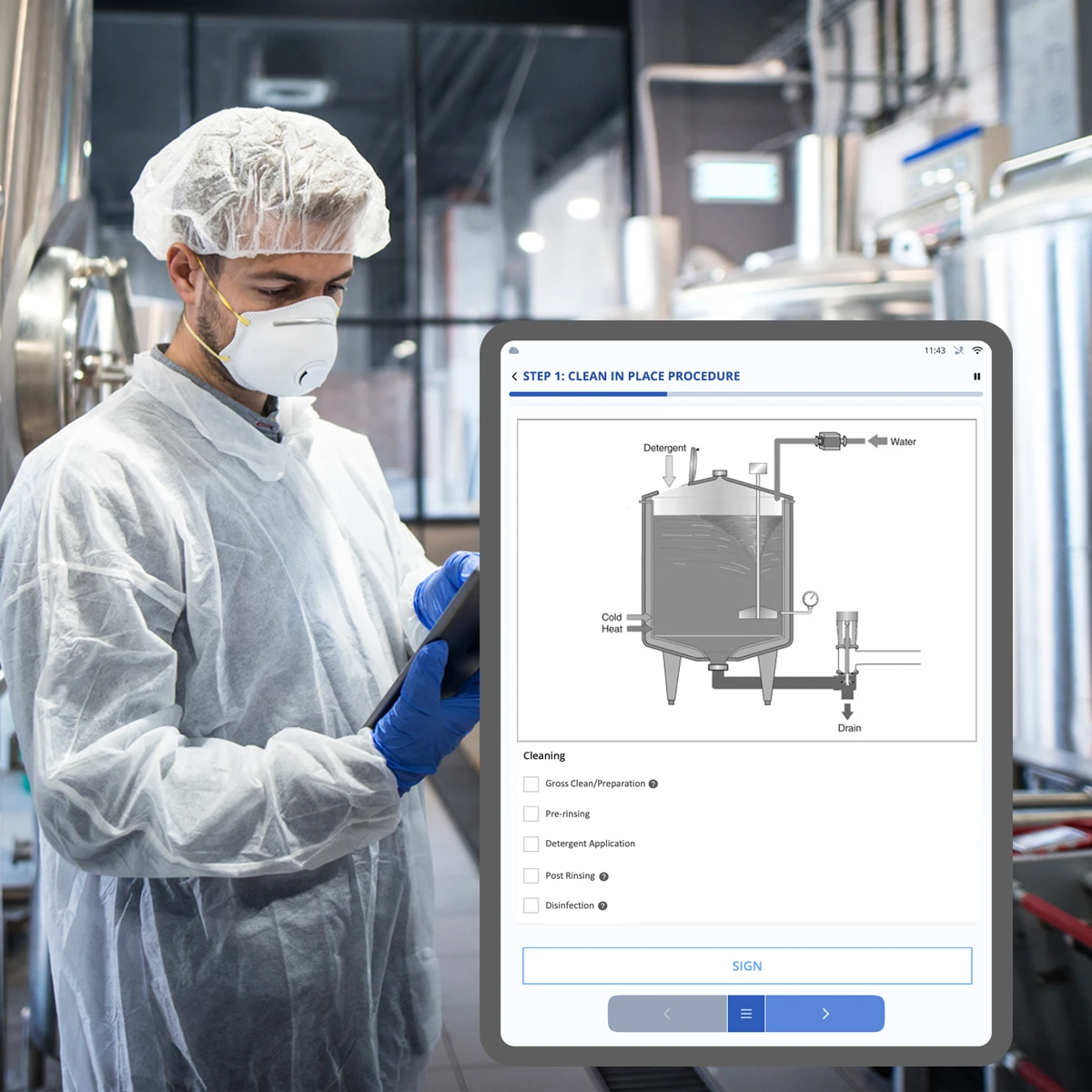
Augmentir helps ensure that Standard Operating Procedures (SOPs) for Clean-in-Place (CIP) systems and product changeovers are followed consistently and documented in real time. This reduces the risk of contamination and non-compliance.

a worker in dairy manufacturing using Augmentir connected worker technology


2. Workforce Development and Knowledge Retention

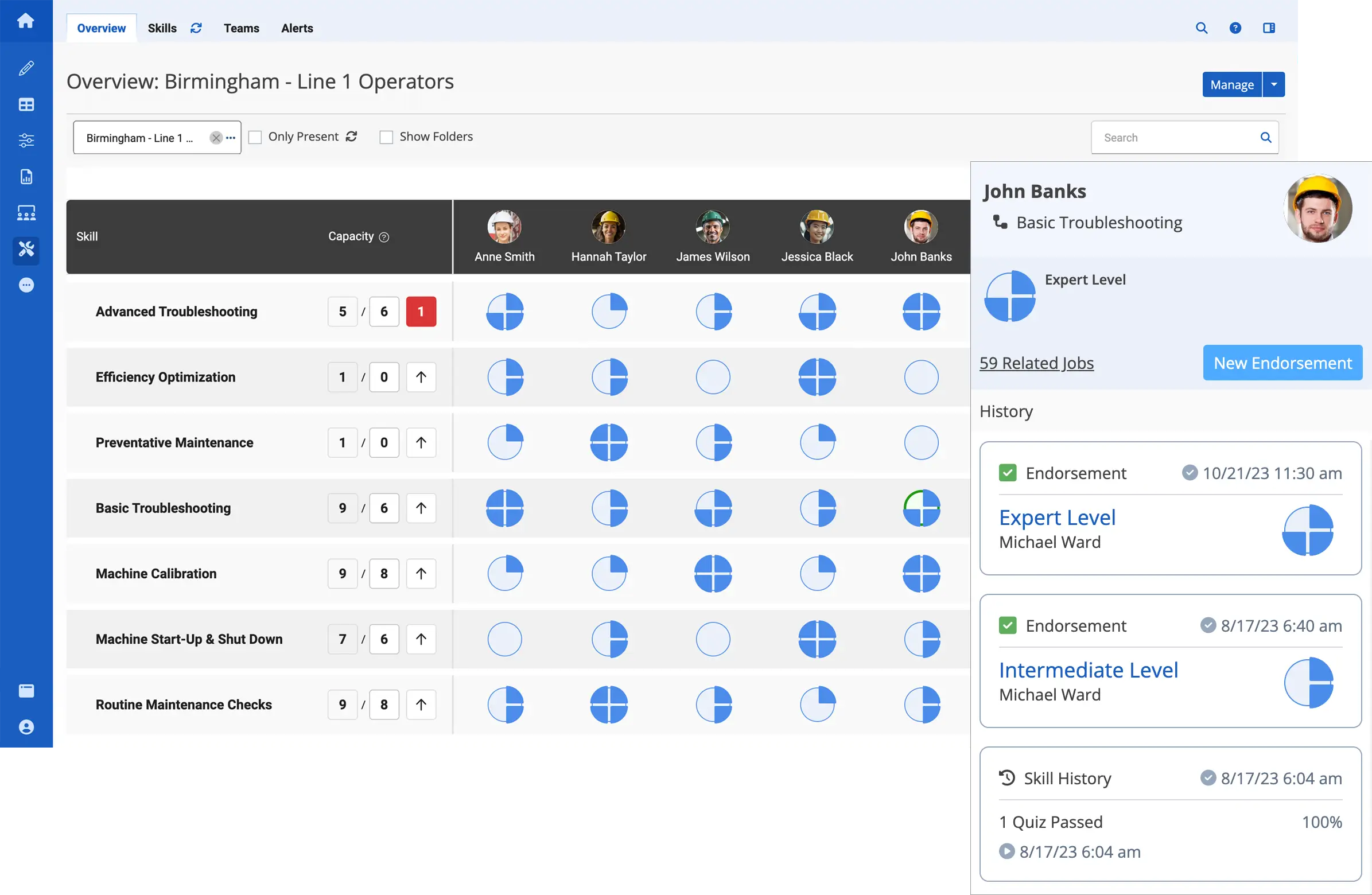
With an aging workforce and growing training demands, Augmentir’s embedded skills tracking and adaptive learning tools ensure that employees are properly trained and matched to the right jobs based on their evolving capabilities.

workforce performance insights with augmentir ai platform

3. Real-Time Issue Resolution

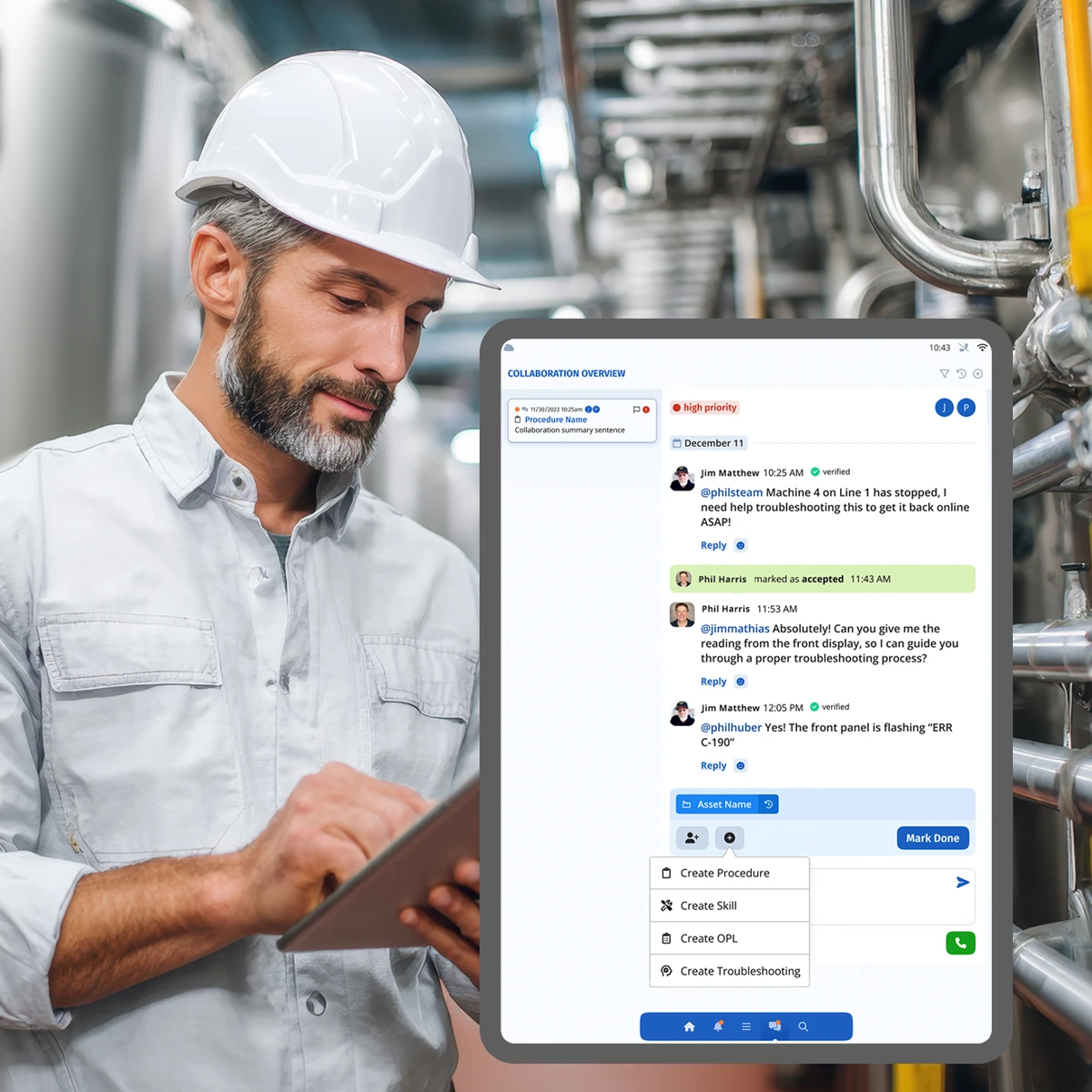
Whether it’s a malfunctioning separator or an alert from a pasteurizer, frontline workers can instantly connect and collaborate using Augmentir’s connected worker technology. This reduces downtime and accelerates resolution—without waiting for external support.

worker collaboration in dairy manufacturing with connected worker technology

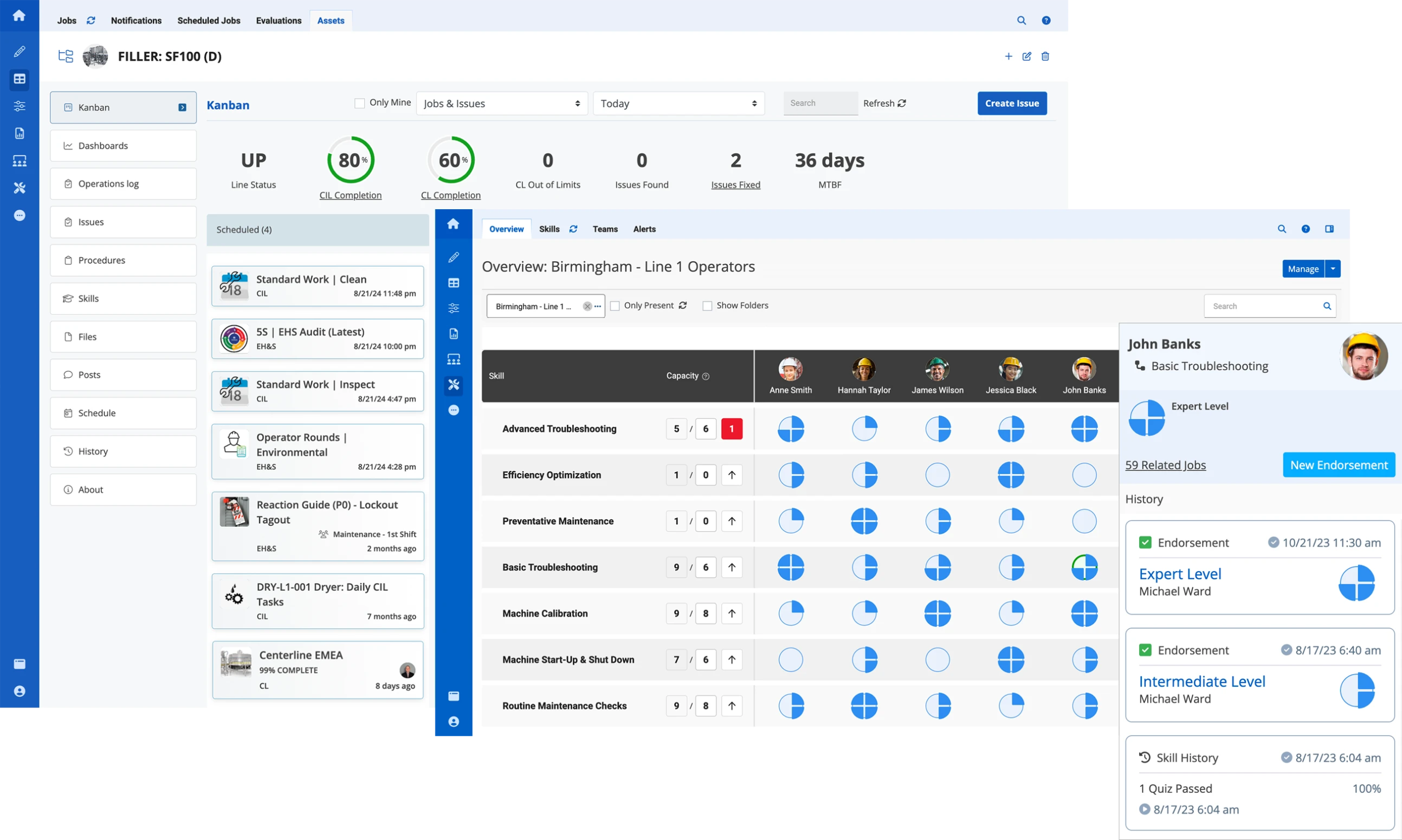
Augmentir enables effective, context-based collaboration across shifts, sites, and languages. Teams can share information in real time, and directly update work procedures to reflect tribal knowledge exchanged during collaboration sessions. Augmentir’s AI captures and transforms this expertise into sharable corporate knowledge, improving visibility and communication.

Workers can also raise, track, and manage maintenance notifications digitally using a visual Kanban board. Monitor operational KPIs, and seamlessly escalate issues to enterprise Plant Maintenance systems or CMMS platforms.

4. AI-Powered Insights

Augmentir’s AI continuously analyzes data from work execution to uncover patterns and opportunities for optimization — such as which procedures cause delays, or where additional training is needed.

connected worker technology for safety compliance

5. Integration-Friendly

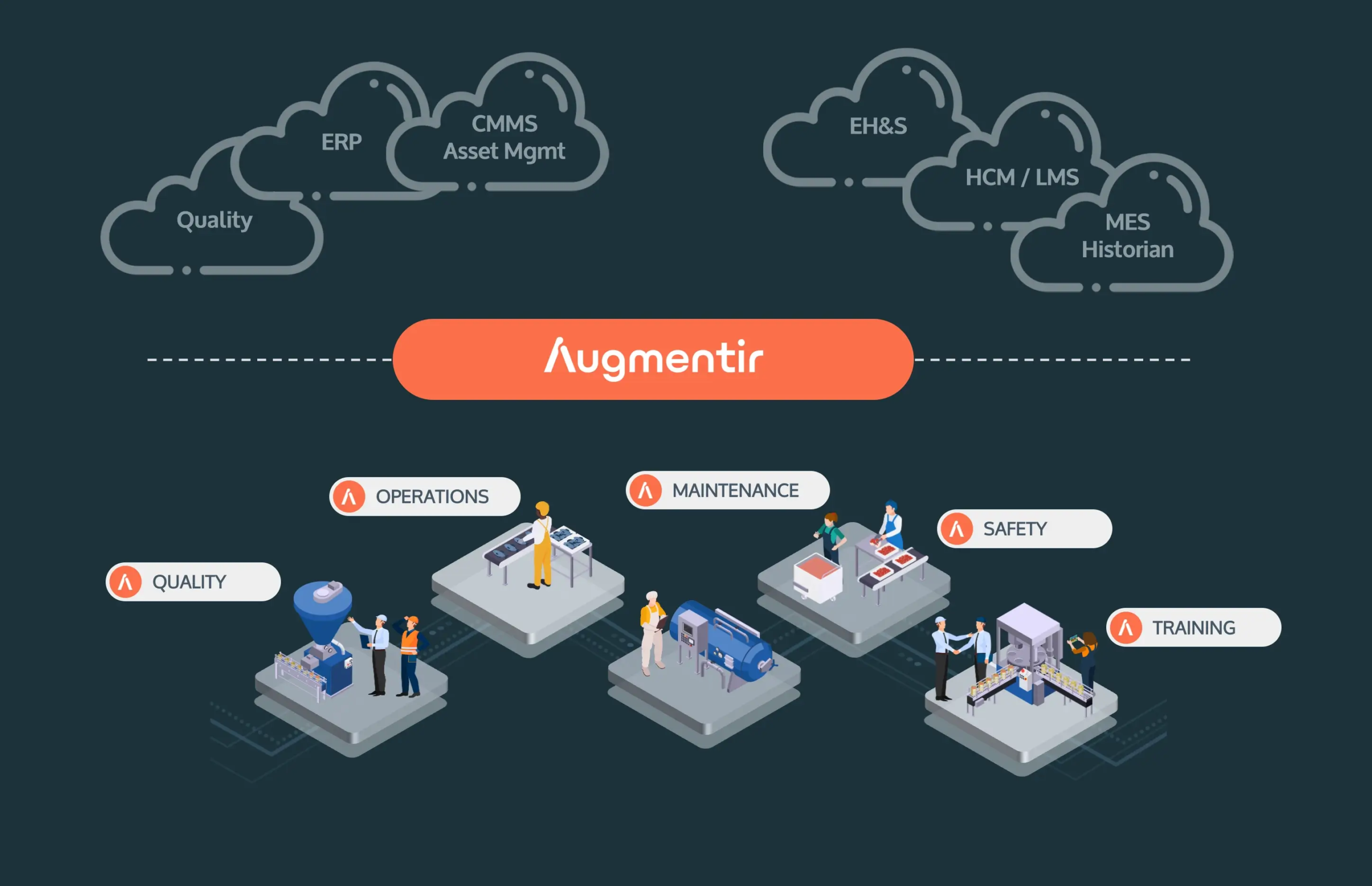
Augmentir can seamlessly integrate with existing ERP, MES, CMMS, and QMS systems, providing a flexible way to modernize without ripping and replacing core infrastructure. This integration infrastructure allows Augmentir to act as a “Single Pane of Glass” for a manufacturer’s frontline operations.

augmentir connected-worker platform single pane of glass for frontline operations

Real-World Impact

Dairy companies adopting Augmentir’s Connected Worker platform reports:

  • Up to 72% reduction in onboarding and training time
  • 27% reduction in quality issues and improved first-time quality and compliance adherence
  • 21% decrease in unplanned downtime
  • Higher worker engagement and retention

A New Standard for Frontline Excellence

In an era where labor shortages, quality demands, and operational agility define success, the world’s leading dairy manufacturers, such as Müller Milk, are turning to Augmentir to modernize their frontline operations. By replacing manual, paper-based processes with AI-powered digital tools, these industry leaders are empowering their workforce, optimizing every task, and transforming their plants into smart, data-driven operations. Augmentir is not just a tool — it’s becoming the new standard for operational excellence in the dairy industry.

Request a demo to learn how Augmentir can modernize your dairy operations.


See Augmentir in Action
Get in Touch for a Personalized Demo

AI-powered technology may be the missing puzzle piece for today’s workforce crisis.

AI-powered technology may be the missing puzzle piece for today’s workforce crisis in manufacturing.

Is it just us or does recruiting, training, and retaining top talent today feel a lot like searching for that one elusive puzzle piece? The seismic shift in the workforce is forcing us to get creative and be adaptable like never before.  It’s a new generation and if we want to be competitive in hiring in this ultra-competitive environment, we need to re-access how we train, develop, and retain talent, embrace the variable nature of the labor market, and meet workers where they are. 

We can no longer try to force-fit the old model of staffing and training into a space that looks drastically different. It’s not just about a labor shortage or the supply chain challenges created by the pandemic. Workers themselves are changing. What they want from work, and how they want to work.

The solution to this head-scratching puzzle? AI-based technology. Digital work instructions and individualized training and on-the-job training (OJT) can improve productivity, reliability, independence, and safety for every worker. It offers flexibility in scheduling for operations managers. It reduces downtime. All of which contribute to a more efficient – and profitable – operation.

Sound too good to be true? Brace yourselves. It’s not. Here are three ways that AI-powered technology can help.

1. Moving onboarding and training closer to the point of work

Imagine if we could train and develop someone in the context of doing their work, leading to increased engagement and allowing organizations to retain top talent. Furthermore, we could see an increase in productivity as they constantly evolve their learnings.

AI is allowing companies to understand a worker’s skillset and provides the ability for personalized digital work instructions to guide them in the context of work while they are doing their job, whether it’s a new worker or one with dozens of years of experience. With an AI-based onboarding approach, organizations are able to hire a wider range of individuals with varying skill sets and get those individuals productive faster.

2. Give support at the moment of need

Are you a people watcher? We are. Ever take notice of who is on the factory floor? Last time I checked, we got the “newbies” and “veterans”. The variability of the workforce, both skilled and young, proves that there’s not a one size fits all approach to troubleshooting and performance support.

Enter AI.

Give workers the support and guidance they need, at the moment of need, whether it’s immediate access to a digital troubleshooting guide, or connecting virtually with a subject matter expert.  Delivering personalized work procedures for every worker allows for continuous learning and growth.

3. Improve engagement and retention

Workers that are connected and empowered with digital technology can discover and nurture diverse skills based on their unique competencies and experience. They can earn greater responsibility and independence. This increases confidence and job satisfaction. Which in turn can improve employee retention and slow the revolving door of continual recruiting and training. 

The aftermath?

Workers are likely to stay and want to grow in the company when they feel included. Shortly, workers begin walking with poise and a “can-do” attitude to their next job task.


What else is possible with AI-powered connected worker technology?

AI-based technology is ideal for training workers in this variable environment. AI-based systems individualize information about workers based on previous training and data-driven performance insights and augments their capabilities. It offers step-by-step guidance at the moment of need for regularly scheduled maintenance as well as troubleshooting. It helps managers learn about workers’ existing skills and build a rationale for specific roles, resources, and certification support and then make clear recommendations based on demands.

Technology should fit into your business as simply as sliding that last puzzle piece into place. Workers are the heart of your business, and you should adapt technology to fit your business, not the other way around.

Technology should fit into your business as simply as sliding that last puzzle piece into place. That includes how you train your workers. But no two workers are exactly alike. Each will learn and approach problems differently. So why not use the technology that recognizes and adapts to those differences to your advantage?


To learn more about how Augmentir can help you embrace this opportunity, contact us for a personalized demo.

Augmentir was recently recognized by Verdantix as one of the top 10 best AI-powered industrial copilot vendors offering comprehensive solutions for workforce management and productivity efficiency.

Generative AI Industrial Copilots—AI assistants powered by large language models (LLMs) and tailored for manufacturing environments—are rapidly becoming essential tools for modern manufacturers. These copilots provide frontline workers and engineers with real-time, context-aware guidance, troubleshooting support, and automated documentation, all through natural language interactions.

top 10 gen-ai powered industrial copilot vendors to watch in 2025

Their rise is driven by critical industry challenges: a widening skills gap as experienced workers retire, ongoing workforce shortages, and the urgent need to boost productivity and operational efficiency. By capturing institutional knowledge and delivering it instantly to less-experienced workers, industrial copilots help manufacturers maintain performance, reduce downtime, improve safety, and accelerate digital transformation efforts.

Verdantix, an independent research and advisory firm that provides data-driven insights and strategic guidance on digital strategies for industrial organizations, recently covered the topic of generative AI industrial copilots in a market insights report. Verdantix’s market insight report highlights 10 innovative industrial copilot vendors delivering robust solutions for workforce management and productivity optimization. Industrial leaders can leverage this report to deepen their understanding of AI-driven technologies and explore how these solutions can support their own industrial transformation efforts.

Augmentir was recognized by Verdantix as one of the Top 10 Gen-AI-powered Industrial Copilot Vendors to Watch for 2025.

Top 10 Industrial Copilot Vendors

Here are the top 10 GenAI-Powered Industrial Copilot Vendors To Watch In 2025 as reported by Verdantix:

  • Augmentir – Augmentir’s generative AI assistant, Augie™, is a transformative tool designed to enhance industrial operations by providing real-time, context-aware support to frontline workers. Augie integrates data from various sources—including operational systems, training modules, and workforce management platforms—to deliver personalized guidance, streamline workflows, and facilitate rapid content creation.
  • ABB – ABB’s Genix Copilot, developed in collaboration with Microsoft, integrates large language models like GPT-4 to enhance industrial operations. It provides real-time, contextual insights to improve efficiency, productivity, and sustainability across sectors such as energy and utilities.
  • AVEVAAVEVA, now part of Schneider Electric, has developed an Industrial AI Assistant, built on Microsoft Azure, that offers a conversational interface for users to access and summarize operational data. This assistant aims to improve decision-making and efficiency in industrial processes.
  • C3 AIC3 AI‘s Generative AI Suite provides domain-specific solutions to assist technicians with equipment troubleshooting and reduce training time. The suite enables enterprise users to rapidly access and act on data through intuitive search and chat interfaces.
  • CogniteCognite‘s Generative AI Copilot, integrated within its Data Fusion platform, delivers real-time, contextualized insights for industrial operations. It enhances decision-making by providing a centralized view of industrial data, aiding in safety, reliability, and quality management.
  • IBM– IBM’s Copilot Runway assists enterprises in creating, customizing, and managing AI copilots, including integration with Microsoft 365. This offering aims to enhance productivity and drive business transformation through seamless AI adoption.
  • Nanoprecise – Nanoprecise’s ReKurv.ai is a generative AI solution designed for maintenance professionals in industrial environments. It offers real-time, contextual answers based on equipment behavior and operational data to enhance decision-making on factory floors.
  • Palantir – Palantir’s Artificial Intelligence Platform (AIP) connects AI with data and operations to drive automation across processes. It provides tools for building AI-driven functions and managing agents, facilitating real-time decision-making in critical contexts.
  • Siemens – Siemens’ Industrial Copilot, developed with Microsoft, is a generative AI assistant designed to enhance human-machine collaboration. It assists staff in designing products and organizing production and maintenance processes, aiming to improve productivity across industries.
  • SymphonyAI – SymphonyAI offers AI-driven solutions tailored for various industries, focusing on enhancing operational efficiency and decision-making. Their platforms integrate generative AI to provide actionable insights and improve business outcomes.

These companies, along with Augmentir, represent a transformative shift in how industrial leaders are deploying GenAI—not just to automate tasks, but to empower frontline workforces and drive measurable operational gains.

Key Benefits of Industrial Copilots

Industrial copilots offer a range of transformative benefits across operations, maintenance, training, and safety. Here are some of the key benefits:

Operational Efficiency & Productivity

  • Task Automation: Copilots can automate repetitive administrative tasks such as work order generation, data entry, and scheduling, freeing up time for skilled workers.
  • Real-Time Assistance: Provide workers with instant access to SOPs, manuals, and troubleshooting guides, improving first-time fix rates and reducing downtime.
  • Intelligent Recommendations: Suggest optimal next steps, tools, or parts based on contextual data, enhancing decision-making on the shop floor.

Data-Driven Insights

  • Contextualized Information: Copilots integrate data from multiple sources (ERP, CMMS, sensors, IoT) and present it in a unified, actionable format.
  • Anomaly Detection: Use AI to detect trends or anomalies in equipment performance or worker activity that could indicate operational risks or inefficiencies.

Knowledge Retention & Training

  • Just-in-Time Learning: Provide on-demand guidance and microlearning in the flow of work, tailored to workers’ roles and skill levels.
  • Knowledge Capture: Automatically document expert procedures and best practices to ensure tribal knowledge is retained and reused.

Safety & Compliance

  • Proactive Hazard Alerts: Warn workers of unsafe conditions based on environmental data, worker behavior, or equipment status.
  • Audit Support: Maintain up-to-date logs and documentation for compliance with industry regulations and standards.

Scalability & Workforce Empowerment

  • Support for Multi-Lingual & Diverse Teams: Enable consistent communication and guidance across geographically dispersed and multilingual teams.
  • Worker Empowerment: Give frontline workers more autonomy through AI guidance, increasing engagement and reducing reliance on supervisory intervention.

Augie™: An Industrial Copilot to Empower the Frontline Workforce

Introduced in early 2023, Augie™ is an industrial copilot designed specifically for the industrial frontline. Unlike traditional tools that rely heavily on equipment data alone, Augie™ integrates insights from frontline operations, training, engineering, and workforce data to deliver real-time, contextual support to frontline workers and supervisors.

augie generative ai industrial copilot

Key Features Behind Verdantix Recognition

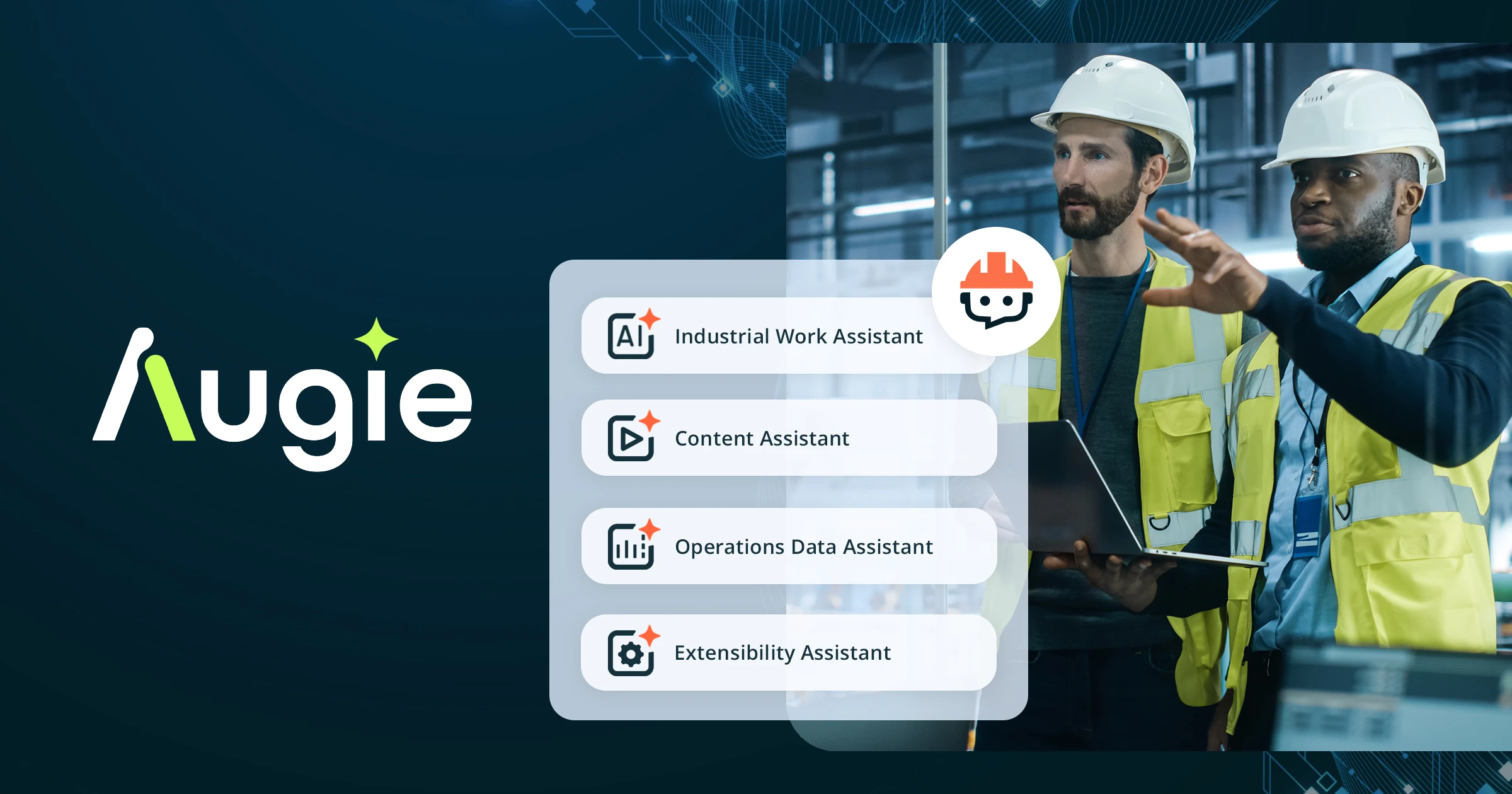
Verdantix highlighted Augmentir due to several standout capabilities within the Augie™ industrial copilot:

Industrial Work Assistant

Provide real-time support and guidance to workers on the floor or in the field. Augie helps workers with standard work, troubleshooting, and information access.

generative ai in manufacturing use case - using augie industrial copilot for training and work assistance

Content Assistant

Automatically converts standard files (Word, Excel, PDFs) into smart digital workflows such as SOPs and checklists. Augie can take your existing content and generate digital, smart forms, checklists, and interactive work procedures. Augie accelerates your transition to a paperless operation, and provides a robust tool for capturing tribal knowledge and converting it into digital corporate assets.

augie convert content paperless shop floor

Operations Data Assistant

Interpret operational data through natural language queries, eliminating the need for complex reports or dashboards. The Augie industrial copilot helps operations leaders gain insights into your frontline operations by understanding and summarizing your operational data, generating reports, and providing insights into continuous improvement opportunities.

augie data assistant continuous improvement

Extensibility Assistant

Offers developers tools to build custom GenAI experiences through user-defined functions and APIs. The Augie Extensibility Assistant from Augmentir empowers industrial companies to go beyond basic generative AI by enabling more intelligent and autonomous support for frontline operations. Through its seamless integration with Augmentir’s AI Agent Builder, Augie allows users to create and deploy AI agents that can interact with and analyze operational data, trigger automated workflows, and respond contextually to frontline needs. This extensibility framework lets manufacturers tailor AI assistance to their unique environments—connecting to third-party systems, retrieving and acting on data, and continuously learning from worker behavior and outcomes. The result is a scalable, adaptive solution that extends GenAI from simple question-answering to proactive, intelligent task support across the digital thread.

industrial ai agent studio - build custom ai agents for manufacturing

Solving Real Industrial Challenges

The industrial sector faces a range of challenges: growing skills gaps, legacy processes, inconsistent quality, and labor shortages. Augie™ directly addresses these by:

  • Boosting workforce performance with personalized, AI-driven task support.
  • Improving decision-making via fast access to operational and procedural knowledge.
  • Accelerating continuous improvement by uncovering inefficiencies through embedded data analytics.

The Future of Frontline Work, Powered by the Augie Industrial Copilot

Augmentir’s inclusion in Verdantix’s Top 10 GenAI Industrial Copilot Vendors watch list underscores its leadership in shaping the next generation of intelligent, AI-powered industrial tools. As frontline work evolves, platforms like Augie will be instrumental in bridging workforce gaps, maximizing productivity, and enabling safer, smarter operations.

Request a demo and see how Augie is redefining frontline performance.


See Augmentir in Action
Get in Touch for a Personalized Demo

Unlock frontline workforce performance and improve safety and quality by removing 7 key barriers with Augmentir’s AI-powered Connected Worker Platform.

In a recent conversation with a manufacturing operations leader now focused on training, a familiar challenge emerged: pinpointing the true culprits behind frontline performance issues. Is it the process? The training? Or something deeper?

Rather than spinning in circles, we reframed the conversation with one simple, powerful question:

“What barriers exist that prevent good performance?”

frontline workforce performance in manufacturing

This shift in perspective uncovered a set of common – and deeply entrenched – challenges. But more importantly, it revealed how the right digital tools, like Augmentir’s Connected Worker Platform, can systematically remove these barriers to unlock new levels of efficiency, quality, and engagement.

1. Inconsistent or Outdated Work Instructions

“Operators don’t always have clear, current procedures. We rely on tribal knowledge too much.”

When frontline workers rely on word-of-mouth or outdated paper instructions, variability and errors become inevitable. Small deviations in procedure can accumulate into major quality issues or production inefficiencies.

The results? Incorrect assemblies, wasted materials, process delays, or even safety incidents. Over time, these inconsistencies create a culture of uncertainty, where each shift or team may interpret the “right way” differently — hurting overall operational performance.

How Augmentir Helps:

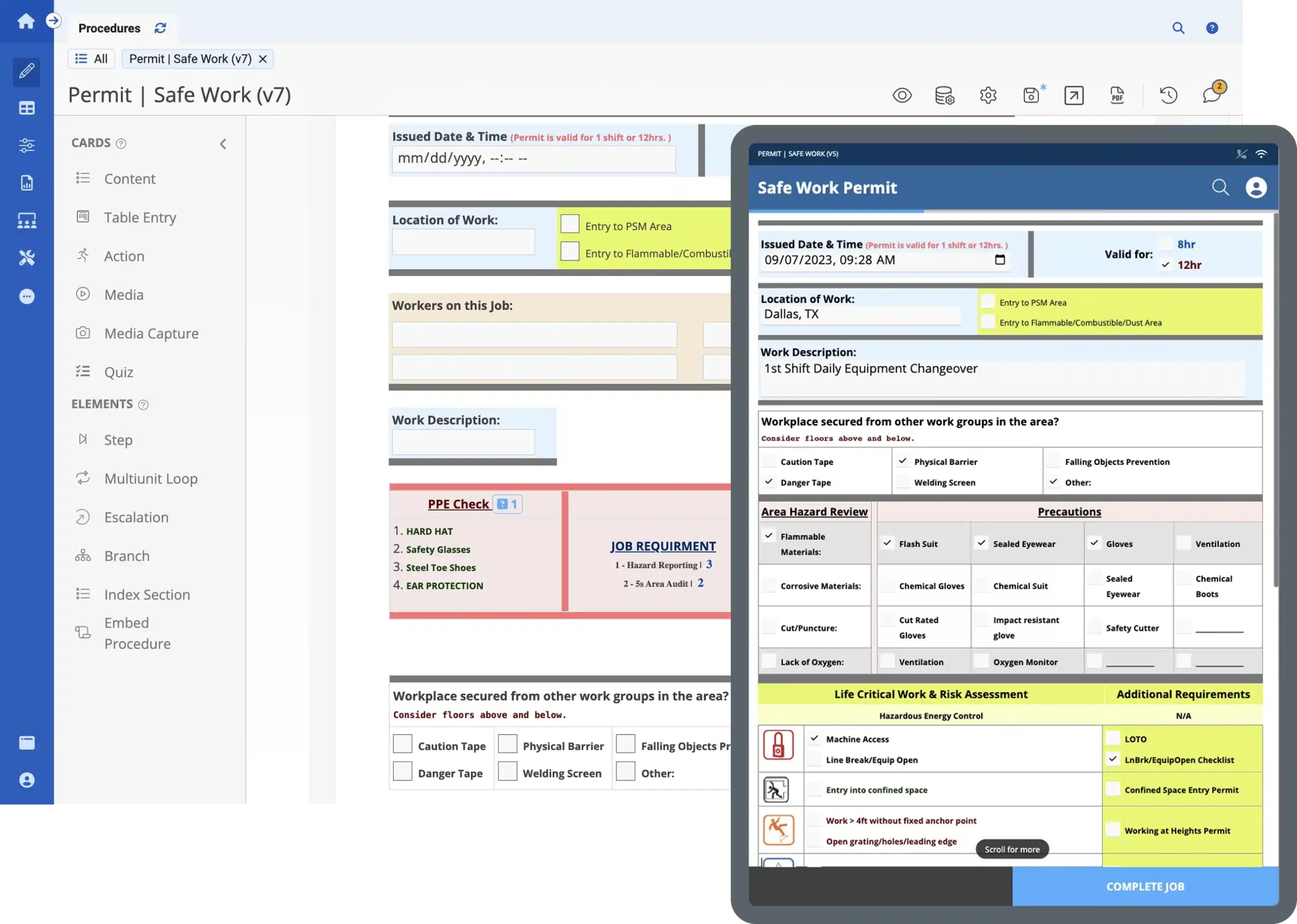
  • Smart Digital Workflows: Augmentir digitizes and standardizes work instructions, ensuring that every operator, on every shift, follows the most up-to-date procedures. Augmentir’s no-code authoring environment allows you to create, update, and deliver work instructions to users through any mobile device or wearable technology appropriate for the job.
  • Augie™ Generative AI Content Assistant: Quickly generate standard work procedures from Excel, Word, PDFs, images, or videos. Augie takes your existing content and generates digital smart forms, checklists, and digital work instructions.
  • AI-driven content recommendations: The platform continuously learns from real-time execution data, surfacing opportunities to update or improve workflows based on actual performance and feedback.

create digital safe work permit

2. Lack of Visibility into Workforce Capability

“We don’t always know who’s trained or qualified to do what. That slows us down or leads to errors.”

Without a clear view of skills and qualifications, managers are left guessing. As a result, unqualified workers may be assigned to critical tasks, increasing the risk of quality defects or compliance violations. Teams lose time shuffling responsibilities, and supervisors become hesitant to delegate.

This visibility gap also creates missed opportunities for upskilling and slows down workforce agility — a major issue in today’s high-turnover environments.

How Augmentir Helps:

  • Skills & Certification Tracking: Augmentir’s digital skills matrix and skills management capabilities give supervisors real-time visibility into who is qualified for each task.
  • Personalized Work Instructions: Smart work instructions deliver guidance and support matched to the needs of each worker, so that everyone can work at their personal best.
  • AI-Based Workforce Profiling: The system learns from task execution data to automatically update worker profiles, enabling smarter workforce planning and targeted upskilling.

3. Reactive Problem Solving

“We often operate in firefighting mode. By the time we detect a problem, it’s already costly.”

Manufacturing teams often find themselves reacting to quality issues, inefficiencies, or breakdowns after the damage is done. This “firefighting mode” leaves little time for structured problem solving and often results in compounding consequences — missed production targets, increased scrap or rework, unexpected downtime, or worse.

When frontline teams are stuck in reactive cycles, quality issues go undetected, potentially leading to customer complaints, warranty claims, or even costly product recalls. In high-risk environments, delayed detection can also result in safety incidents, regulatory violations, or compliance lapses. In short, reaction-mode doesn’t just waste time — it puts revenue, reputation, and workers at risk.

How Augmentir Helps:

  • Real-Time Operational Insights: Augmentir captures granular execution data across tasks, revealing trends and anomalies before they escalate.
  • AI-Powered Root Cause Analysis: The platform correlates performance data with variables like shift, equipment, and training gaps to surface underlying causes — proactively.
  • Industrial Collaboration Tools: Effectively collaborate and share information across your frontline teams. Augmentir provides manufacturing collaboration software to support context-based collaboration, connecting team members across shifts, plants, and languages.
  • Automated Alerts and Dashboards: Teams can receive real-time notifications and visualizations that help prioritize issues before they disrupt operations.

manufacturing collaboration software from augmentir for continuous improvement in manufacturing

4. Disconnected Systems and Information Silos

“Information lives in too many places — paper, spreadsheets, different apps — so we don’t see the full picture.”

When critical information is fragmented across departments and systems, decision-making becomes slow, misinformed, or reactive. Frontline teams waste time hunting down documents, while managers struggle to identify trends or take corrective action across shifts and sites.

This fragmentation contributes to process delays, miscommunication, redundant training efforts, and reduced responsiveness — all of which erode efficiency and customer satisfaction.

How Augmentir Helps:

  • Integrated, Single Pane of Glass Platform: Augmentir centralizes work instructions, training records, skills data, and performance analytics into a single platform.
  • Built-in Integrations: Seamless connections with MES, ERP, QMS, and LMS systems ensure that frontline and back-office teams stay aligned.

augmentir connected-worker platform single pane of glass for frontline operations

5. Low Engagement or Lack of Ownership

“Operators don’t always feel connected to the bigger picture. That impacts quality and efficiency.”

When workers feel like cogs in a machine — disconnected from purpose, feedback, or opportunities for growth — their performance suffers. Disengagement leads to lower productivity, reduced quality focus, and higher turnover, all of which directly impact the bottom line.

Without ownership and recognition, frontline teams are less likely to take initiative, escalate issues, or contribute ideas for improvement.

How Augmentir Helps:

  • Personalized Work Experiences: Augmentir tailors tasks and support to each worker’s skill level and role, helping them succeed and grow.
  • Feedback Loops and Microlearning: The platform makes it easy for workers to give feedback and receive targeted coaching, reinforcing a culture of continuous improvement.
  • Digital Recognition & Performance Insights: Operators can see their impact and progression over time, boosting engagement and accountability. This improves workforce performance throughout the employee lifecycle.

the connected worker lifecycle and continuous improvement in manufacturing

6. High Turnover and Training Burden

“We’re constantly onboarding and retraining. It’s hard to get people up to speed quickly.”

Frequent turnover and lengthy training cycles make it difficult to maintain consistent performance. Traditional training approaches often require pulling experienced workers off the floor, leading to productivity dips and training bottlenecks.

The consequences include long ramp-up times, repetitive errors from new hires, and overburdened veteran employees. Worse, training documentation often goes stale quickly, failing to reflect process changes or lessons learned.

How Augmentir Helps:

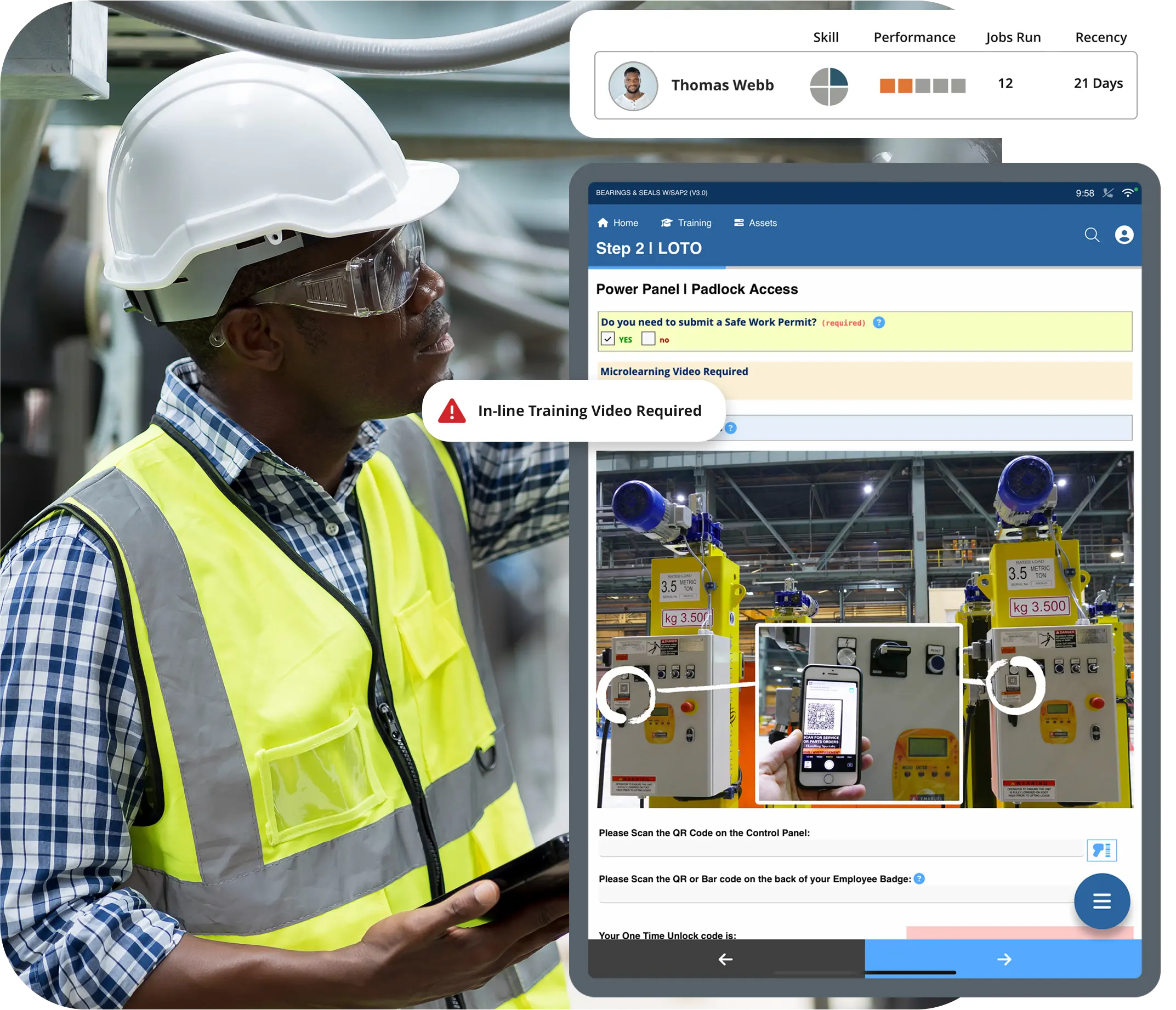
  • Accelerated Onboarding: Step-by-step guided workflows with embedded videos and support reduce time-to-competency.
  • On-the-Job Learning: Contextual guidance within tasks enables learning in the flow of work, minimizing downtime and increasing retention.
  • Training Content Versioning: Built-in tools ensure training materials evolve alongside your operations.connected worker technology for safety compliance

7. Inconsistent Execution Across People, Shifts or Lines

“We see variability across lines or shifts — even when the process is the same.”

Even when processes are well-documented, execution can vary wildly depending on who is performing the task, when, or where. These inconsistencies lead to uneven quality, production delays, and missed KPIs, especially when variability isn’t visible or well understood.

Without a way to measure and compare performance at the individual or team level, continuous improvement efforts fall flat.

How Augmentir Helps:

  • Execution Intelligence: Augmentir analyzes execution patterns across shifts, lines, and facilities to uncover where and why variability exists.
  • Standardization Through AI: The platform uses AI insights to recommend adjustments to work instructions and training, helping bring every worker up to best-in-class performance.
  • Targeted Coaching: Managers can identify who needs support and deliver it efficiently, closing gaps faster.

workforce performance insights with augmentir ai platform

The Bottom Line: A Smarter Path to High-Performance Frontlines

Rather than blaming either training or operations, the right question is: “What’s getting in the way of great performance?”

Augmentir’s AI-driven Connected Worker Platform helps manufacturers answer that question — and act on it — with precision and speed. By eliminating the barriers outlined above, companies can build a high-performance frontline workforce that is skilled, engaged, and aligned with business goals.

Ready to break down your barriers to performance?

Let’s talk about how Augmentir can help.


See Augmentir in Action
Get in Touch for a Personalized Demo

Recently, Augmentir completed a rigorous qualification audit as part of a Tier 1 Pharmaceutical Manufacturing company’s Good Manufacturing Practice (GMP), and we are pleased to announce that our product successfully passed the audit.

A recent article published by The Washington Post shows some shocking numbers on the amount of Americans leaving their jobs over the past year. It’s no surprise that hotel and restaurant workers are resigning in high numbers due to the pandemic, but what is surprising is the fact that the manufacturing industry has been hit the hardest with “a nearly 60 percent jump” compared to pre-pandemic numbers. This “Great Resignation in Manufacturing” is the most of any industry, including hospitality, retail, and restaurants, which have seen about a 30% jump in resignations.

However, if you dig deeper, this trend isn’t new. This recent increase in job quitting in manufacturing has simply magnified a problem that had already been brewing for years, even prior to the start of the pandemic. In fact, in the four years prior to the pandemic (2015-2019), the average tenure rate in manufacture had decreased by 20% (US Bureau of Labor Statistics).

This accelerating workforce crisis is placing increased pressure on manufacturers and creating significant operational problems. The sector that was already stressed with a tight labor market, rapidly retiring baby-boomer generation, and the growing skills gap is now facing an increasingly unpredictable and diverse workforce. The variability in the workforce is making it difficult, if not impossible to meet safety and quality standards, or productivity goals. 

Manufacturing leaders’ new normal consists of shorter tenures, an unpredictable workforce, and the struggle to fill an unprecedented number of jobs. These leaders in the manufacturing sector are facing this reality and looking for ways to adjust to their new normal of building a flexible, safe and appealing workforce. As a result, managers are being forced to rethink traditional onboarding and training processes.  In fact, the entire “Hire to Retire” process needs to be re-imagined. It’s not the same workforce that our grandfather’s experienced, and it’s time for a change.

The Augmented, Flexible Workforce of the Future

The reality is that this problem is not going away. The Great Resignation in manufacturing has created a permanent shift, and manufacturers must begin to think about adapting their hiring, onboarding, and training processes to support the future workforce in manufacturing – an Augmented, Flexible Workforce.

What does this mean?

  • It means adopting new software tools to support a more efficient “hire to retire” process to enable companies to operate in a more flexible and resilient manner.
  • It means starting to understand your workforce at an individual level and using data to intelligently closes skills gaps at the moment of need and enables autonomous work.
  • And it means taking advantage of data.  More specifically, real-time workforce intelligence that can provide insights into training, guidance, and support needs.

Investing in AI-powered connected worker technology is one way to boost this operational resiliency. Many manufacturing companies are using digital Connected Worker technology and AI to transform how they hire, onboard, train, and deliver on-the-job guidance and support. AI-based connected worker software provides a data-driven approach that helps train, guide, and support today’s dynamic workforces by combining digital work instructions, remote collaboration, and advanced on-the-job training capabilities. 

As workers become more connected, manufacturers have access to a new rich source of activity, execution, and tribal data, and with proper AI tools can gain insights into areas where the largest improvement opportunities exist. Artificial Intelligence lays a data-driven foundation for continuous improvement in the areas of performance support, training, and workforce development, setting the stage to address the needs of today’s constantly changing workforce. Today’s workers embrace change and expect technology, support and modern tools to help them do their jobs.


To learn more about how AI is being used to digitize and modernize manufacturing operations, contact us for a personalized demo.

Learn how Digital Standard Work effectively transforms manufacturing production and enables operational excellence.
Manufacturing organizations are feeling the pressure of increased customer demands, skilled labor shortages, and intense shifts in their frontline workforces, however, they can effectively overcome these obstacles with digital standard work enabled by smart connected worker technology. Digital standard work promotes operational excellence in manufacturing through facilitated knowledge-sharing, enhanced process standardization, increased employee engagement, improved workforce agility, and overall optimization of workforce abilities.

digital standard work in manufacturing

Standardized work in manufacturing (centerlining, machine setup/maintenance, inspection checklists, workforce training, lubrication procedures, etc.) is effective for continuously improving the most efficient and safe methods for performing work to meet customer demand while minimizing waste. Digital Standard Work takes these processes one step further, enhancing them with digital technology to establish a true culture of continuous improvement where frontline workers and shop floor processes benefit from digital workflows, collaboration, AI-powered guidance, generative AI assistants, real-time access to centralized knowledge bases, and more.

By redefining standard work for the digital age, manufacturers can achieve operational excellence through increased efficiency, quality, flexibility, and innovation across their frontline workforces. Read more on Digital Standard Work and how it effectively transforms manufacturing production and enables success:

Digitizing Standard Work in Manufacturing

According to Forbes and McKinsey, through digital tools manufacturers can reduce machine downtime by 30% to 50% and quality-related costs can be reduced by 10% to 20%. Effectively digitizing manufacturing standard work through smart, AI-driven connected worker technology involves:

  • Interactive Digital Work Instructions
    Replace paper-based standard operating procedures (SOPs) with interactive digital work instructions that include multimedia elements like videos, images, and animations. These can be accessed by workers on tablets, wearables, and other mobile devices right on the shop floor.
  • Data Capture and Integration
    Leverage smart tools and sensors to automatically capture shop floor data from the manufacturing process, such as torque values, cycle times, and quality checks. This data can be integrated into the digital work instructions to provide real-time feedback and ensure adherence to standards.
  • Workflow Automation
    Automate non-value-added tasks like data entry, approvals, and documentation through connected worker platforms. This streamlines workflows, reduces errors, and frees workers to focus on value-adding activities aligned with standard work.
  • Knowledge Management
    Digitize and centralize tribal knowledge and tacit knowledge, best practices, and process documentation in a connected worker platform. This ensures standardized methods are easily accessible and updatable for consistent knowledge sharing across the workforce.

Using smart, connected worker platforms to digitize and optimize standard work in manufacturing drives improved productivity, ensures better and more consistent product quality, and fosters a safer work environment for enhanced operational success. Connected worker platforms that digitize standard work can also be used to support a company’s broader IWS  (integrated work systems) strategy, which helps improve operational excellence in manufacturing.

Pro Tip

Using a low-code no-code workflow builder simplifies the creation of complex digital workflows for frontline work processes. Furthermore, integrating remote collaboration tools facilitates real-time guidance, knowledge sharing, and the ability to update standard work procedures based on captured tribal knowledge.

A

Engaging Frontline Workers with Digital Standard Work

As manufacturing workforces shift due to retirement and tribal knowledge loss, effective workforce training has become critical for continued success. Interactive digital interfaces, augmented and enhanced capabilities, and wearable technologies make standard work practices like workforce training more engaging and accessible, improving workforce adoption and adherence.

Digital tools facilitate information visibility and knowledge sharing among frontline workers, enabling them to learn from each other, share best practices, and contribute to a culture of continuous improvement. By tracking and analyzing performance data from digital systems, manufacturers can identify top performers, provide personalized feedback, and recognize achievements, fostering a sense of engagement and motivation among frontline workers.

Digital Standard Work empowers frontline workers by involving them in process improvements, recognizing their contributions, and providing opportunities for learning and growth, leading to increased job satisfaction and commitment. By leveraging digital technologies and interactive interfaces, manufacturers can transform Standard Work procedures into engaging and empowering experiences for their frontline workforce, driving productivity, quality, and a culture of continuous improvement.

Most importantly it gives manufacturing frontline and factory staff the tools they need to be successful and thus create a more satisfied environment where employees come to work and feel good about what they are doing and how they are doing it.

Driving More Effective Collaboration

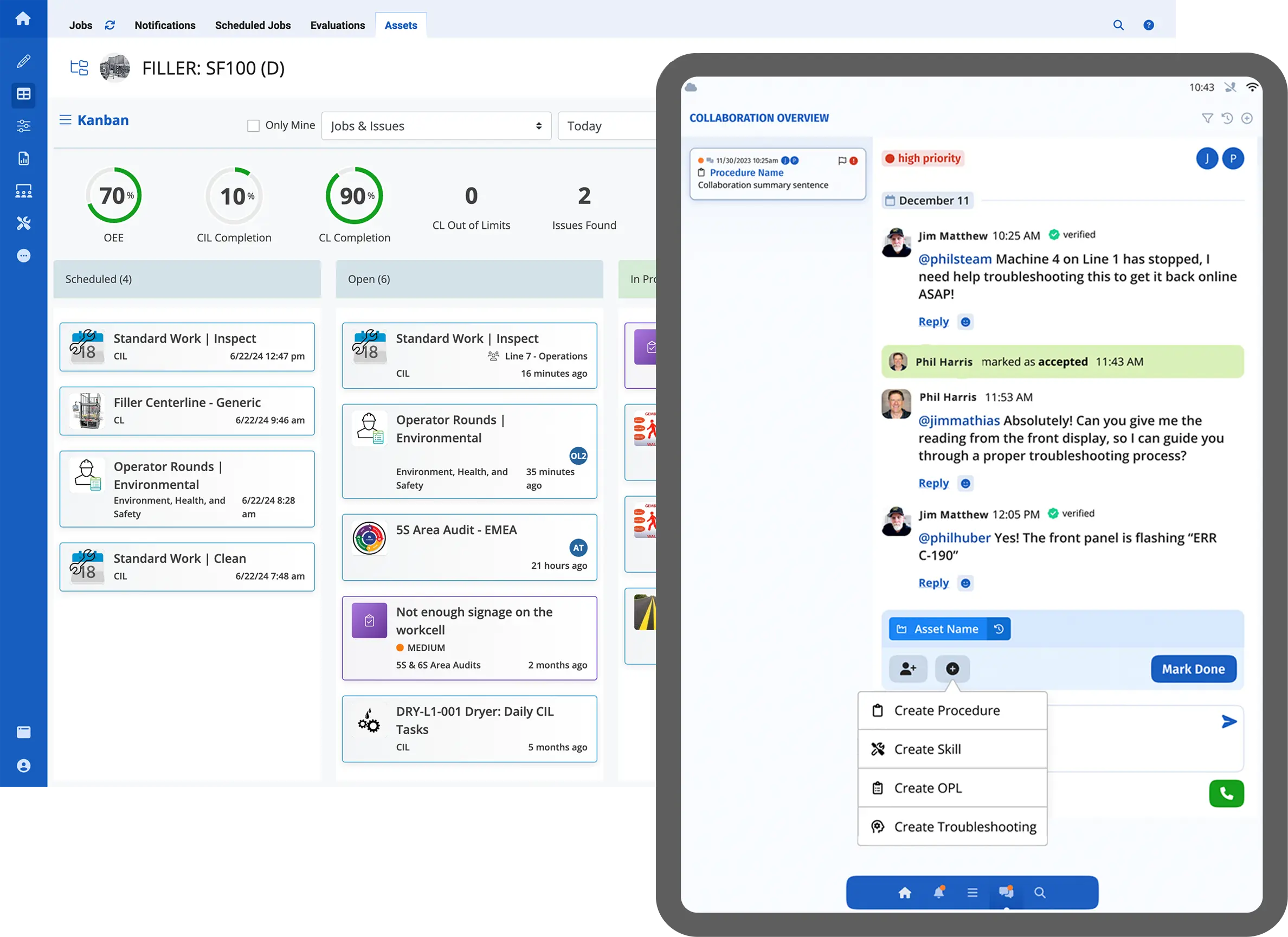
Digital standard work also facilitates better collaboration across your frontline teams. Effective communication starts with digital tools, and by implementing digital standard work with connected worker technology, manufacturers can connect frontline team members across shifts, departments, locations, and languages, improving visibility into workforce planning, training, skills tracking, daily management, troubleshooting, and more.

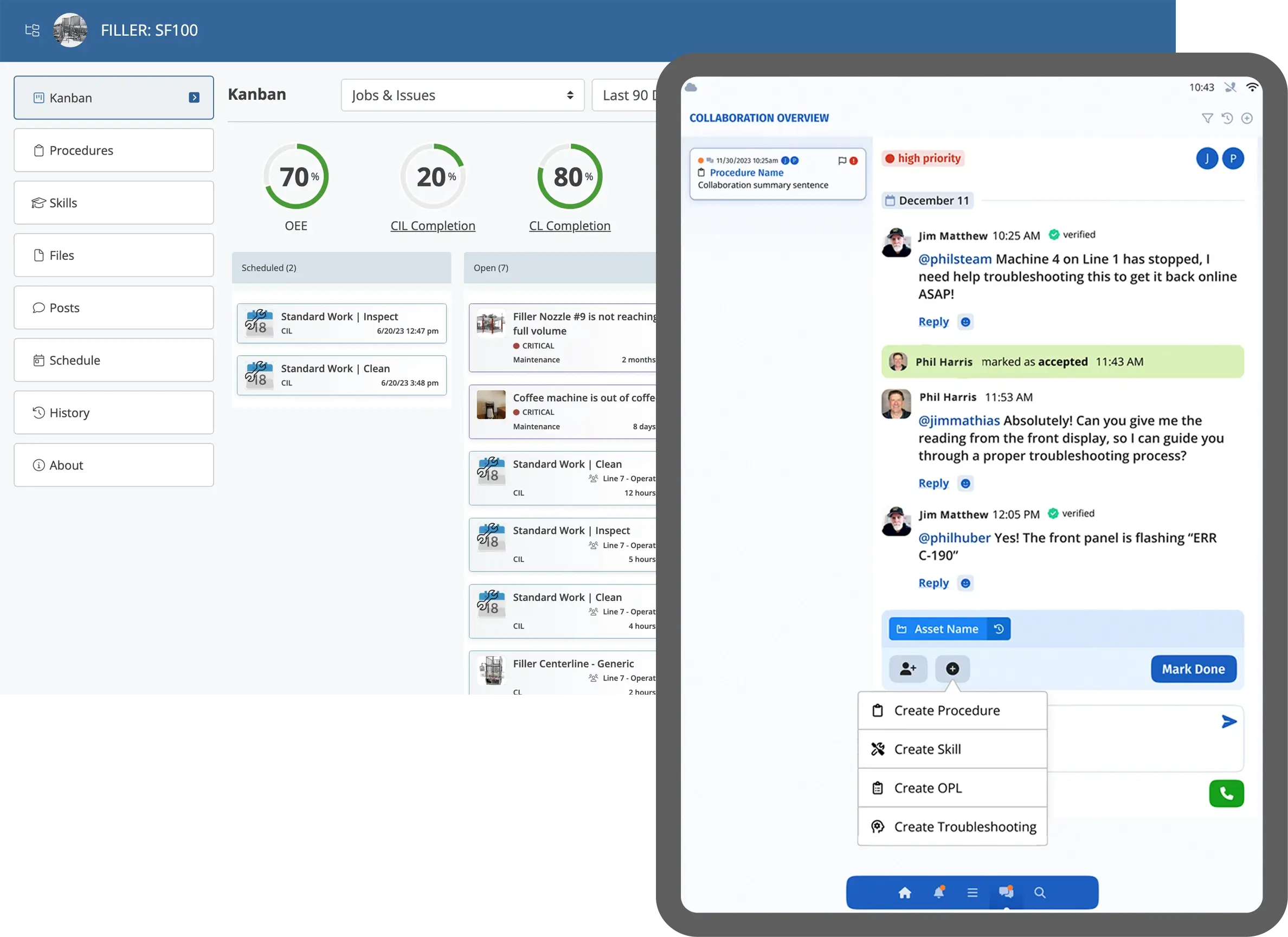
industrial collaboration with augmentir

From frontline workers to executives, a digital standard work strategy that leverages connected worker technology allows employees to collaborate seamlessly and easily access information. Connected worker solutions that include industrial collaboration tools allow workers to virtually connect to subject matter experts for remote guidance and assistance. These software tools are becoming commonplace in manufacturing and other industrial settings, where companies are faced with an increasingly distributed and remote workforce, yet still require team collaboration to help troubleshoot and resolve issues. In a nutshell, workers can get more done with greater accuracy in less time.

Interested in learning more?

If you’d like to learn more about how Augmentir and our AI-powered connected worker solution digitizes standard work, streamlines operations, improves communication, and empowers frontline workers with the tools and information they need, schedule a demo with one of our product experts.


See Augmentir in Action
Get in Touch for a Personalized Demo

Learn how continuous and workflow learning can help modernize employee training in the manufacturing industry.

Staying ahead of the curve in today’s manufacturing marketplace means that businesses need to innovate and adapt. To accomplish this, organizations must have a skilled workforce and ongoing training and workforce management processes to support continuous learning and development.

Modernizing training cultivates employee skillsets by implementing continuous learning in the flow of work.

modernize manufacturing training with continuous learning

Continuous learning is the process of attaining new skills on a constant basis. Workflow learning involves educating yourself on the job using resources and self-directed learning materials. Done together, this modern training approach can help streamline productivity.

If you want to learn how to improve manufacturing training with continuous learning and workflow learning, explore this article that answers the following:

What is continuous learning?

Continuous learning in manufacturing involves enabling workers to learn new skills regularly. It’s a great way to improve employee performance and innovation. According to Forbes, embracing a culture of continuous learning can help organizations adapt to market demands, foster innovation, as well as attract and retain top talent.

Learning can come in different forms, from formal course training to hands-on experience. Employees are encouraged to be self-starters who want to evolve their skills on an on-going basis. A good example of a continuous learning model is everboarding; everboarding is a modern approach toward employee onboarding and training that shifts away from the traditional “one-and-done” onboarding model and recognizes learning as an ongoing process.

How can continuous learning be used in manufacturing?

When businesses don’t support continuous learning, manufacturing processes stagnate. This contributes to a lack of innovation and hinders potential opportunities for success that a company may experience.

In a nutshell, the more workers know and the more they can accomplish, the more they can contribute to business growth. This may consist of employees taking an online course or learning a new technique hands-on, no matter what department they’re in.

For example, assembly line workers may learn new manufacturing processes to ensure everything is functioning properly. Meanwhile, operators may study the latest machinery to learn new tricks of the trade.

What is workflow learning?

Workflow training in manufacturing involves learning while doing. This means that workers pick up new skills while on the job through hands-on experience.

The key to workflow learning is that it happens while employees perform their everyday tasks.

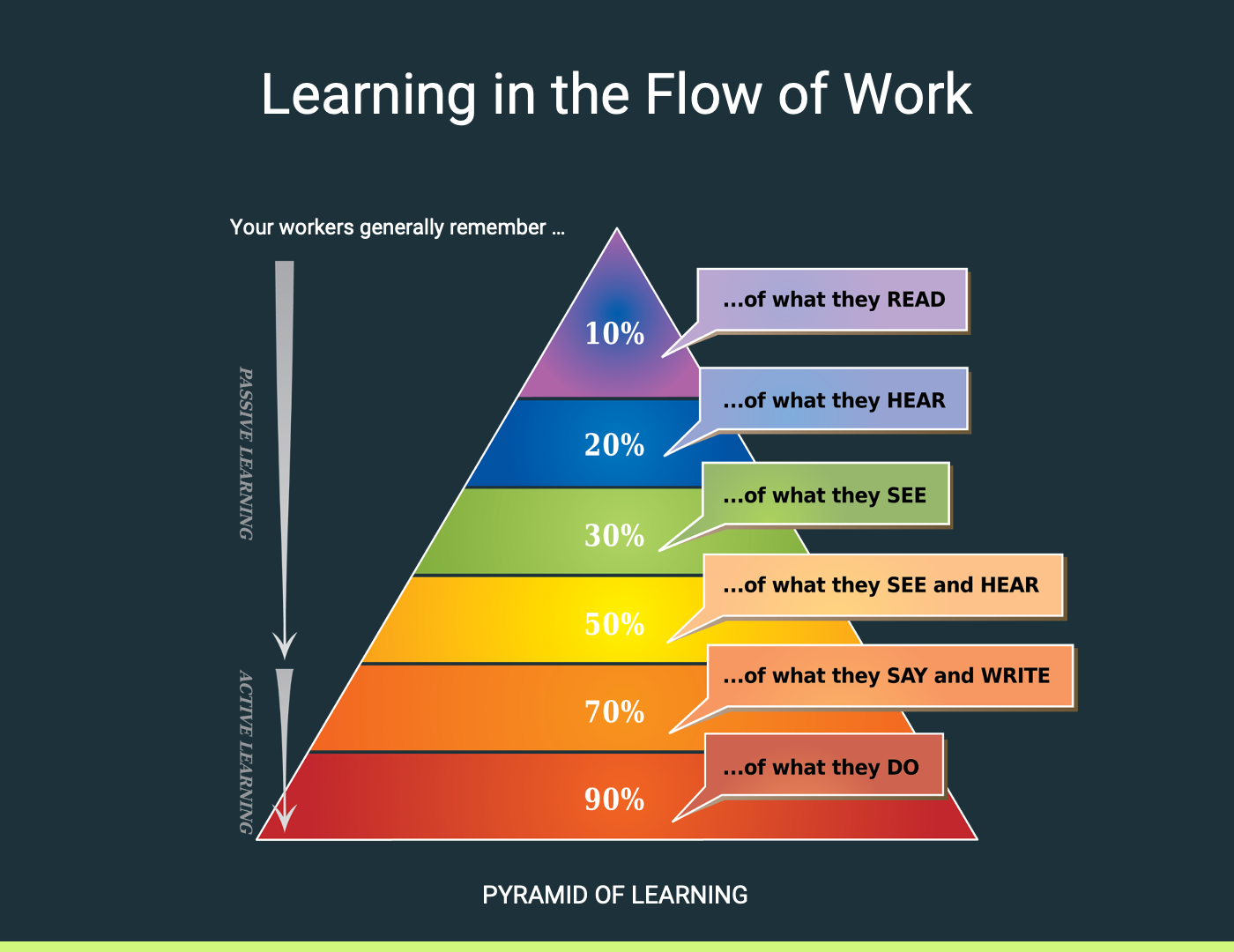
Many workers in the manufacturing industry work in shift-based environments, making it difficult for them to attend traditional classroom-based training sessions. With workflow learning, organizations can incorporate more learning processes into the everyday workday of frontline workers – essentially bridging the gap between knowing and doing. This “active learning” aligns with the Pyramid of Learning visual model that illustrates the different stages of learning and their relative effectiveness.

pyramid of learning

Active learning involves the learner actively engaging with the material, often through problem-solving, discussion, or application of the knowledge while they are on the job.

In general, active learning is considered more effective than passive learning in promoting deep understanding and retention of information. Therefore, learning leaders often strive to design learning experiences that involve higher levels of active learning, moving beyond the lower levels of the pyramid and promoting critical thinking, creativity, and problem-solving skills.

How can workflow learning be used in manufacturing?

Workflow learning consists of using resources at your disposal to complete tasks. This strategy is sometimes referred to as performance support.

For example, workers can look up answers to questions, steps of a process, or new services while performing their jobs instead of interrupting their workflow to go to a class or training session.

Pro Tip

Active, or workflow learning can be implemented with mobile learning solutions that leverage connected worker technology and AI to provide workers with bite-sized, on-demand training modules that they can access on smartphones or tablets. These modules can be developed with customized learning paths that are focused on the type of tasks and work employees are doing on the factory floor.

A

How can technology improve manufacturing training?

The nature of manufacturing training is changing in the age of artificial intelligence. Today, many training processes can be streamlined and optimized using digital and smart, connected worker technologies.

For instance, data collected from everyday manufacturing processes can polish training programs online. Experienced workers can share best practices on customized dashboards for other employees to access. These can be updated in real-time and show changes highlighted to better optimize manufacturing processes.

Digital training tools can also help improve learning speed and retention. For example, workers who need visuals or real-world scenarios can assess them using AI-powered software to maximize their training.


Augmentir is the world’s leading AI-powered connected worker solution that helps industrial companies optimize the safety, quality, and productivity of the industrial frontline workforce. Contact us for a live demo, and learn why leading manufacturers are choosing us to elevate their manufacturing operations to the next level.


See Augmentir in Action
Get in Touch for a Personalized Demo