Posts

The evolution of AI in manufacturing has seen tremendous growth over the past few decades, now becoming more adaptive and collaborative, and being used to augment and directly support frontline workers.

The evolution of artificial intelligence and machine learning technologies in manufacturing has seen tremendous growth over the past few decades, with astounding leaps in technology and industry-wide transformations.
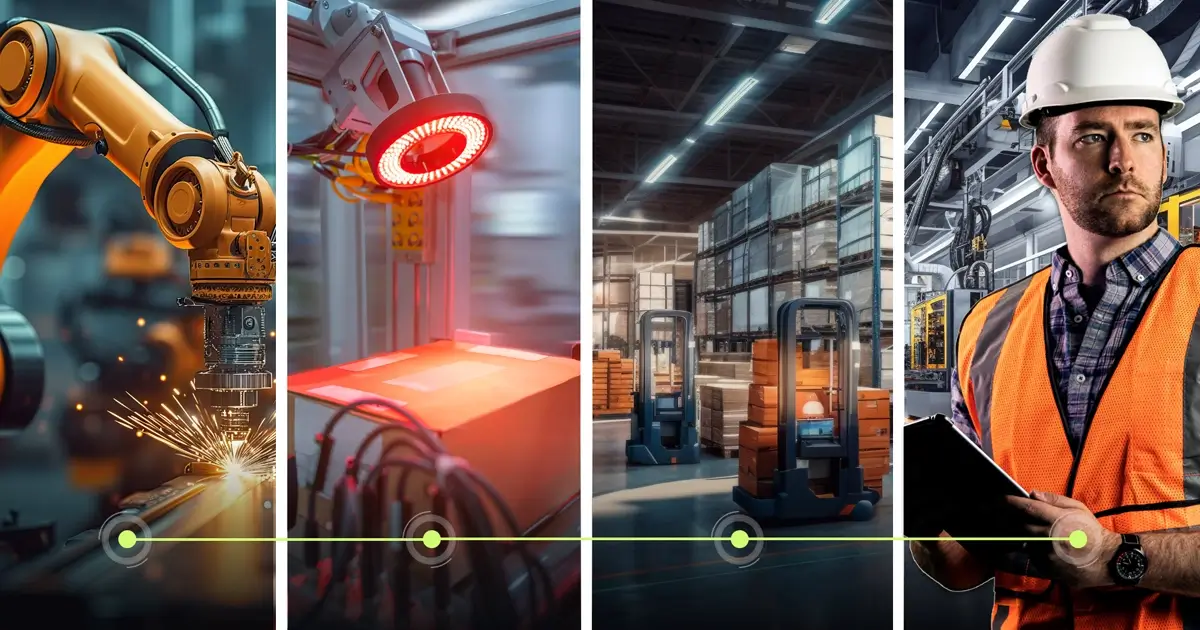
evolution of ai in manufacturing

Dating back to the 1960’s, manufacturers started using AI in robotics and basic automation. This early usage focused on automating manual, highly repetitive human tasks such as assembly, parts handling, and sorting, allowing for higher levels of production and efficiency.

Over time, this evolved with AI-enabled machine vision systems, which were used to automate visual inspections, allowing for better quality control and precision during production cycles. More recently, AI has been at the center of warehouse automation, as well as the Industrial Internet of Things (IIoT), where physical machines and equipment are embedded with sensors and other technology for the purpose of connecting and exchanging data, which is used in predictive analytics for machine health monitoring. Manufacturers can now glean valuable insights from data collected over time about optimizing their operations for maximum efficiency without sacrificing quality.

Despite the breath of applications that AI has in the industrial setting, there is a common thread across all of the above examples – AI has largely been used to automate highly repetitive or manual tasks, or perform functions designed to replace the human worker.

These examples laid the groundwork for the adoption of AI in manufacturing and for the use of AI technologies that augment and directly support frontline workers today.

Read below for more information on how the use of AI and GenAI is evolving in manufacturing, and being used to augment the human worker, transforming productivity and efficiency at a time when workforce optimization is needed most.

Using AI to Augment, not Replace the Workers in our Factories

Today, AI technologies in manufacturing have evolved to encompass a diverse range of applications. According to Deloitte, 86% of surveyed manufacturing executives believe that AI-based factory solutions will be the primary drivers of competitiveness in the next five years. Robotics and automation have become more adaptive and collaborative, working alongside and augmenting human workers to streamline production processes and increase efficiency – rather than simply trying to replace them.

As computing power and algorithmic capabilities improved, AI in manufacturing has become more advanced and widespread. The emergence of Industry 4.0, characterized by the convergence of digital technologies, further accelerated AI’s role in manufacturing. By leveraging tools like connected worker solutions to gather frontline data, manufacturing organizations can now capitalize on AI’s extraordinary computing power to analyze that data and derive actionable insights, improved processes, and more.

Much like the industry has learned to optimize equipment from the 1.7 Petabytes of connected machine data that is being collected yearly, we are now able to optimize frontline work processes and people from highly granular connected worker data, with one major caveat: In order to leverage this incredibly noisy data, a system has to be designed with an AI-native strategy, where the streaming and processing of this data is intrinsic to the platform – not added as an afterthought.

The potential for AI to help augment the human worker is there, but why now?

Because for today’s manufacturers, time is not on your side.

The workforce crisis in manufacturing is accelerating, and at the forefront of the minds of Operations and HR leaders. Job quitting is up, tenure rates are down, and manufacturers struggle daily to find the skilled staff necessary to meet production and quality goals. The threat is huge – with significant impacts to safety, quality, and productivity.

AI-based connected worker solutions allow industrial companies to digitize and optimize processes that support frontline workers from “hire to retire”. These solutions leverage data from your connected workforce to optimize training investments and proactively support workers on the job, across a range of manufacturing use cases.
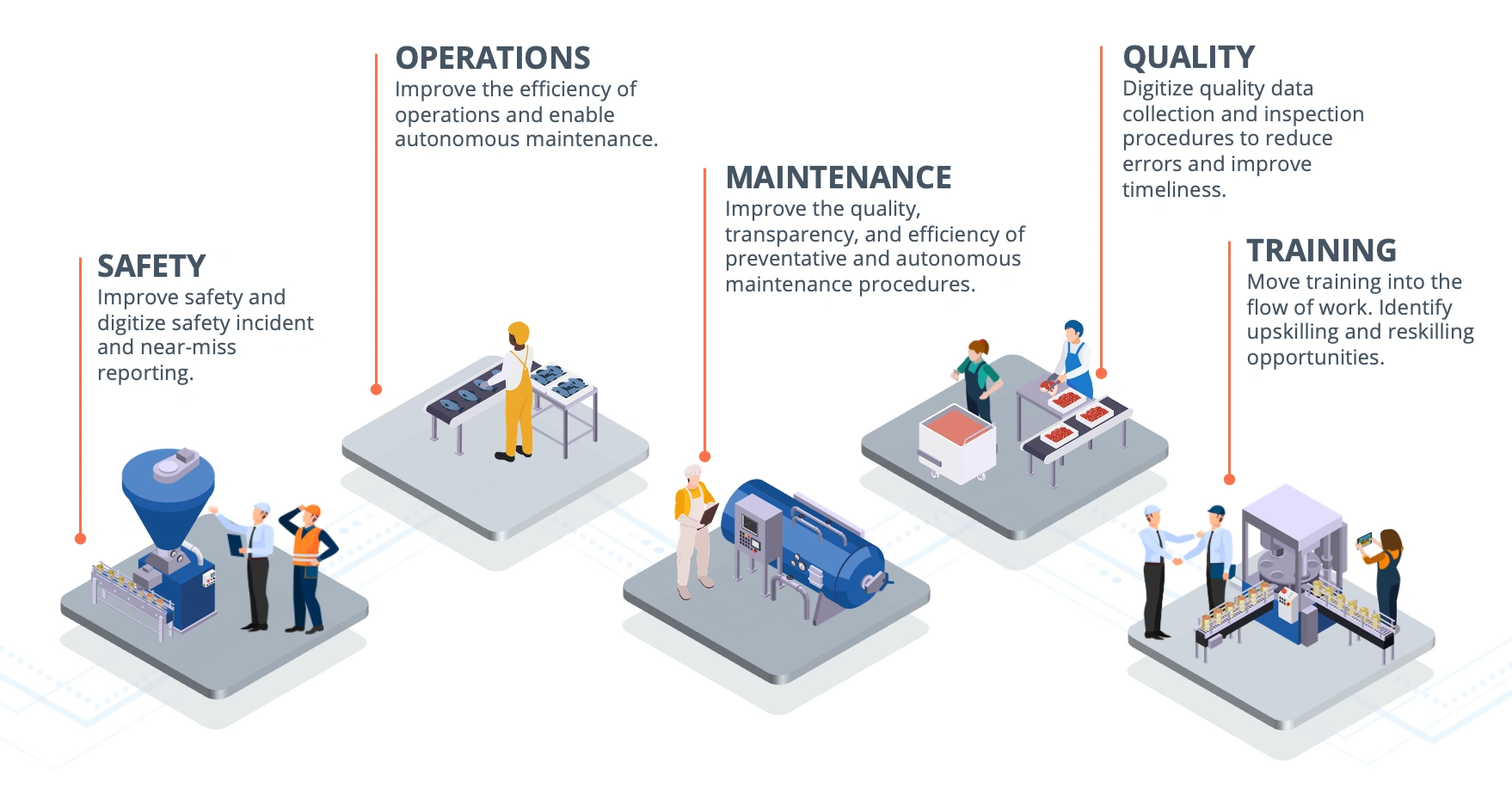
 

paperless factory

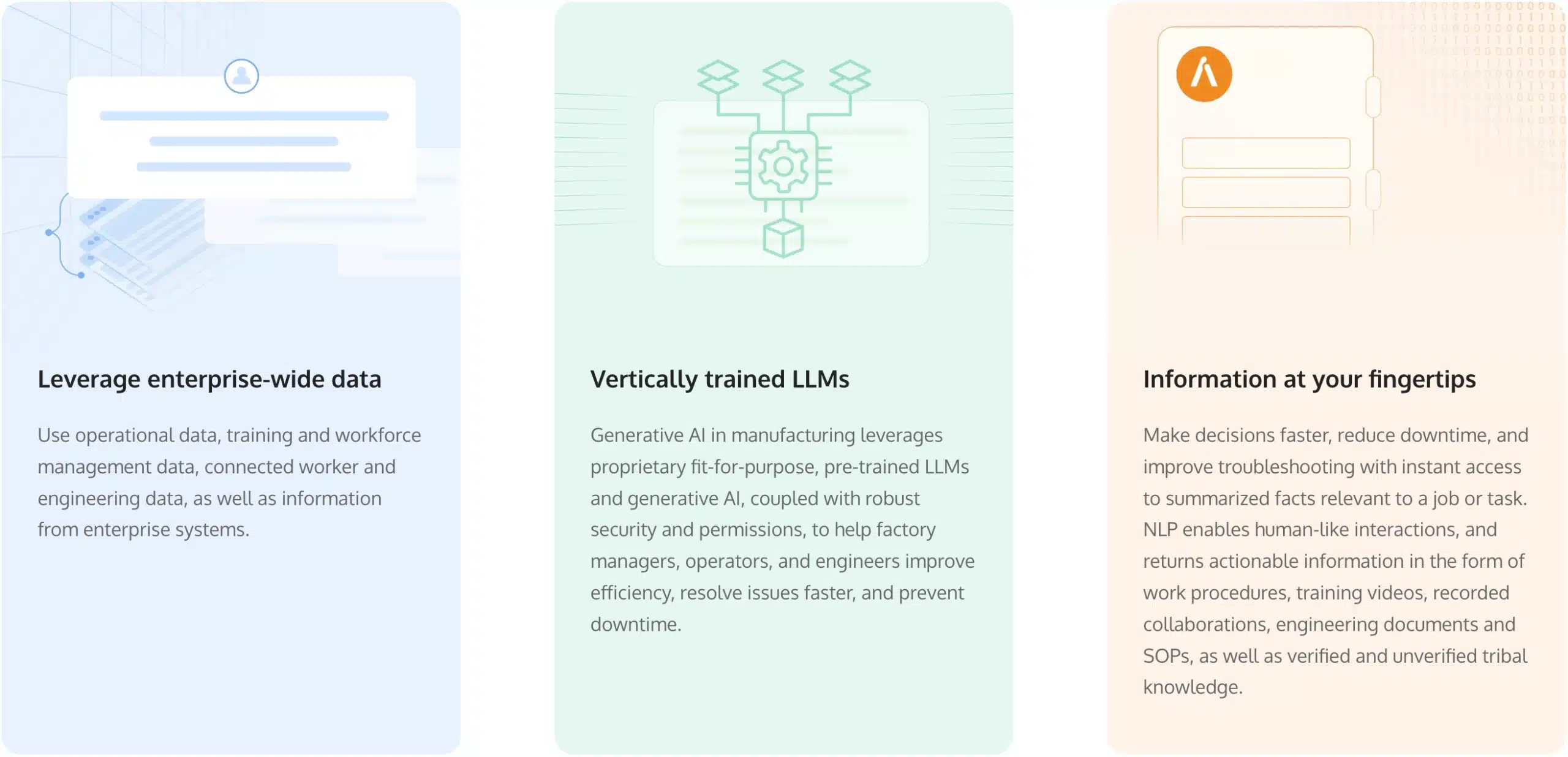
Furthermore, solutions that leverage Generative AI and proprietary fit-for-purpose, pre-trained Large Language Models (LLMs) can enhance operational efficiency, problem-solving, and decision-making for today’s less experienced frontline industrial workers. Generative AI assistants can leverage enterprise-wide data, provides instant access to relevant information, closes skills gaps with personalized support, offers insights into standard work and skills inventory, and identifies opportunities for continuous improvement.

Augmentir’s AI-Native Journey

At Augmentir, since the beginning, we pioneered an AI-native approach toward manufacturing and connected frontline worker support. 
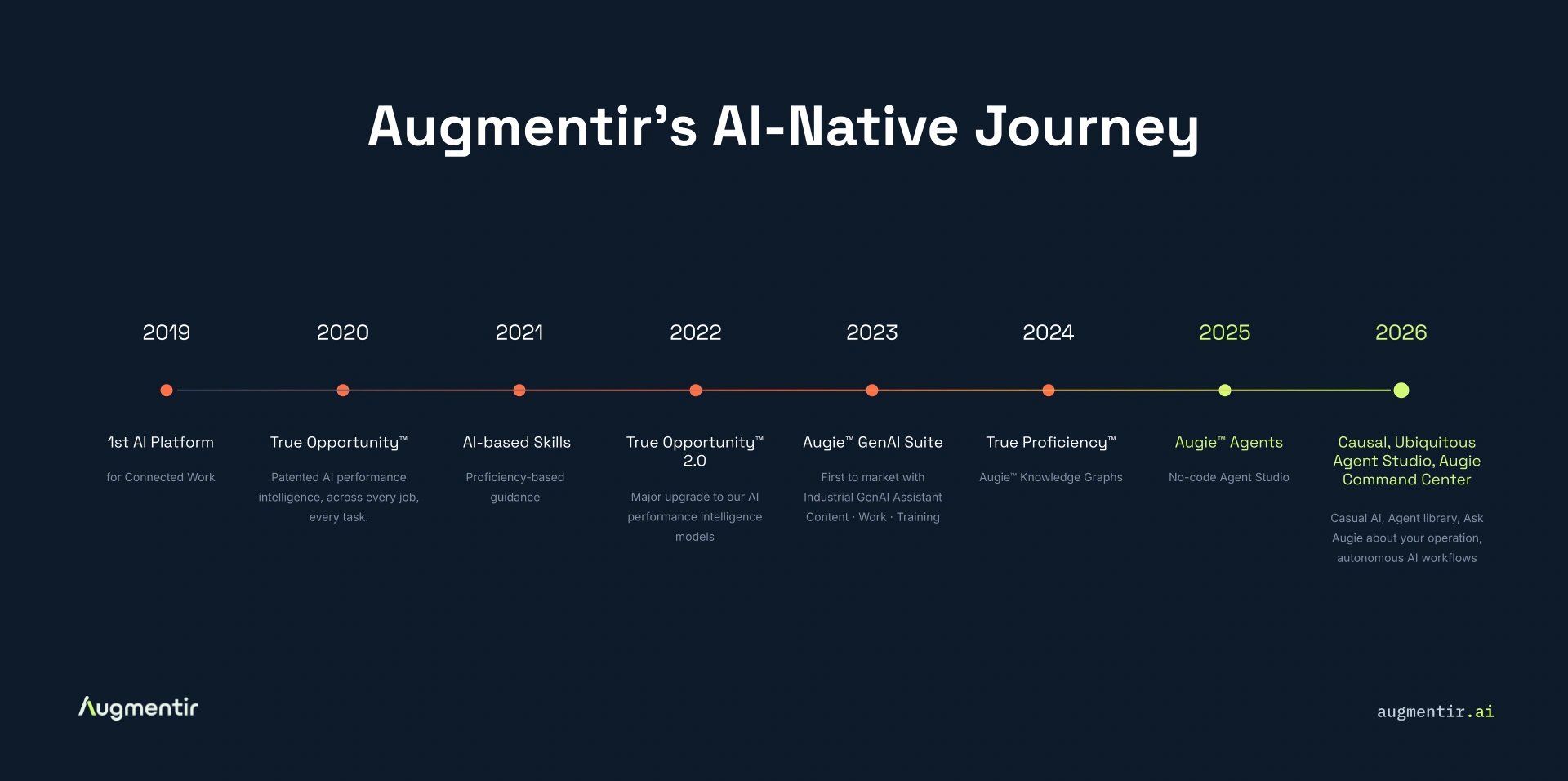
augmentir ai-native journey

Many manufacturing solutions incorporated AI technology as an add-on or afterthought as the technology gained more advanced capabilities and popularity. We, however, have been championing and building a suite of solutions using AI as a foundation. Our platform was designed from the bottom up with AI capabilities in mind, placing us as a leader in the connected frontline worker field. 

  • 2019 – Augmentir launched the world’s first AI-native connected platform for manufacturing work empowering frontline workers to perform their jobs with higher quality and increased productivity while driving continuous improvement across the organization. This marked the start of our AI-native journey, giving industrial organizations the ability to digitize human-centric work processes into fully augmented procedures, providing interactive guidance, on-demand training, and remote expert support to improve productivity and quality.
  • 2020 – Augmentir unveiled True Opportunity™, the first AI-based workforce metric designed to help improve operational outcomes and frontline worker productivity through our proprietary machine learning algorithms. These algorithms take in frontline worker data, then combine it with other Augmentir and enterprise data to uncover and rank the largest capturable opportunities and then predict the effort required to capture them.
  • 2021 – Building on user feedback and field data, Augmentir reveals True Opportunity 2.0™, with improved and enhanced capabilities surrounding workforce development, quantification of work processes, benchmarking, and proficiency. By Leveraging anonymized data from millions of job executions to significantly improve and expand the platform’s ability and automatically deliver in-app AI insights we were able to increase benefits and returns for Augmentir customers.
  • 2022 – Augmentir announces the release of True Productivity™ and True Performance™. True Productivity allows industrial organizations to stack rank their largest productivity opportunities across all work processes to focus continuous improvement teams at the highest ROI and True Performance determines the proficiency of every worker at every task or skill enabling truly personalized workforce development investments.
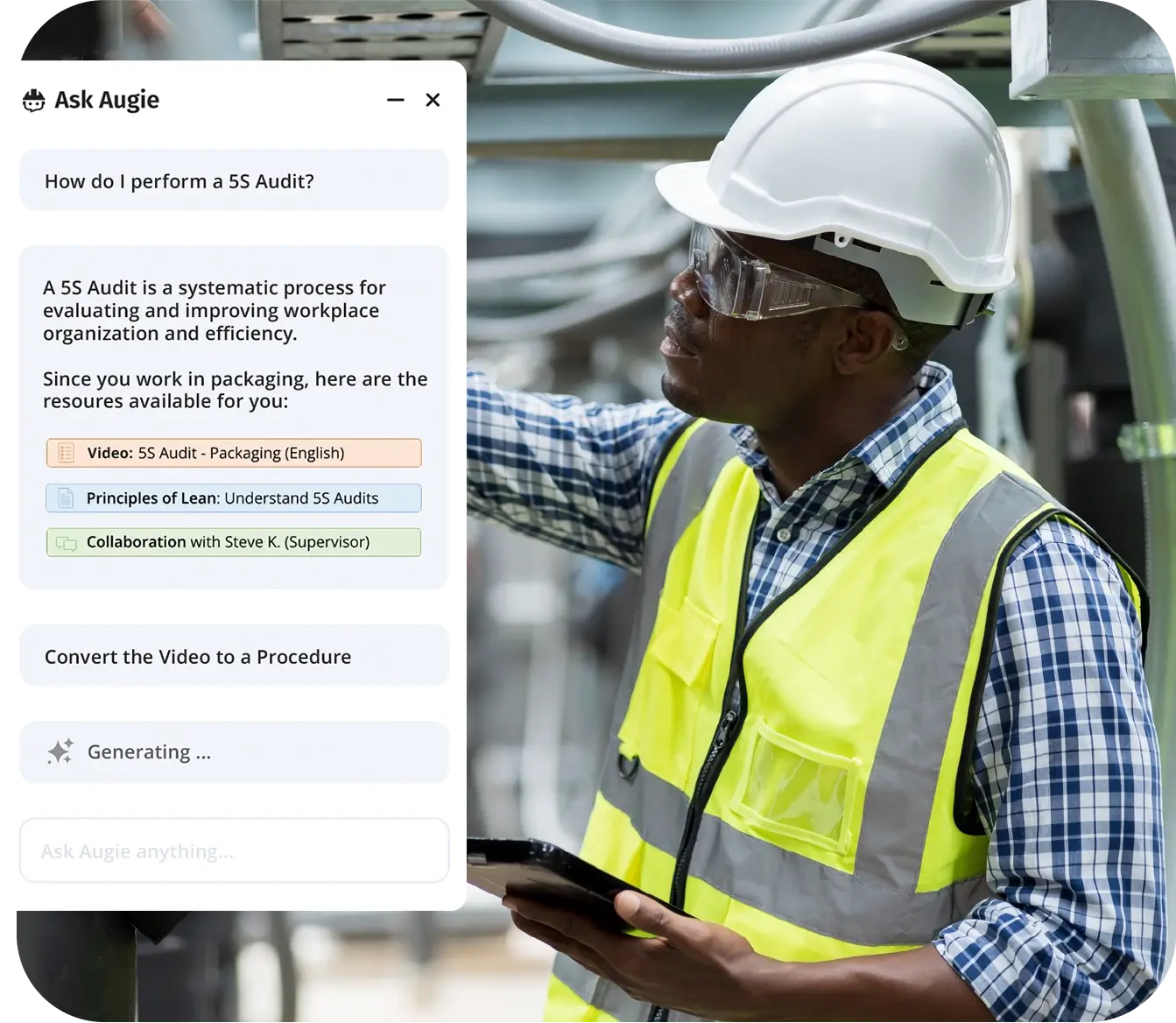
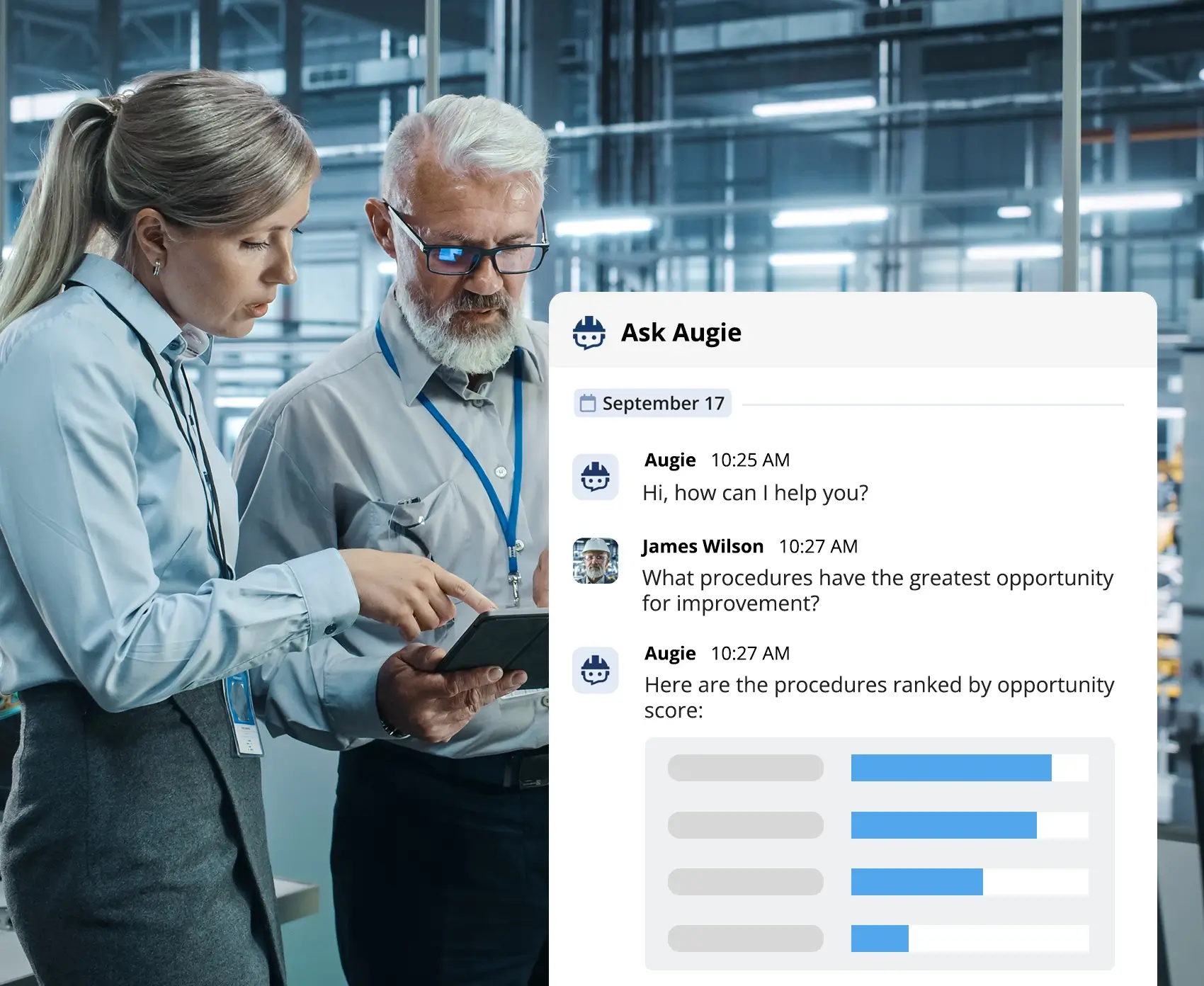
  • 2023 – Augmentir launches Augie™ – the GenAI-powered assistant for industrial work. By incorporating the foundational technology underpinning generative AI tools like ChatGPT, we enhanced our already robust offering of AI insights and analytics. Augie adds to this, improving operational efficiency and supporting today’s less experienced frontline workforce through faster problem-solving, proactive insights, and enhanced decision-making.
  • 2024 – As this year progresses, we have already continued to refine our AI-native solutions and apply user feedback and additional features to best support frontline industrial activities and workers everywhere.
  • 2025 –First to market with industrial AI Agents and a no-code AI Agent Studio purpose-built for frontline operations.
  • 2026 and beyond – Advancing to Agentic Automation, expanding our AI Agent Library and introducing Augie Command Center, Casual AI, and autonomous execution across the platform.

We are deeply involved in applying AI and emerging technologies to manufacturing activities to augment frontline workers, not replace them. Providing enhanced support, access to key knowledge (when and where it does the most good), and improving overall operational efficiency and productivity.

The Future of AI in Manufacturing – The Journey Forward

As we press onward into the future, we at Augmentir are determined to champion the application of AI and smart manufacturing to augment and enhance frontline workers and industrial processes. We will continue to evolve our application of AI and its use cases in manufacturing to help frontline teams and workforces, reinforcing our AI-native pedigree.

The addition of Augie to our existing AI-powered connected worker solution is an important step forward. Augie is a Generative AI assistant that uses enterprise-wide data, provides instant access to relevant information, closes skills gaps with personalized support, offers insights into standard work and skills inventory, and identifies opportunities for continuous improvement. Augie is a result of our dedication to empowering frontline workers, leveraging AI to support manufacturing operations, and giving manufacturing workers better tools to do their jobs safely and more efficiently.

With patented AI-driven insights that digitize and optimize manufacturing workflows, training and development, workforce allocation, and operational excellence, Augmentir is trusted by manufacturing leaders as a industrial transformation partner delivering measurable results across operations. Schedule a live demo today to learn more.
 

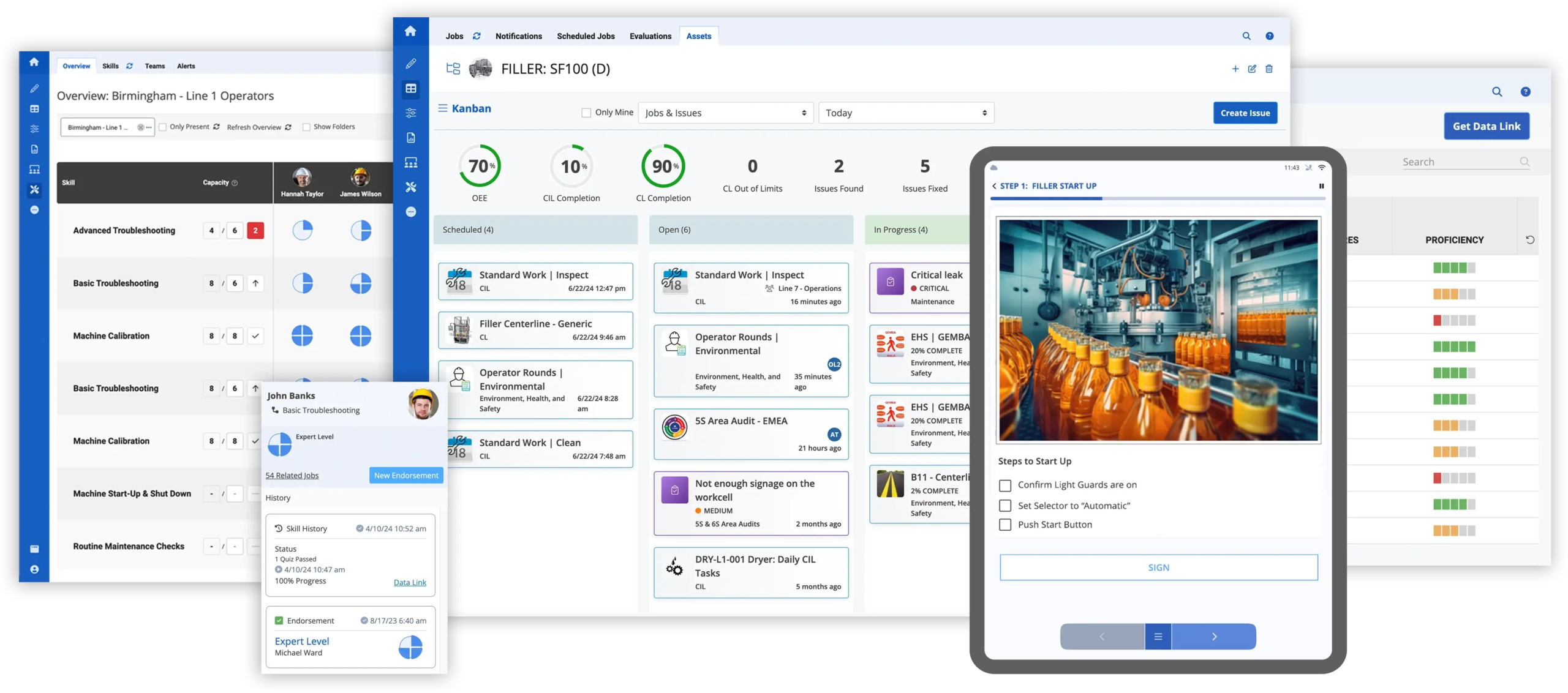
See Augmentir in Action
Get in Touch for a Personalized Demo

You may have noticed that our website and brand look a little different. Augmentir has a new look, but under the hood, its the same powerful AI that is helping to transform the industrial workforce of the future.

You may have noticed that our website and brand look a little different. Well, that’s because behind the scenes for the past few months, we’ve been under construction (no pun intended).

Augmentir was founded in 2018 with the vision to use AI to empower the industrial frontline workforce to perform at their best. This was a continuation of our rich history – our founding team has been at the forefront of three of the most important of these software technology revolutions in manufacturing over the past three decades – Wonderware Software in 1987, Lighthammer in 1997, and ThingWorx in 2008.

A lot has changed since then. The world we live in today is not the same as it was 4 years ago. And in the last two years, the COVID-19 pandemic has altered the stability of the workforce and drastically magnified some of the industry’s top workforce challenges, which stem from the unprecedented levels of dynamism in the areas of skills diversity, reduced tenure, and increased churn from the “Great Resignation”. Unlike the stable and predictable workforce of the recent past, today companies have to live in the new normal where workers are hard to find, hard to engage, and hard to keep.

These top challenges of today have only reinforced the need for an AI-powered, data-driven approach to empowering frontline workers.

This data-driven era we’re entering into is one of continuous learning and development with tools like remote collaboration and digitized work processes truly integrating frontline workers into the fabric of the business from a collaboration standpoint whereas they may have been overlooked before.

Augmentir’s AI-powered connected worker platform provides the tools to not only survive in this new normal but to thrive.

You can’t build a truly modern, connected workforce without AI

The term “connected worker” has become a recent buzzword in the manufacturing world, and is now considered a tool that the new generation of workers expect to work with. But true connected work means using AI to allow frontline workers to have access to internal and external resources that are appropriate for when and how they need them.

Augmentir isn’t your typical connected worker platform. Our platform was built from the ground up on an AI foundation. AI algorithms are ideal for analyzing large amounts of data collected from a connected workforce. AI can detect patterns, find outliers, cleanse data and find correlations and patterns that can be used to identify opportunities for improvement and create a data-driven environment that supports continuous learning and performance support. Our connected worker platform utilizes AI to help train, guide, and support today’s frontline workers in a dynamic workforce by combining digital work instructions, remote collaboration, continuous development and advanced on-the-job training capabilities.

This approach aligns perfectly with the dynamic, changing nature of today’s workforce, and is ideally suited to achieve and sustain effective on-the-job performance.

As the world’s only AI-powered connected worker platform, we decided it was time to refresh our brand identity to accentuate our strongest feature and the thing that makes Augmentir unique – AI. We’re still the same AI-native connected worker platform that you know – just with a new look.

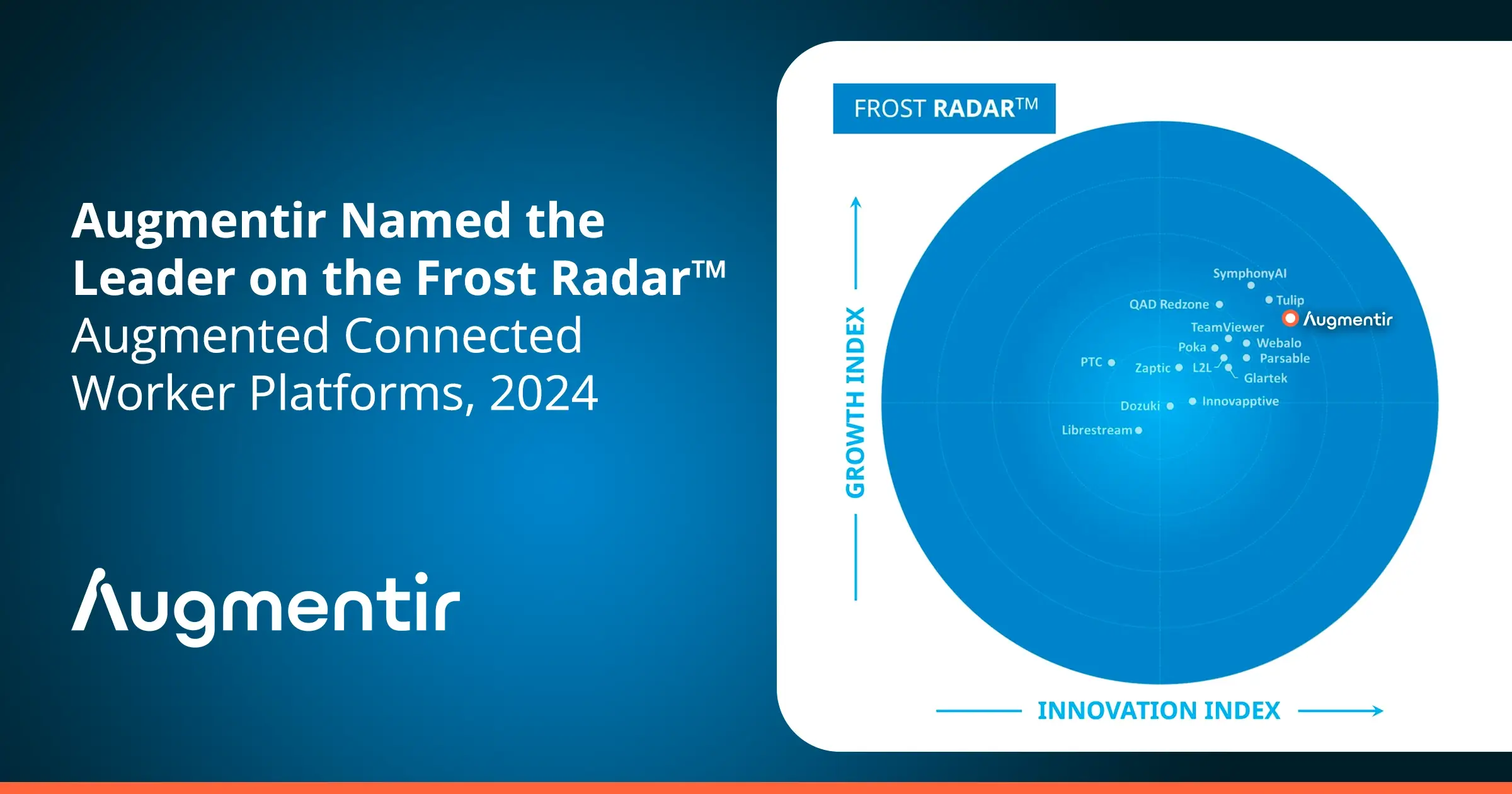
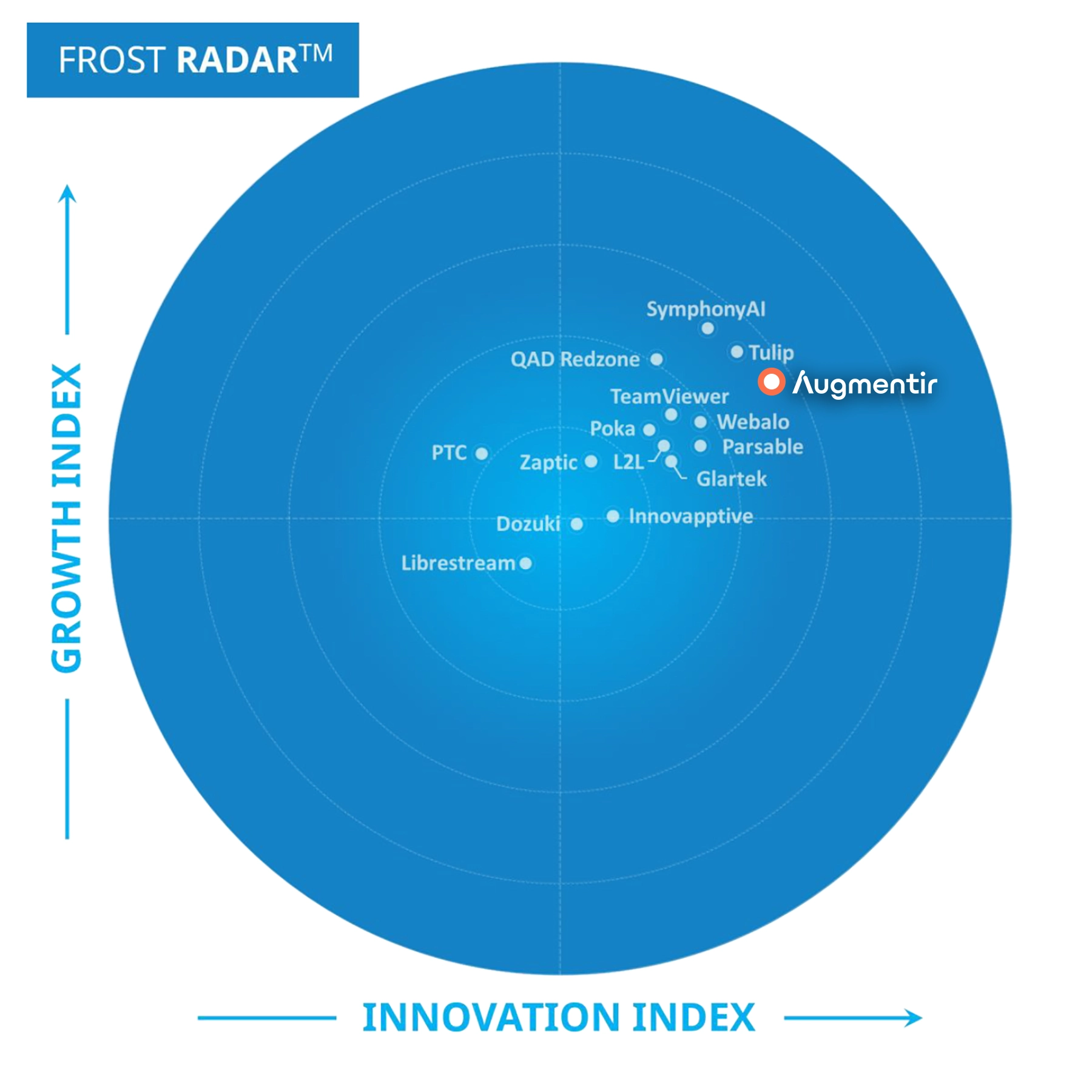
The latest Frost & Sullivan Radar report recognizes Augmentir as the Leading Augmented Connected Worker Platform.

Augmented Connected Worker (ACW) solutions revolutionize manufacturing and industrial operations and Augmentir is leading the way!

The recent Frost & Sullivan Radar report recognized Augmentir as the Leading ACW Solution with our AI-powered connected worker platform. AWC is a concept that combines the methodologies behind connected worker and augmented worker initiatives to provide a clearer, more accurate picture of what the future of manufacturing work looks like.

augmentir named the leader in frost radar for augmented connected worker platforms 2024

Read below to learn more about Augmentir in the Frost Radar report and how ACW technologies benefit both manufacturers and their workers alike.

The Frost & Sullivan Augmented Connected Worker Radar Report 2024

The Frost & Sullivan Radar Report, or Frost Radar™, is an analytical tool that benchmarks the future growth of leading organizations across multiple industries. Through careful selection and research across criteria that encompasses 2 major indices and 10 evaluation criteria, analysts select organizations that will be able to successfully support users into the future.

This edition of the Frost Radar, ranked Augmentir #1 out of all the ACW vendors. Augmentir empowers organizations to embrace Augmented Connected Worker initiatives through a comprehensive platform that combines connected worker and AI technologies to connect and support frontline workers like never before.

frost radar augmented connected worker platforms

As manufacturing workers become more interconnected, they can use AI tools in conjunction with smart connected worker solutions to gain insights that pinpoint areas with significant potential for improvement, this allows them to truly augment their workforces equipping them with the knowledge and abilities to complete their work safely and competently.

For more information on the Frost Radar, and the evaluation methodology used by Frost & Sullivan, click here.

Augmentir Ranked #1 Connected Worker Platform, Most Complete Solution on the Market

Frost & Sullivan has identified nine functionalities that are essential for a complete ACW solution.

  1. Knowledge and data management. The solution serves as a repository of knowledge.
  2. Work assistance and productivity. It provides digital tools to enhance frontline workers’ tasks, such as digital work instructions, digital Kanban boards, and navigation guidance.
  3. Seamless experience. The solution must be easily accessible from available devices (phones, tablets, wearables) to integrate seamlessly into everyday operations.
  4. Skills management. This serves as an extension for learning management systems (LMS) and provides supervisors and plant managers the necessary tools to upskill the workforce.
  5. Channel for communication. The solution offers native features to enable collaboration across operations, such as remote assistance, multi-site or multi-team workflows, and news feeds.
  6. Reporting and analytics. This refers to pre-built dashboards with workforce and task execution data. The ACW platform can also provide tools for configuring custom dashboards and integrating data from other systems.
  7. Integrations. The solution comes with a variety of pre-built connectors and tools to easily build new integrations to common systems.
  8. Platform capabilities. NC and LC development environments allow the building of digital procedures, workflows, training programs, and dashboards. Standard templates are available to accelerate time to value and the default deployment option is cloud-based.
  9. Integrated AI. The solution leverages AI in one or more ways. AI-enabled features include predictive maintenance, automatic creation of workflows/digital work instructions/troubleshooting procedures based on video or worker input, automatic analysis and optimization recommendations for processes, AI-powered search engines, copilots, live translations, and more.

Frost & Sullivan ranked Augmentir as a Leader in both innovation and growth within the ACW solution landscape.

According to Frost & Sullivan:

Augmentir offers one of the most comprehensive ACW solutions in the market. Its new AI copilot sets it apart from most other products in the market by covering a variety of use cases. The company’s plans to leverage engagement data from the workforce is a unique initiative in the current market. All these factors contribute to making Augmentir the leader in the Frost Radar Innovation Index.

Augmenting Frontline Workers with an AI Platform for Connected Work

Manufacturing is uniquely situated as an industry to benefit from Augmented Connected Worker solutions leveraging AI-powered connected worker technology for process improvements, quality, management, enhanced training, and more. ACW initiatives facilitate faster onboarding, increased workforce flexibility, and the retention of essential knowledge.

augmentir connected worker platform

AI – including generative AI tools, software, and assistants – plays a crucial role in ACW initiatives, addressing overarching trends like skills variability and the loss of tribal knowledge within the workforce. It serves as the cornerstone for implementing data-driven improvements in operational performance and continuous enhancement.

At Augmentir, we believe that a connected worker platform’s purpose goes beyond just delivering instructions and remote support; it should continually optimize the entire connected worker ecosystem and augment the capabilities of frontline workers. With this in mind, we introduced Augie™ – our generative AI assistant for industrial work, in early 2023.

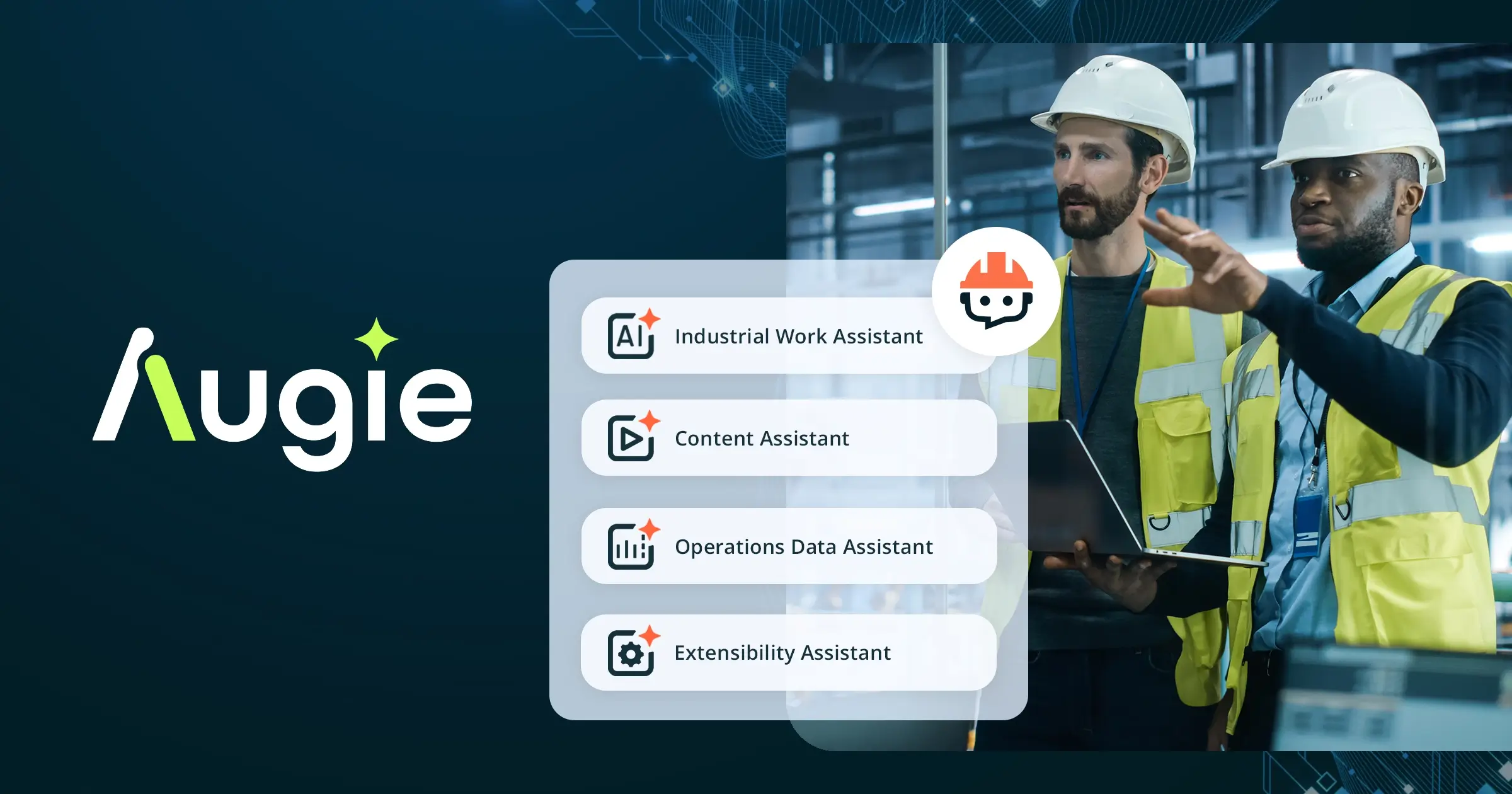
With Augie, manufacturers can unlock previously untapped potential in their frontline personnel and operations. Our recent expansion and enhancements now offer the first-ever suite of dedicated GenAI assistants for manufacturing enterprises covering anything from Troubleshooting, Operations, and Data Insights, to Content Creation and even GenAI-as-a-Service.

Interested in learning more?

If you’d like to learn more about Augmentir and see how our AI-powered connected worker platform enables Augmented Connected Worker initiatives to improve safety, quality, and productivity across your workforce, schedule a demo with one of our product experts.


See Augmentir in Action
Get in Touch for a Personalized Demo

Learn how manufacturers combat the manufacturing skilled labor shortage and close skills gaps with an Augmented Connected Workforce (ACWF).

An Augmented Connected Workforce (ACWF) offers manufacturing and other industrial organizations a powerful solution to combat the ever-worsening skilled labor shortage and skills gap. According to a report by Deloitte and the Manufacturing Institute, an estimated 2.1 million manufacturing jobs could go unfilled by 2030 and the cost of those missing jobs could potentially total $1 trillion in 2030 alone.

augmented connected workforce acwf manufacturing

By integrating advanced technologies like artificial intelligence (AI), connected worker platforms, and other emerging solutions manufacturers can enhance the capabilities of their existing workforce and bridge skill gaps. Connected worker tools offer real-time monitoring of your frontline workforce, ensuring seamless operations. Moreover, connectivity enables remote collaboration, allowing experts to assist frontline workers from anywhere in the world. This interconnected ecosystem empowers workers with the tools they need to succeed and attracts new talent by showcasing a commitment to innovation and technology-driven growth.

Through an ACWF, manufacturers can effectively combat the manufacturing skilled labor shortage and close the skills gap while driving productivity, innovation, and remaining competitive. Read more about ACWF in manufacturing below:

Implementing an ACWF in Manufacturing

A critical element of transitioning from a traditional workforce to an Augmented Connected Workforce (ACWF) is implementing and adopting new technologies and processes. Here are a few steps that can help with the adoption of ACWF technologies and smooth transitions in industrial settings:

  • Step 1: Assess Current Processes – Organizations must understand existing workflows and identify areas where AI, connected worker platforms, and other ACWF technology can replace paper-based and manual processes to enhance efficiency and productivity.
  • Step 2: Invest in Technology – Procure  AI-driven analytics platforms, mobile technology, and wearable technology to enable real-time data collection and remote collaboration.
  • Step 3: Training and Onboarding – Provide comprehensive training programs to familiarize workers with new technologies and workflows. Emphasize the importance of safety protocols and data privacy.
  • Step 4: Pilot Programs – Start with small-scale pilot programs to test the effectiveness of the implemented technologies in real-world manufacturing environments. Target high-value use cases that can benefit from a transition from paper to digital.
  • Step 5: Continuous Improvement – Gather feedback from workers and supervisors during pilot programs and adapt implementation initiatives based on their input. Continuously optimize processes and technologies for maximum effectiveness.

By following these steps, manufacturers can smooth the transition from a traditional manufacturing workforce to an ACWF, empowering their frontline workers with improved capabilities, skills, and overall operational excellence.

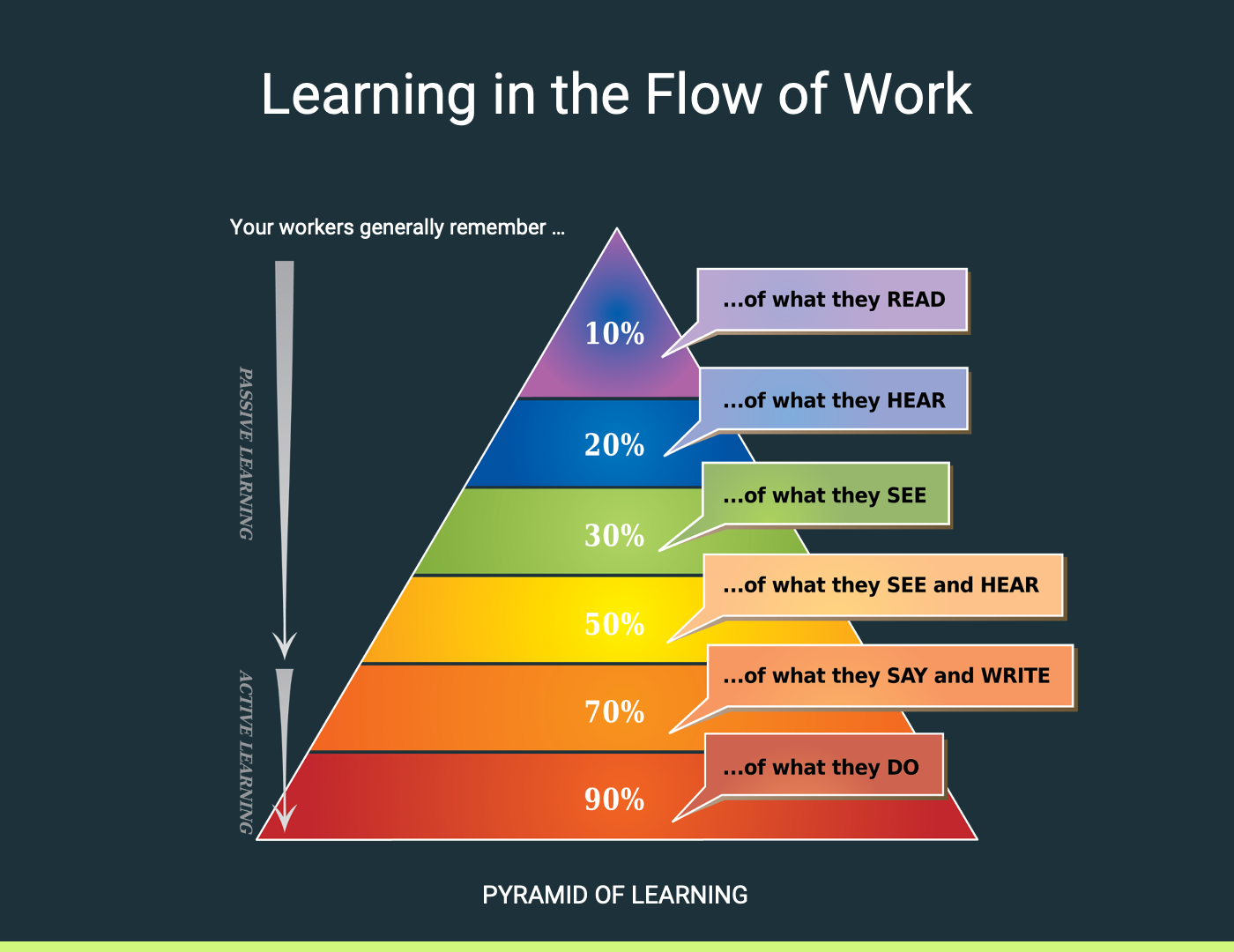
Supporting Learning in the Flow of Work

Augmented Connected Workforce (ACWF) technologies allow for increased frontline support and for new processes around learning and training to strategically upskill and reskill, reduce time to competency for new workers, and to combat the skilled labor shortage in manufacturing and more. Connected worker tools, such as wearable devices and IoT sensors, enable real-time monitoring of worker performance and environmental conditions, ensuring safety and efficiency on the factory floor.

pyramid of learning

An ACWF also allows for improved workflow learning capabilities giving frontline workers access to expert guidance, remote assistance and collaboration, microlearning, and other learning in the flow of work options regardless of the worker’s location.

ACWF tools further enhance frontline activities through:

  • Digital work instructions and guidance: Smart, connected worker platforms provide digital work instructions, procedures, and visual guidance easily accessible to workers on mobile devices.
  • Digital mentors and training: Some ACWFs incorporate “digital mentors” – GenAI-powered industrial assistants that can provide step-by-step guidance to workers, especially new hires.
  • Knowledge capture and sharing: Connected frontline worker applications serve as knowledge sharing platforms, capturing data and insights from frontline workers, which can then be analyzed by AI software and used to improve processes, update work instructions, and share knowledge across the organization
  • Performance monitoring and feedback: ACWF solutions provide visibility into worker performance, allowing managers to identify areas where additional training or support is needed.

augmented connected workforce in manufacturing

In summary, ACWF initiatives empower frontline workers with the digital tools, knowledge, and support they need to learn and improve their skills directly within their daily workflows, rather than relying solely on formal training programs. This helps close skills gaps and drive continuous improvement.

Future-proofing Manufacturing Operations with an ACWF

Adopting an Augmented Connected Workforce (ACWF) approach centered around augmenting frontline workers with mobile technology, immersive training, collaborative decision-making, and continuous improvement, allows manufacturers to future-proof their operations and gain a sustainable competitive advantage. This concept empowers employees with powerful tools that augment and enhance their capabilities, productivity, and overall business processes by accessing critical information and fostering collaboration

AI-powered software can analyze vast amounts of data to optimize production processes and predict workforce development needs. At the same time, connected frontline worker solutions enable the integration of mobile and wearable technologies and provide real-time data insights, aiding in optimizing factory operations and adapting to evolving industry trends.

For an Augmented Connected Workforce, integrating AI and connected worker technologies serves as a vital strategy for manufacturers navigating the skilled labor crisis. Augmentir encourages organizations to embrace ACWF transformations and expedites adoption through a comprehensive connected worker platform leveraging the combined benefits of connected worker and AI technologies.

With Augmentir, frontline workers can access critical information, real-time data and insights, and expert advice and guidance all in the flow of work preventing lost time and improving both efficiency and productivity. Schedule a live demo to learn more about how an Augmented Connected Workforce future-proofs manufacturing operations and enhances frontline activities.


See Augmentir in Action
Get in Touch for a Personalized Demo

AI is playing a key role in changing the manufacturing landscape, augmenting workers and empowering them with improved, optimized processes, better data, and personalized instruction.

Deloitte recently published an article with the Wall Street Journal covering how AI is revolutionizing how humans work and its transformative impact. They emphasized that AI is not merely a resource or tool, but, that it serves almost as a co-worker, enhancing work processes and efficiency. This article discussed how the evolving form of intelligence augments human thinking and emphasized this as a catalyst for accelerated innovation.

Manufacturing is uniquely situated to benefit from AI to improve operations and empower their frontline workforces. The skilled labor gap has reached critical levels, and the market is under tremendous stress to keep up with growing consumer demand while staying compliant with quality and safety standards. Manufacturing workers are crucial to the success of operations – maintenance, quality control and assurance, and more – manufacturers rely upon their workforce to ensure production proceeds smoothly and successfully.

AI is playing a key role in changing the manufacturing landscape, augmenting workers and empowering them with improved, optimized processes, better data for informed decision-making, troubleshooting, personalized instructions and training, and improved quality assurance and control. According to the World Economic Forum, an estimated 87% of manufacturing companies have accelerated their digitalization over the past year, the IDC states 40% of digital transformations will be supported by AI, and a recent study from LNS Research found that 52% of industrial transformation (IX) leaders are deploying connected worker applications to help their frontline workforces. Not only that, AI technology is expected to create nearly 12 million more jobs in the manufacturing industry.

Integrating AI into manufacturing not only enhances productivity, but also opens the door to new possibilities for worker safety, training, and innovative new manufacturing practices. Here are some ways AI is transforming manufacturing operations:

  • AI-based Workforce Analytics: Collecting, analyzing, and using frontline worker data to assess individual and team performance, optimize upskilling and reskilling opportunities, increase engagement, reduce burnout, and boost productivity.
  • Personalized Training in the Flow of Work: With AI and connected worker solutions, manufacturers can identify and supply training at the time of need that is personalized to each individual and the task at hand.
  • Personalized Work Instructions: AI enables manufacturers to offer customized digital work instructions mapped to their skill levels and intelligently assign work based on each individual’s capabilities.
  • Digital Performance Support and Troubleshooting Guide: Generative AI assistants and bot-based AI virtual assistants offer support and guidance to manufacturing operators, enabling access to collaborative technologies and knowledge bases to ensure the correct actions and processes are taken.
  • Optimize Maintenance Programs: AI algorithms analyze data from sensors on machinery and other connected solutions to predict when equipment is likely to fail. This enables proactive maintenance, minimizing downtime and reducing maintenance costs. Additionally, with AI technologies, manufacturers can implement autonomous maintenance processes through a combination of digital work instructions and real-time collaboration tools. This allows operators to independently complete maintenance tasks at peak performance.
  • Improve Quality Control: AI-powered solutions can improve inspection accuracy and optimize quality control and assurance processes to identify defects faster. With connected worker solutions, manufacturers can effectively turn their frontline workforce into human sensors supplying quality data and enhancing assurance processes.
  • Ensure Worker Safety: AI-driven safety systems coupled with connected worker technologies monitor the work environment, supplying real-time data and identifying potential hazards to ensure a safer workplace for employees.

connected enterprise

As AI continues to advance, the manufacturing industry is poised for even greater transformation, improving both the quality of products and the working conditions for employees. AI is revolutionizing the way humans work and how the manufacturing industry approaches nearly every process across operations, augmenting work interactions, productivity, efficiency, and boosting innovation.

Explore top use cases for generative AI in manufacturing, how GenAI copilots and digital assistants work, and benefits for frontline workers.

Generative AI in manufacturing refers to the application of generative models and artificial intelligence techniques to optimize and enhance various aspects of the manufacturing process.

While traditional AI focuses on data analysis, pattern recognition, and decision-making, generative AI creates new content and synthetic data, enabling innovative solutions. This involves using AI algorithms to generate new product designs, optimize production workflows, predict maintenance needs, and improve production efficiency within frontline operations.

generative ai in manufacturing

According to McKinsey, nearly 75% of generative AI’s major value lies in use cases across four areas: manufacturing, customer operations, marketing and sales, and supply chain management. Manufacturers are uniquely situated to benefit from generative AI and it is already a transformative force for some. Generative AI is driving innovation and efficiency across the manufacturing sector, enabling advanced digital solutions and competitive advantages. A recent Deloitte study found that 79% of organizations expect generative AI to transform their operations within three years, and 56% of them are already using generative AI solutions to improve efficiency and productivity.

Manufacturing is rapidly evolving and by integrating cutting-edge technologies like Generative AI, manufacturers can better support, augment, and enhance their frontline workforces with improved decision-making, collaboration, and data insights. Gen AI is being adopted as a modern alternative to traditional methods, surpassing manual inspections and basic automation to deliver greater operational improvements.

Join us below as we dive into generative AI in manufacturing exploring how it works, the benefits and risks, and some of the top use cases that generative AI, specifically generative ai digital assistants, can provide for manufacturing operations:

What is Generative AI in Manufacturing

Generative AI refers to artificial intelligence systems designed to create new content, such as text, images, or music, by learning patterns from existing data. In manufacturing, this includes the ability to generate new product designs and create synthetic data, such as realistic images, videos, or text, to support manufacturing innovation and AI training. The use of Large Language Models (LLMs) and Natural Language Processing (NLP) enables these systems to analyze vast amounts of data, leveraging advanced algorithms and machine learning algorithms to improve prediction accuracy and operational efficiency, simulate different scenarios, and generate innovative solutions that can impact a wide range of manufacturing processes.

generative ai in manufacturing with LLMs and NLP

Large Language Models

Large Language Models (LLMs) are a type of generative artificial intelligence model that have been trained on a large volume – sometimes referred to as a corpus – of text data. They are capable of understanding and generating human-like text and have been used in a wide range of applications, including natural language processing, machine translation, and text generation.

In manufacturing, generative AI solutions should leverage proprietary fit-for-purpose, pre-trained LLMs, coupled with robust security and permissions.  Industrial LLMs use operational data, training and workforce management data, connected worker and engineering data, as well as information from enterprise systems. LLMs can also enhance document search by efficiently finding, extracting, and summarizing information from technical manuals, reports, and operational records.

Natural Language Processing

Natural Language Processing (NLP) is a branch of artificial intelligence that focuses on the interaction between computers and humans using natural language. It involves the development of algorithms and models that enable computers to understand, interpret, and respond to human language in a way that is both meaningful and useful.

For generative AI, NLP is a key technology that enables the assistants to understand and generate human-like text, providing seamless conversational user experiences and valuable assistance to frontline workers, engineers, and managers in manufacturing and industrial settings.

NLPs allow the AI to process and interpret natural language inputs, enabling it to engage in human-like interactions, understand user queries, and provide relevant and accurate responses. This is essential for common manufacturing tasks such as real-time assistance, documentation review, predictive maintenance, and quality control.

By combining large language models and natural language processing, generative AI can produce coherent and contextually relevant text for tasks like writing, summarization, translation, and conversation, mimicking human language proficiency. NLP also enables interactive learning experiences, allowing employees to engage with training content, receive immediate feedback, and clarify doubts in real time.

Benefits of Leveraging Generative AI in the Manufacturing Industry

Generative AI and solutions that leverage them offer several benefits for manufacturing operations, including:

  • Operational/Production Optimization and Forecasting: GenAI technology offers a significant boost to manufacturing processes by monitoring and analyzing in real-time, spotting problems quickly, and providing predictive insights and personalized assistance to boost efficiency for manufacturing workers. Through process optimization and enhancing efficiency with real-time data analysis and automation, manufacturers can streamline operations, reduce downtime, and improve productivity. Additionally, AI assistants empower manufacturers to explore multiple control strategies within their process, identifying potential bottlenecks and failure points.
  • Proactive Problem-Solving: Generative AI-powered tools provide real-time monitoring and risk analysis of manufacturing operations, enabling the quick identification and resolution of issues to optimize production and efficiency. They can spot events as they happen, providing valuable insights and recommendations to help operators and engineers rapidly identify and resolve problems before they escalate. Predictive analytics and improved quality control help reduce waste and support continuous improvement in manufacturing processes.
  • Reduce Unplanned Downtime: Generative AI solutions can analyze vast datasets to predict equipment maintenance needs before issues arise, allowing manufacturers to schedule maintenance proactively, minimizing unplanned disruptions. Generative AI can also optimize maintenance schedules and delivery schedules to further reduce downtime and improve supply chain reliability. This not only improves downtime but also contributes to the overall operational resilience of mission-critical equipment.
  • Personalized Support and On-the-job Guidance: Generative AI tools can be tailored to diverse roles within the manufacturing plant, offering personalized assistance to operators, engineers, and managers. It can provide role-based, personalized assistance, and proactive insights to understand past events, current statuses, and potential future happenings, enabling workers to perform their tasks more effectively and make better, more informed decisions. GenAI solutions and applications involved implementing generative AI provide optimized parameters for operators and help manage inventory more effectively.

These benefits demonstrate the significant impact of generative AI on frontline manufacturing activities, improving overall operational efficiency, adjusting processes where needed, and driving operational excellence.

Pro Tip

Generative AI assistants can take these benefits one step further by incorporating skills and training data to measure training effectiveness, identify skills gaps, and suggest solutions to prevent any skilled labor issues. This guarantees that frontline workers have the essential skills to perform tasks safely and efficiently, while also establishing personalized career development paths for manufacturing employees that continuously enhance their knowledge and abilities.

A

Risks of Generative AI in Manufacturing

Generative AI in manufacturing presents several risks, including data security, intellectual property concerns, and potential bias in AI models. The reliance on vast amounts of data raises the risk of data breaches and cyberattacks, potentially exposing sensitive information. Intellectual property issues may arise if AI-generated designs or processes inadvertently infringe on existing patents or proprietary technologies. Additionally, biases in training data can lead to suboptimal or unfair outcomes, affecting the quality and equity of AI-driven decisions. There is also the risk of over-reliance on AI, which may reduce human oversight and lead to errors if the AI models make incorrect predictions or generate flawed designs. Ensuring proper validation, transparency, and human intervention is crucial to mitigating these risks.

The use of any genAI tool in manufacturing requires careful consideration of ethical, data privacy, and security risks, as well as potential impacts on employment.

Top Use Cases for Generative AI Manufacturing Assistants

Generative AI assistants and frontline copilots are AI-powered tools designed to provide valuable assistance and insights in industrial settings, particularly in manufacturing. These assistants are a type of generative AI that are used in manufacturing operations to enhance human-machine collaboration, streamline workflows, and offer proactive insights to optimize performance and productivity for frontline workers. The manufacturing sector is being transformed by these advanced AI applications, which are driving efficiency, innovation, and better decision-making across the industry.

What makes frontline AI assistants unique among other generative AI copilots is the enhanced human-like interaction beyond standard data analytics and analysis to understand the context around a process or issue; including what happened and why, as well as anticipate future events.

Generative AI assistants work via specialized large language models (LLMs) and generative AI, providing contextual intelligence for superior operations, productivity, and uptime in industrial settings. Additionally, they typically involve natural language processing for understanding human language, pattern recognition to identify trends or behaviors, and decision-making algorithms to offer real-time assistance. This, combined with machine learning techniques, allows them to understand user inputs, provide informed suggestions, and automate tasks. AI and machine learning are used together in manufacturing to automate defect detection and optimize supply chains, further enhancing operational efficiency.

Here are 6 of the top use cases for generative AI in manufacturing:

1. Troubleshooting

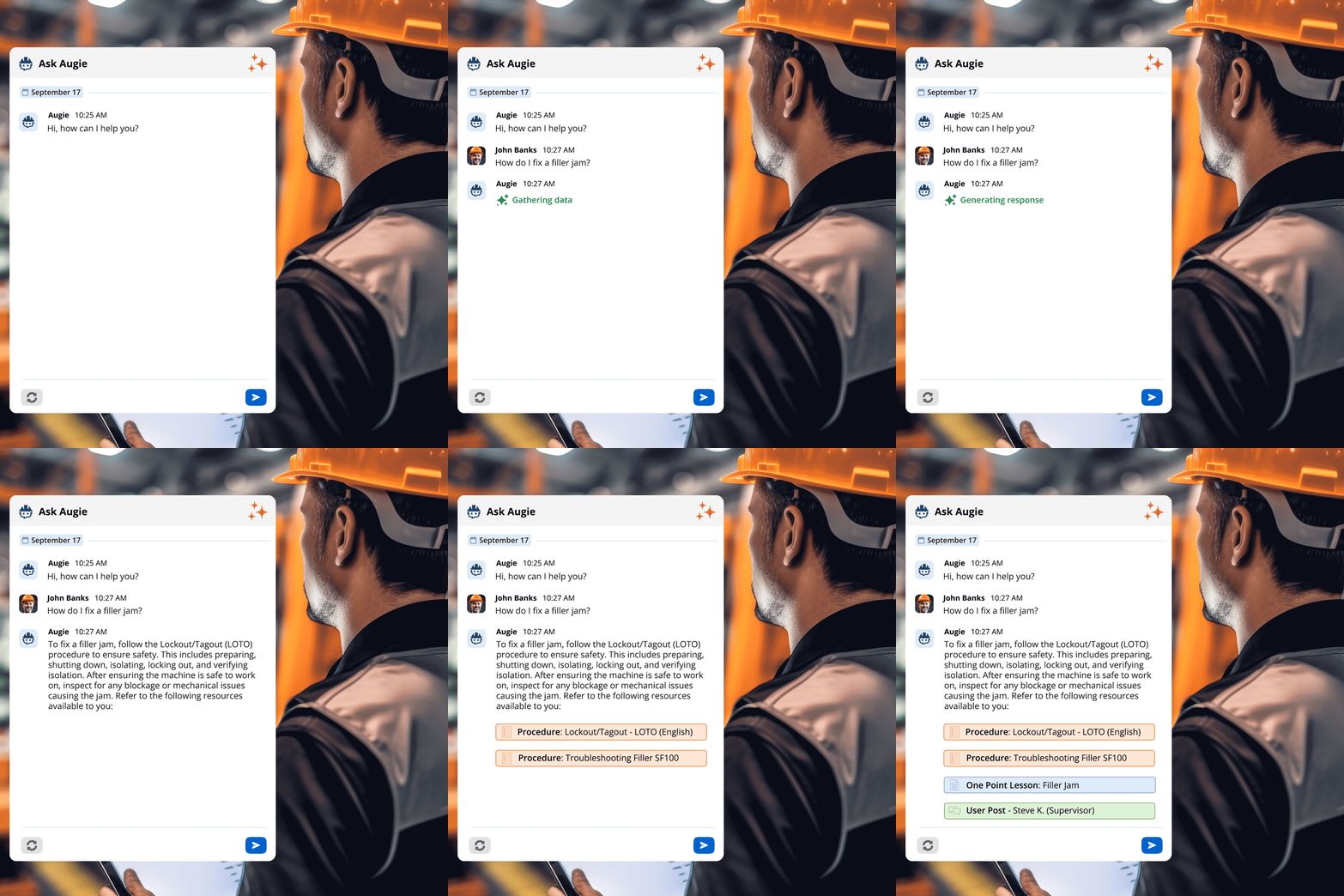
Troubleshooting is such a critical use case in manufacturing. With today’s skilled labor shortage, frontline workers are often times in situations where they don’t have the decades of tribal knowledge required to quickly troubleshoot and resolve issues on the shop floor. AI assistants can help these workers make decisions faster and reduce production downtime by providing instant access to summarized facts relevant to a job or tasks, this could come from procedures, troubleshooting guides, captured tribal knowledge, or OEM manuals.

generative ai in manufacturing use case - troubleshooting

2. Personalized Training & Support

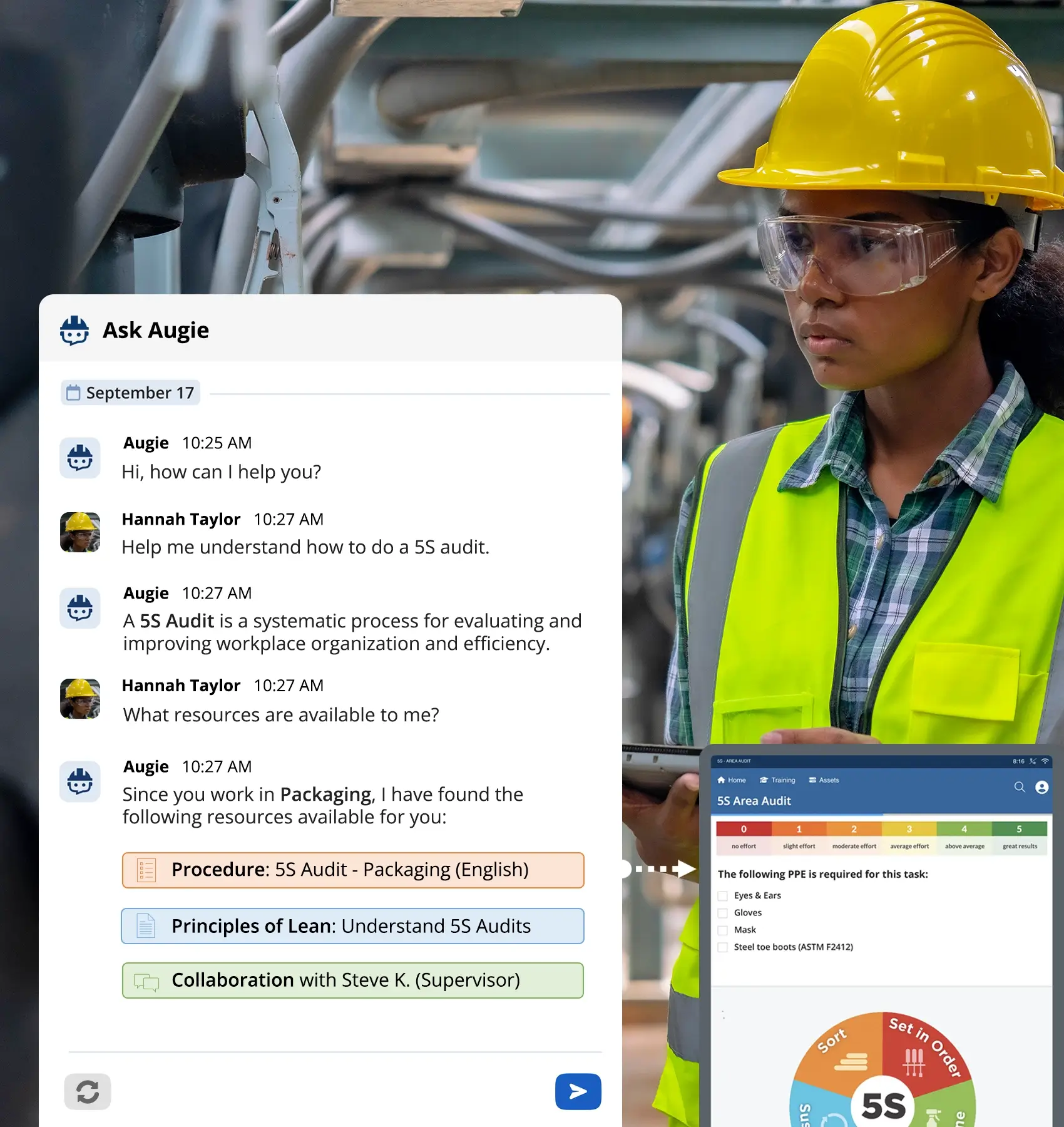
With GenAI assistants, manufacturers can instantly close skills and experience gaps with information personalized, context-aware to the individual worker. This could include: on the job training materials, one point lessons (OPLs), or peer/user generated content such as comments and conversations.

generative ai in manufacturing use case - training and work assistant

3. Leader Standard Work

With Generative AI assistants, operations leaders can assess and understand the effectiveness of standard work within their manufacturing environment, and identify where there are areas of risk or opportunities for improvement.

4. Converting Tribal Knowledge

One of the more pressing priorities that many manufacturers face is the task of capturing and converting tribal knowledge into digital corporate assets that can be shared across the organization. With connected worker technology that utilizes Generative AI, manufacturing companies can now summarize the exchange of tribal knowledge via collaboration and convert these to scalable, curated digital assets that can be shared instantly across your organization.

generative ai in manufacturing use case - convert tribal knowledge

5. Continuous Improvement

AI and GenAI assistants can help us identify areas for content improvement, and make those improvements, measure training effectiveness, and measure and improve workforce effectiveness.

generative ai in manufacturing use case - continuous improvement

6. Operational Analysis

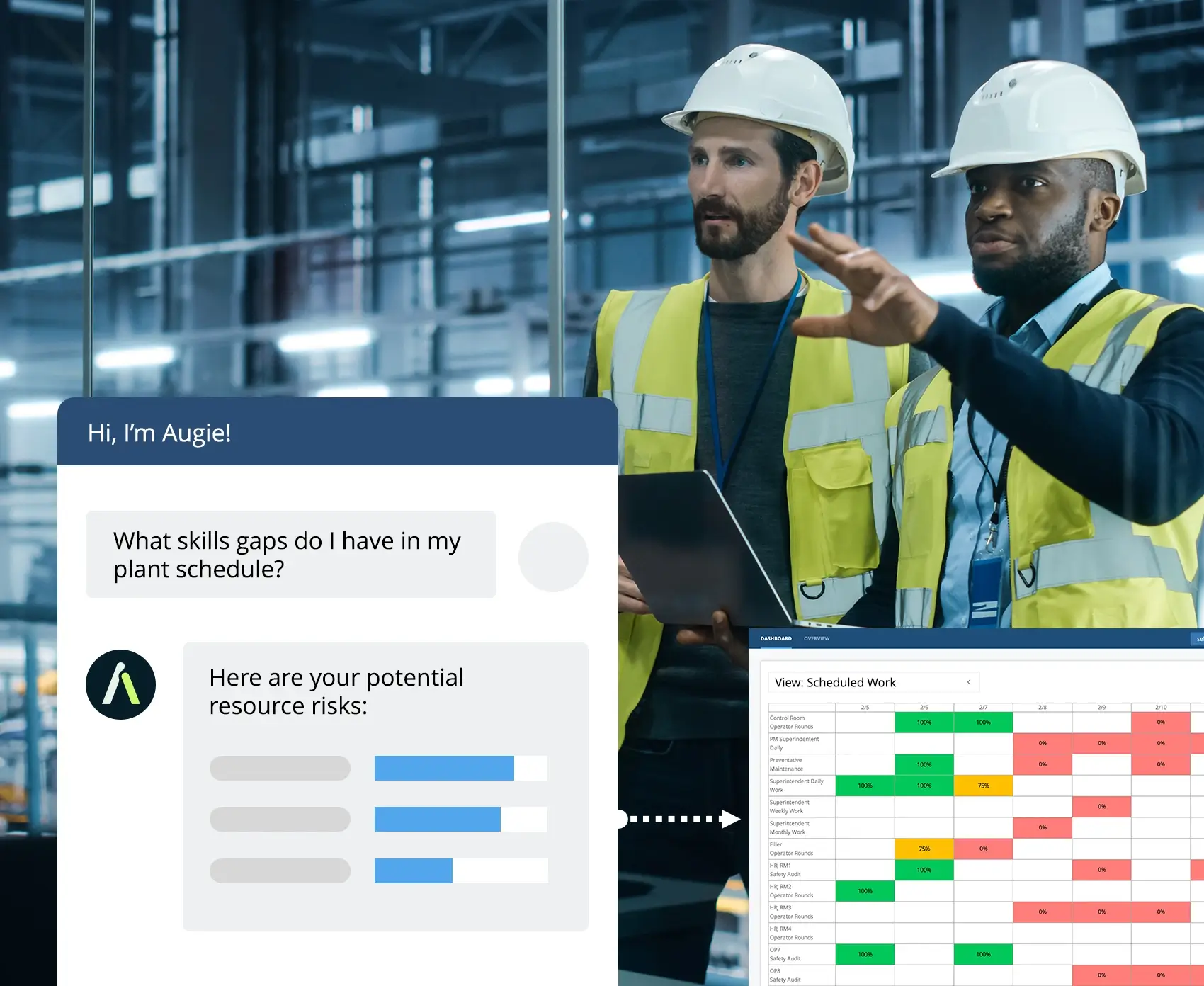
Generative AI assistants can also provide value when it comes to operational improvements. GenAI assistants can use employee attendance data to help shift managers or line leaders determine where the risks are, and potentially offset any resource issues before they become truly problematic. An organization’s skills matrix, presence data, and production schedules all can feed into a fit-for-purpose, pre-trained LLM – giving you information that manufacturing leaders need to keep their operations running.

generative ai in manufacturing use case - operational analysis

Generative AI and other AI-powered solutions are leveling up manufacturing operations, analyzing data to predict equipment maintenance needs before issues arise, allowing for proactive maintenance scheduling, and minimizing unplanned disruptions. With these tools manufacturers can empower frontline workers with improved collaboration and provide real-time assistance with contextual information, ensuring relevant and timely support during critical decision-making processes.

Overall, generative AI is transforming a wide array of manufacturing and industrial activities, connecting workers in ways that were previously thought impossible, and making frontline tasks and processes safer and more efficient for workers everywhere.

Future-proofing Manufacturing Operations with Augie™

Augie™, Augmentir’s generative AI assistant for frontline work, represents the next generation of generative AI solutions, purpose-built to help manufacturing companies future-proof their operations. By harnessing the power of artificial intelligence and machine learning, Augie enables manufacturers to optimize production processes, improve quality control, and reduce maintenance costs—all while adapting to rapidly changing market demands.

paperless shop floor with augie industrial generative ai suite

With Augie, manufacturers can analyze vast amounts of data from diverse sources, including machine data, sensor data, and historical data, to identify patterns and make predictive, data-driven decisions. This advanced platform delivers real-time insights into production processes, allowing manufacturers to quickly respond to shifts in demand, supply chain disruptions, or operational anomalies. Augie also features sophisticated algorithms for demand forecasting, inventory management, and supply chain optimization, helping companies minimize environmental impact and maximize operational efficiency.

Augie pulls in skill capabilities, workforce development information, and training data in addition to MES and ERP data. It offers contextual, proactive insights and automated workflows to optimize production and prevent bottlenecks, contributing to manufacturing efficiency, uptime, quality, and decision-making.

Additionally, Augie ties together operational data, training and workforce management data, engineering data, and knowledge/information from various disparate enterprise systems to empower frontline workers, streamline workflows, and increase manufacturing performance.

By integrating Augie into their operations, manufacturers can boost productivity, reduce unplanned downtime, and achieve significant cost savings. The platform’s AI-driven quality control ensures improved product quality, while its customer service automation capabilities enhance responsiveness and satisfaction. Ultimately, Augie empowers manufacturing companies to stay ahead of the competition, adapt to evolving industry trends, and secure a sustainable, competitive advantage in the global marketplace.

Augmentir is trusted by manufacturing leaders as a digital transformation partner delivering measurable results across operations. Schedule a live demo today to learn more.
 

See Augmentir in Action
Get in Touch for a Personalized Demo

Learn how to digitize your operations and build a paperless factory in this paperless manufacturing guide from Augmentir.

Manually managing and tracking production in manufacturing has become a thing of the past. That’s because manufacturers are adopting a new digital approach: paperless manufacturing.

Paperless manufacturing uses software to manage shop floor execution, digitize work instructions, execute workflows, automate record-keeping and scheduling, and communicate with shop floor employees. More recently, this approach also digitizes skills tracking and performance assessments for shop floor workers to help optimize workforce onboarding, training, and ongoing management. This technology is made up of cloud-based software, mobile and wearable technology, artificial intelligence, machine learning algorithms, and advanced analytics.

More recently, your journey to paperless manufacturing is being accelerated through the availability of generative AI assistants and supporting import tools that can streamline the conversion of existing content into interactive, mobile-ready content for your frontline teams.

paperless manufacturing and digital factory

Paperless manufacturing software uses interactive screens, dashboards, data collection, sensors, and reporting filters to show real-time insights into your factory operations. If you want to learn more about paperless manufacturing processes, explore this guide to learn about the following:

What is a paperless factory?

A paperless factory uses AI-powered software to manage production, keep track of records, and optimize jobs being executed on the shop floor. Paperless manufacturing is intended to replace written record-keeping as well as paper-based work instructions, checklists, and SOPs, and keep track of records digitally.

For example, in most manufacturing operations, everything from quality inspections to operator rounds and planned and autonomous maintenance is done on a regular basis to make sure factory equipment is operating properly and quality and safety standards are met. In most manufacturing plants, these activities are done manually with paper-based instructions, checklists, or forms.

Operators and shop floor workers in paperless factories use software to execute work procedures and see production tasks in ordered sequences, which enables them to implement tasks accordingly. Workers are able to view operating procedures, or digital work instructions, using mobile devices (wearables, tablets, etc.) in real-time.

benefits of digital work instructions

Furthermore, paperless manufacturing incorporates the digitization of shop floor training, skills tracking, certifications, and assessments.  This digital approach uses skills management software helps optimize HR-based processes that were previously managed via paper or spreadsheets, and includes the ability to:

  • Create, track, and manage employee skills
  • Instantly visualize the skills gaps in your team
  • Schedule or assign jobs based on worker skill level and proficiency
  • Close skill gaps with continuous learning
  • Make data-driven drive operational decisions

In addition to improving workforce development and operational efficiency, digital work instructions, training records, and inspection processes can help support ISO 45001 occupational health and safety management systems, improving consistency, traceability, and accountability across safety-related activities.

digital skills management in a paperless factory

What are the benefits of going paperless in manufacturing?

There are a number of reasons for factories to go paperless, from cost-effectiveness to increased productivity and sustainability. A paperless system can revolutionize production processes, workforce management, and business operations.

Here are the top benefits of going paperless:

  1. Accelerate employee onboarding: By digitizing onboarding and moving training into the flow of work, manufacturers can reduce new hire onboarding time by 82%.
  2. Increase productivity: Digitizing manufacturing operations means no more manual, paper-based data collection or record-keeping. Workers have more time to run their equipment, execute shop floor tasks, and find solutions to problems.
  3. Boost data accuracy: People are prone to making mistakes, but shop floor data capture and validation can help offset human error and improve accuracy.
  4. Improved workforce management: Digital skills tracking and AI-based workforce analytics can help optimize production operations and maximize worker output.
  5. Manage real-time operations: Human-machine interface systems eliminate the need for paper, files, and job tickets. This means that workers can analyze inventory and other data in real-time.
  6. Save money: Although going paperless means that the cost of paper is eliminated, the savings extend beyond that. With greater productivity, operations in real-time, and improved production optimization, costs can be reduced in many areas.

How do you go paperless in manufacturing?

Going paperless starts with digitizing activities across the factory floor to increase productivity, and extending that value through a digital connection between the shop floor and enterprise manufacturing systems. We lay out below the four basic steps for how to go paperless in manufacturing:

Step 1: Digitize your existing content with Gen AI and Connected Worker technology.

Paperless manufacturing starts with the use of modern, digital tools that can quickly and easily digitize and convert your existing paper-based content. Tools like Augmentir’s Augie™, a generative AI suite of technologies, helps you import and convert existing content regardless of format. Once converted, Connected Worker solutions that incorporate enhanced mobile capabilities and combine training and skills tracking with connected worker technology and on-the-job digital guidance can deliver significant additional value. A key requirement to start is to identify high-value use cases that can benefit from digitization, such as quality control or inspection procedures, lockout tagout procedures, safety reporting, layered process audits, or autonomous maintenance procedures.

Pro Tip

You can now import existing PDF, Word, or Excel documents (just like the PDF above) directly into Augmentir to create digital, interactive work procedures and checklists using Augie™, a Generative AI content creation tool from Augmentir. Learn more about Augie – your industrial Generative AI Assistant.

A

Step 2: Augment your workers with AI and Connected Worker technology.

AI-based connected worker solutions can help both digitize work instructions and deliver that guidance in a way that is personalized to the individual worker and their performance. AI Bots that leverage generative AI and GPT-like AI models can assist workers with language translation, feedback, on-demand answers, access to knowledge through natural language, and provide a comprehensive digital performance support tool.

As workers become more connected, companies have access to a rich source of job activity, execution, and tribal data, and with proper AI tools can gain insights into areas where the largest improvement opportunities exist.

Step 3: Set up IoT sensors for machine health monitoring.

The industrial Internet of Things (IoT) uses sensors to boost manufacturing processes. IoT sensors are connected through the web using wireless or 4G/5G networks to transmit data right from the shop floor. The use of machine health monitoring tools along with connected worker technology can provide a comprehensive shop floor solution.

Step 4: Connect your frontline to your enterprise.

Digitally connected frontline operations solutions not only enable industrial companies to digitize work instructions, checklists, and SOPs, but also allow them to create digital workflows and integrations that fully incorporate the frontline workers into the digital thread of their business.

The digital thread represents a connected data flow across a manufacturing enterprise – including people, systems, and machines. By incorporating the activities and data from these previously disconnected workers, business processes are accelerated, and this new source of data provides newfound opportunities for innovation and improvement.


Augmentir provides a unique Connected Worker solution that uses AI to help manufacturing companies intelligently onboard, train, guide, and support frontline workers so each worker can contribute at their individual best, helping achieve production goals in today’s era of workforce disruption.

Our solution is a SaaS-based suite of software tools that helps customers digitize and optimize all frontline processes including Autonomous and Preventive Maintenance, Quality, Safety, and Assembly.

paperless factory


Transform how your company runs its frontline operations. Request a live demo today!


See Augmentir in Action
Get in Touch for a Personalized Demo

Frequently Asked Questions (FAQ)

  • What is paperless manufacturing?

    Paperless manufacturing is the use of digital technologies to replace paper-based work instructions, checklists, SOPs, quality records, and production documentation on the shop floor. By digitizing manufacturing processes, companies can improve operational efficiency, reduce errors, increase traceability, and gain real-time visibility into production performance. Modern paperless manufacturing solutions, such as Augmentir's AI-native Connected Worker platform, go beyond simple document digitization by providing intelligent digital workflows, workforce insights, and continuous process optimization.

  • What are the benefits of paperless manufacturing?

    Paperless manufacturing helps reduce paperwork, improve compliance, increase traceability, and streamline operations. With Augmentir, manufacturers also gain workforce insights and AI-driven recommendations to continuously improve performance.

  • How does AI help manufacturers go paperless?

    AI accelerates paperless manufacturing by digitizing processes, optimizing workflows, and providing real-time worker support. Augmentir uses AI to deliver personalized guidance, automate data collection, and help manufacturers achieve faster results from their digital transformation initiatives.

  • What challenges can paperless manufacturing help solve?

    Paperless manufacturing helps solve common challenges such as outdated work instructions, manual data entry, production errors, and limited shop floor visibility. Augmentir's AI-native Connected Worker platform enables manufacturers to digitize workflows, standardize processes, and improve workforce performance across operations.

Learn how Hunter Industries is transforming workforce training and operational performance using Augmentir’s AI-powered Connected Worker platform to reduce scrap, improve changeovers, and close skills gaps.

Manufacturers today face a familiar but increasingly urgent challenge: how to train, upskill, and support a less-skilled, less-experienced frontline workforce while maintaining productivity, quality, and operational efficiency. As product complexity increases and experienced workers retire, traditional training methods simply can’t keep pace.

hunter industries transforms training with ai

A recent Assembly Magazine feature highlights how Hunter Industries, a global manufacturer of irrigation and outdoor lighting products, is tackling this challenge head-on using Connected Worker technology powered by Augmentir. The results demonstrate how AI-driven digital tools can transform training from a static process into a measurable, performance-driven strategy.

The Challenge: Complex Operations and Workforce Variability

Hunter Industries operates advanced manufacturing processes, including injection molding and extrusion, where changeovers and setup tasks require precision and expertise. Like many manufacturers, Hunter faced variability in skill levels across shifts and facilities. Tribal knowledge, paper-based instructions, and manual tracking made it difficult to standardize execution and measure training effectiveness.

As operations scale and workforce demographics shift, these challenges become more pronounced:

  • Skills gaps between new and experienced workers
  • Inconsistent execution of standard operating procedures
  • Limited visibility into training effectiveness
  • Downtime and scrap caused by human error
  • Difficulty scaling best practices across teams

Hunter recognized that improving frontline performance required more than digitizing documents—it required a connected, intelligent system that could adapt to workers in real time.

The Solution: AI-Native Connected Worker Platform

By implementing Augmentir’s Connected Worker platform, Hunter Industries digitized and transformed how work is delivered, supported, and optimized on the shop floor.

augmentir ai-native connected worker platform

Augmentir combines:

  • Digital work instructions to standardize processes
  • AI-driven insights to personalize guidance
  • Skills tracking and competency management
  • Mobile-first tools for frontline accessibility
  • Remote collaboration capabilities
  • Generative AI tools to accelerate content creation and knowledge capture

Instead of relying on static PDFs or binders, workers now receive contextual, step-by-step digital guidance tailored to their skill level. The system continuously analyzes performance data to identify where workers may need additional support, helping reduce errors before they impact production.

This shift from reactive troubleshooting to proactive workforce optimization represents a significant evolution in how manufacturers manage training and performance.

Improving Training Effectiveness with Real-Time Insight

One of the most impactful outcomes of Hunter’s deployment is improved visibility into training effectiveness.

Traditionally, manufacturers measure training completion—not training impact. Workers attend sessions, complete certifications, and move on. But do those sessions actually translate to better performance on the floor?

With Augmentir, Hunter can now connect training data directly to operational outcomes. Supervisors gain insight into:

  • How quickly workers complete tasks
  • Where errors occur most frequently
  • Which procedures require additional coaching
  • Whether recently trained employees are performing at expected levels

This real-time feedback loop enables continuous improvement. As noted in the Assembly Magazine article, Hunter’s operations training leadership can now evaluate whether training efforts are delivering measurable results.

“The use of Augmentir within our manufacturing operation highlights our commitment to our people and innovation in the workplace,” says Yunior Murillo, operations training manager at Hunter Industries. “Augmentir’s platform allows our technicians to perform at their best while improving efficiency across our manufacturing departments. Additionally, the operational insights provided by Augmentir’s AI allow us to focus our training efforts on individuals that need them most and intelligently guide our technicians in their day-to-day activities.”

By linking workforce development directly to performance metrics, Hunter has transformed training from a cost center into a strategic lever for operational excellence.

Reducing Scrap, Downtime, and Changeover Time

Beyond training visibility, the platform has driven tangible operational gains.

Standardized digital workflows reduce process variation, ensuring that critical steps are followed consistently. Built-in validation and guidance minimize mistakes that previously led to scrap or rework.

In high-impact areas like injection molding changeovers, this consistency is critical. Even small improvements in setup execution can significantly reduce downtime and improve overall equipment effectiveness (OEE).

Since implementing connected worker technology, Hunter has seen:

  • Reduced scrap rates
  • Decreased unplanned downtime
  • Faster and more consistent changeovers
  • Improved execution across shifts

These improvements demonstrate that workforce enablement directly influences production performance.

Capturing and Scaling Institutional Knowledge

Another key advantage of connected worker platforms is knowledge retention.

Manufacturers across the industry are facing a wave of retirements among experienced workers. When that expertise walks out the door, companies risk losing years of operational know-how.

Augmentir enables Hunter to digitize tribal knowledge and embed it directly into workflows. Experienced operators can contribute insights, tips, and best practices that become part of standardized digital instructions.

Generative AI further accelerates this process by helping convert legacy documents and subject-matter expertise into structured, accessible guidance. This ensures knowledge is preserved and easily shared across facilities and teams.

Expanding Beyond Manufacturing

The success of Hunter’s initial deployment is driving expansion into additional operational areas, including maintenance teams.

Connected Worker technology isn’t limited to production lines. Maintenance, quality assurance, safety, and field service teams all benefit from real-time guidance, skills tracking, and AI-driven performance insights.

By extending the platform across functions, Hunter is building a more agile, data-driven workforce ecosystem.

A Blueprint for Modern Manufacturing

Hunter Industries’ success story reflects a broader shift occurring across industrial organizations. Manufacturers are recognizing that operational excellence starts with workforce excellence.

Connected Worker platforms powered by AI allow companies to:

  • Close skills gaps faster
  • Standardize work across distributed teams
  • Improve quality and productivity
  • Capture and retain critical knowledge
  • Continuously optimize frontline performance

Rather than treating training as a one-time event, organizations can create a living, evolving system that adapts to workers and operations in real time.

The Future of Workforce Enablement

As manufacturing becomes more complex and competitive, companies that invest in intelligent workforce tools will be better positioned to scale, innovate, and outperform.

Hunter Industries’ journey illustrates what’s possible when AI, digital workflows, and skills intelligence come together in a unified platform.

At Augmentir, we’re proud to partner with forward-thinking manufacturers who are redefining how frontline work gets done.


See Augmentir in Action
Get in Touch for a Personalized Demo

FAQs About AI for Manufacturing Workforce Training

  • How is Hunter Industries using Connected Worker technology to improve workforce training?

    Hunter Industries is using Augmentir’s AI-powered Connected Worker platform to digitize work instructions, personalize training, and provide real-time guidance to frontline workers. By replacing paper-based processes with intelligent digital workflows, Hunter can standardize execution, close skills gaps, and directly connect training efforts to measurable operational performance.

  • What are the benefits of AI-powered Connected Worker platforms in manufacturing?

    AI-powered Connected Worker platforms, like Augmentir, help manufacturers minimize downtime, improve changeover consistency, and accelerate employee onboarding. These systems provide digital work instructions, skills tracking, and performance analytics that allow companies to continuously optimize frontline workforce performance while improving overall equipment effectiveness (OEE).

  • How can manufacturers measure the effectiveness of workforce training?

    With Augmentir, manufacturers can link training data directly to operational outcomes. Instead of only tracking training completion, organizations gain visibility into task completion times, error rates, procedural adherence, and post-training performance metrics. This real-time feedback loop allows companies to continuously improve training programs based on measurable results.

  • How does Connected Worker technology help capture and retain institutional knowledge?

    Connected Worker platforms like Augmentir allow experienced operators to embed best practices, troubleshooting tips, and tribal knowledge directly into digital workflows. Generative AI tools can convert legacy documents and subject-matter expertise into structured digital work instructions, ensuring critical knowledge is preserved and scalable across shifts, facilities, and teams.