Posts

Say hello to the newest addition to the Augmentir platform, Augie – the GenAI powered digital assistant for manufacturing.

Say hello to the future of work in manufacturing with the latest addition to Augmentir’s suite of connected worker tools, Augie™.
augie generative ai assistant for manufacturing

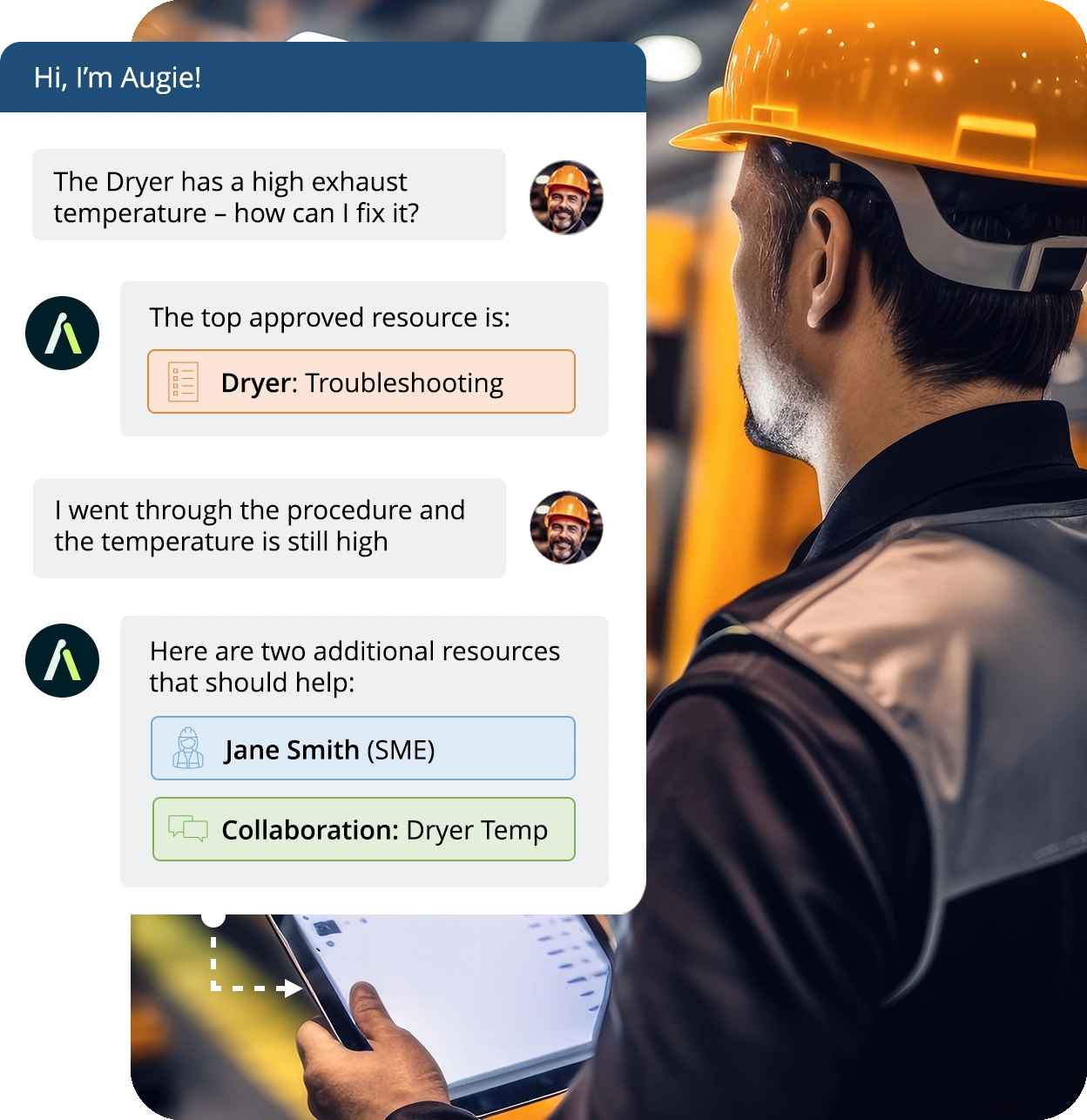
Augie is a digital assistant for frontline operations that utilizes Generative AI and proprietary fit-for-purpose, pre-trained Large Language Models (LLMs) to enhance operational efficiency, problem-solving, and decision-making for today’s less experienced frontline industrial workers. It leverages enterprise-wide data, provides instant access to relevant information, closes skills gaps with personalized support, offers insights into standard work and skills inventory, and identifies opportunities for continuous improvement.

Augie is a result of our dedication to empowering frontline workers, leveraging AI to support manufacturing operations, and giving manufacturing workers better tools to do their jobs safely and more efficiently.

Continue reading below to learn more about how Augie works and how it can benefit your frontline workforce and manufacturing operations:

How our GenAI Powered Assistant Works

Generative AI-powered smart manufacturing assistants are designed to provide secure, role-based, personalized assistance to frontline workers, engineers, and managers in various industries, including manufacturing.

They work by leveraging artificial intelligence and integrations across different software systems, providing guidance and assistance in various tasks to enhance productivity and performance. This includes providing data insights, recommendations on actions to improve performance, and the ability to create analyses and dashboards with a natural language-based assistant.

A majority of smart manufacturing assistants only draw their information from manufacturing execution systems (MES), without tying in other important systems necessary for frontline manufacturing success.

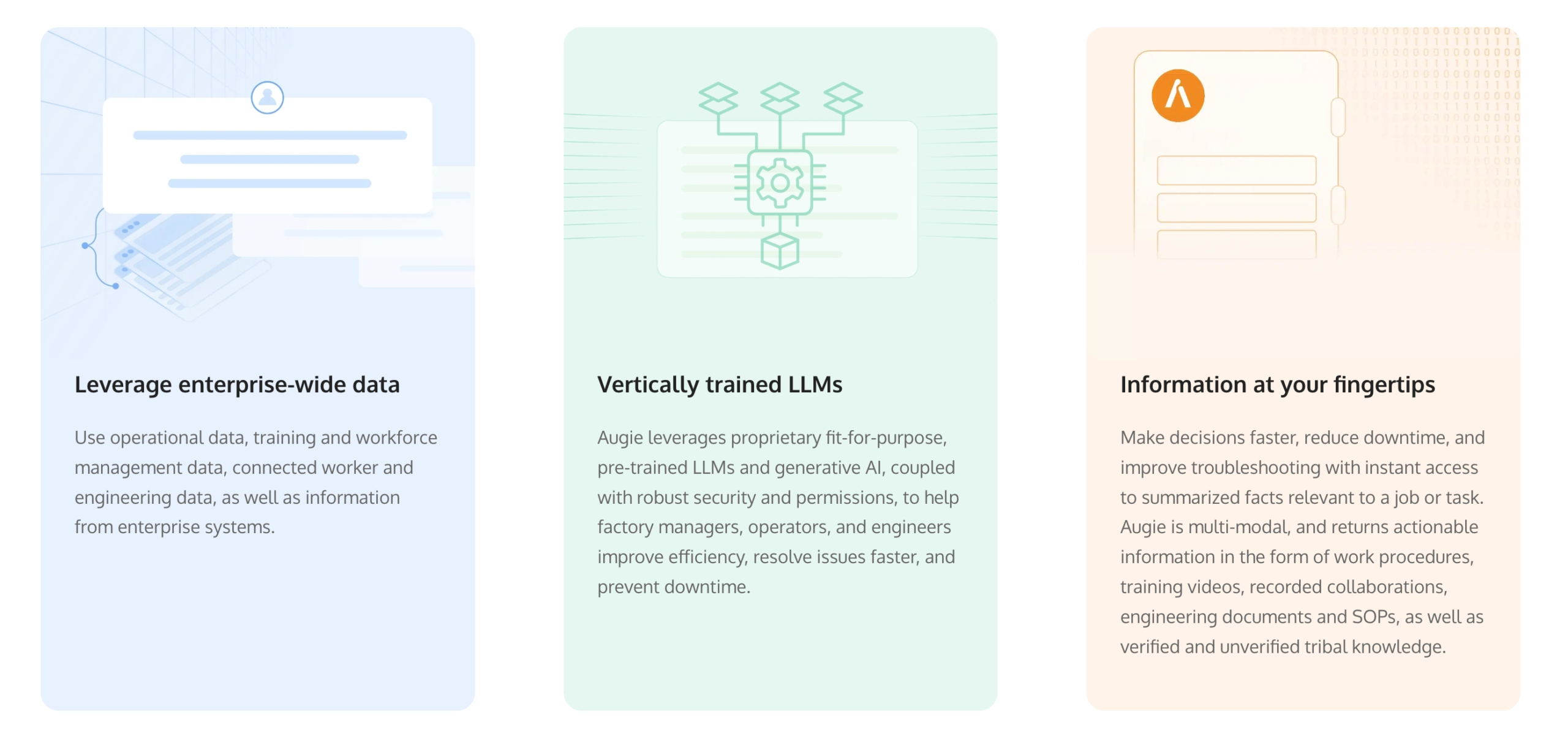
Augie, however, is different. It leverages enterprise-wide data tying in information from a wide range of platforms including operational data, training and workforce management data, connected worker and engineering data, as well as information from enterprise systems.
gen ai industrial manufacturing

How Augie Benefits Your Frontline Workforce

Augie is unique among other smart manufacturing assistants. It leverages proprietary fit-for-purpose, pre-trained LLMs and generative AI, coupled with robust security and permissions, to help factory managers, operators, and engineers improve efficiency, resolve issues faster, and prevent downtime.

With information readily available via Augie, frontline workers can make decisions faster, reduce downtime, and improve troubleshooting with instant access to summarized facts relevant to a job or task. Additionally, Augie is multi-modal, meaning it can return actionable information in the form of work procedures, training videos, recorded collaborations, engineering documents and SOPs, as well as tribal knowledge.

Through Augie, manufacturers can instantly:

  • Close skills and experience gaps with personalized support
  • Gain insights into Leader Standard Work
  • Gain new insights into skills inventories
  • Convert Tribal Knowledge into Digital Corporate Assets
  • Identify opportunities for continuous improvement
  • Forecast potential operational issues

augie gen ai industrial assistant troubleshooting

With Augie by your side, you can streamline manufacturing operations, optimize performance, empower your frontline workforces, and stay ahead in today’s rapidly evolving and competitive landscape.

Webinar

6 Ways Manufacturers Can Use GenAI Today

On-Demand


Improve Operational Efficiency with Augie and Augmentir

The digitization of frontline processes has become a must-have to keep up with the velocity of change – but not just digitization … smart digitization. Recently, Deloitte found that 86% of manufacturing executives believe smart factory solutions will be the primary drivers of competitiveness in the next five years. Leveraging smart, AI-driven connected worker solutions that allow industrial organizations to best support their frontline workforces and optimize processes to make them safer and more efficient is critical to overall enterprise success.

At Augmentir, we have been met with continued success in our efforts to transform manufacturing operations. Our patented Smart AI foundation helps manufacturing organizations close the loop between training and work execution, delivering the data and in-line insights necessary to continuously improve operational excellence day-over-day, year-over-year. Augmentir is the world’s leading connected worker solution, combining smart connected worker and GenAI technologies to drive continuous improvement and enhance performance management initiatives in manufacturing.

The addition of Augie to our platform is a game-changer for factory floor and other frontline workers, allowing for quick reference troubleshooting and useful, contextualized information to be delivered at the moment of need. Furthermore, with Augie, less experienced workers are provided with additional support and individualized guidance based on the job or task needs.

With patented AI-driven insights that digitize and optimize manufacturing workflows, training and development, workforce allocation, and operational excellence, Augmentir is trusted by manufacturing leaders as a digital transformation partner delivering measurable results across operations. Schedule a live demo today to learn more.

 

See Augmentir in Action
Get in Touch for a Personalized Demo

Explore how to digitize Operator Driven Reliability (ODR) programs and processes with an AI-powered Connected Worker Platform for improved efficiency, accuracy, and better results.

Operator Driven Reliability programs, a.k.a. ODR programs, empower frontline operators to take an active role in equipment maintenance and reliability. It recognizes that due to operators’ constant contact with equipment, they are the best situated to detect any potential issues and take preventative steps before any damage is caused.

operator driven reliability odr program

While ODR programs are forward-thinking and apply the same lean manufacturing principles found in autonomous maintenance, in many cases they still have room for improvement. For example, in too many instances manufacturing ODR programs are still completed using outdated pen-and-paper procedures. This causes tasks like plant operator rounds to take far longer than they would if reports, checklists, and work instructions were digitized and delivered via a smart connected worker platform.

Then not only would equipment maintenance and reliability be streamlined and faster, but there would also be a digital footprint available for operational activities like process improvement, data analysis, audit reporting, and more. Read below to discover the benefits of a digital ODR program, including best practices, real-world examples, and insights into the future of ODR and workforce dynamics in manufacturing.

The Benefits of a Digital ODR Program

Digital Operator Driven Reliability (ODR) programs offer significant advantages over traditional pen-and-paper methods. AI-driven connected worker platforms play a crucial role offering integrations with existing systems like ERP, CMMS, MES, and QMS, supporting ODR training with guided support and tutorials, encouraging continuous improvement through performance tracking and digital skills assessments, and even facilitating enhanced industrial collaboration with real-time communication and cross-shift knowledge-sharing.

Further benefits of a digital ODR program include:

  • Enhanced Data Collection and Analysis: Connected worker platforms allow for real-time data capture from operators on the condition of equipment and AI-driven analytics are able to identify trends, offer actionable insights, and predict potential issues.
  • Digital Workflow Optimization: Digital work instructions and checklists optimize and streamline tasks and procedures, standardizing ODR activities, and automating task assignments and reminders for an increase in efficiency and accuracy.
  • AI-Driven Insights and Decision Making: AI-powered tools coupled with data collected through connected worker platforms offer visibility into the frontline workforce like never before, enabling better workforce intelligence, informed decisions about equipment maintenance and reliability, predictive maintenance based on historical data, and more.
  • Digital Documentation and Compliance: Digital forms and checklists offer automatic logging of ODR activities and equipment interventions, easy access to up-to-date standard operating procedures (SOPs), and digital audit trails for regulatory compliance. Overall, digitizing the documentation processes for ODR programs ensures better accountability and regulatory adherence.
Pro Tip

With AI-driven connected worker technology, manufacturers can effectively digitize their ODR programs, significantly enhancing equipment reliability, reducing downtime, and improving overall operational efficiency in manufacturing environments.

A

Digital Operator Driven Reliability – Best Practices and Examples

Implementing a digital ODR program helps manufacturers empower frontline operators, engaging workers with an active role in equipment maintenance and reliability, leading to reduced downtime, improved productivity, and better overall equipment performance.

Below are some best practices and industry examples of digital ODR programs in real-world situations.

Best practices for digital ODR programs:

  • Implement robust data collection and analysis systems
  • Provide mobile accessibility for operators
  • Use digital work instructions and checklists
  • Enable real-time communication and collaboration
  • Integrate with existing systems (ERP, EAM, CMMS, MES)
  • Leverage AI-powered analytics and predictive maintenance
  • Offer digital training, knowledge management, and skill development tools

digital operator driven reliability with autonomous maintenance checklist cil


Autonomous Maintenance Checklist
Free Template
Standardize your autonomous maintenance routines with our free Autonomous Maintenance Checklist Template. Download our PDF template to get started, and learn more about digitizing your autonomous maintenance process with Augmentir.

Industry examples of digital ODR in action:

  • Chemical Manufacturing Plants – Refinery and chemical operators conduct regular valve inspections and adjustments, using digital operator round planning tools to schedule routines and automate notifications.
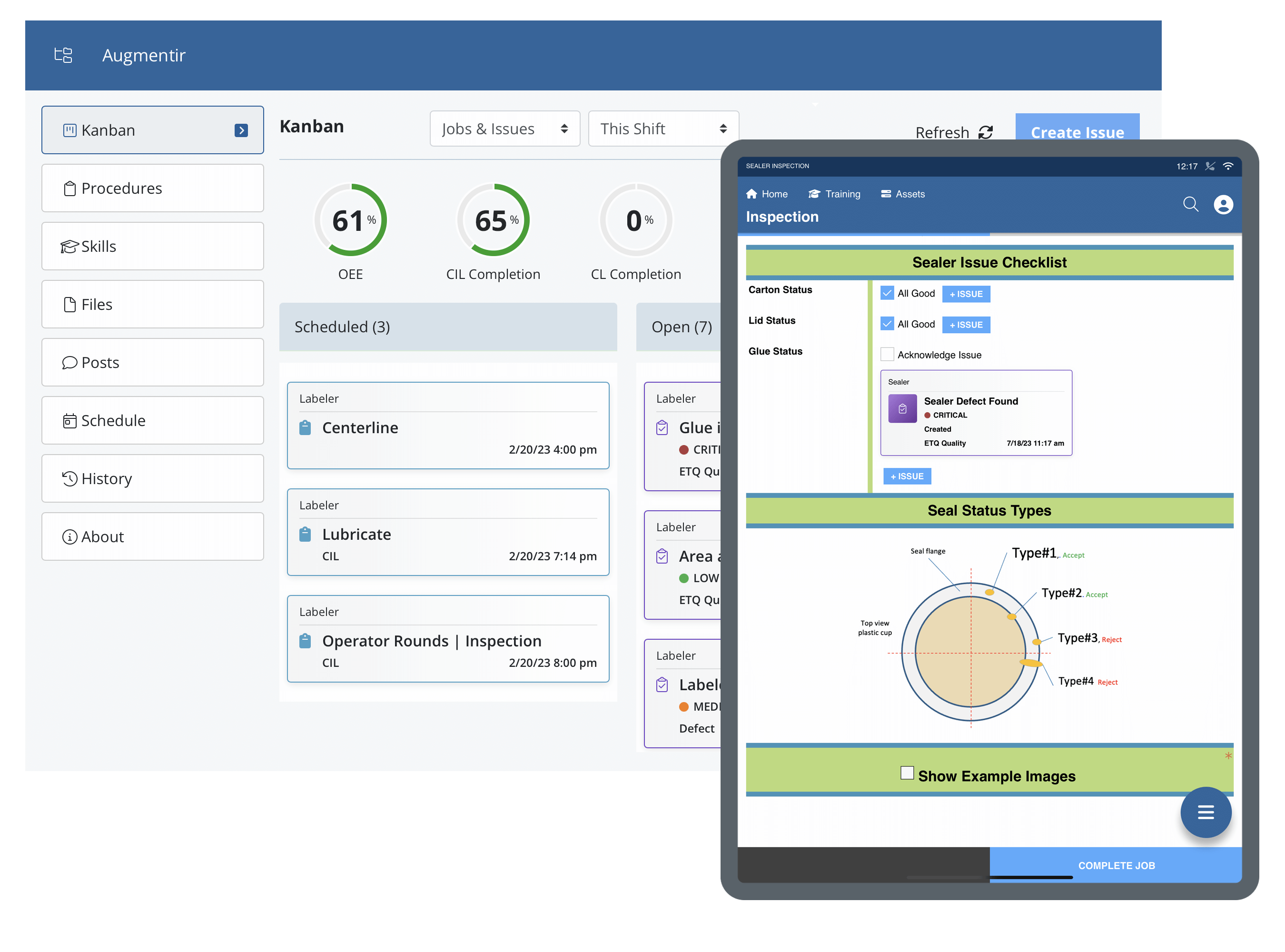
  • Food and Beverage Production – Packaging line operators inspecting sealing mechanisms for proper operation can log equipment condition data into digital systems, clean and lubricate equipment fittings, and provide observations to maintenance teams supported by digital media assets like pictures and videos.
  • Pulp and Paper Mills – Operators conduct regular visual inspections of the Fourdrinier wire (the mesh screen that forms the paper sheet) for signs of wear, damage, or misalignment and use, using digital checklists to streamline and standardize inspection processes and document any minor repairs or adjustments made during their shift.

Through digital ODR practices, manufacturing frontline operators can help detect early signs of problems, maintain optimal machine performance, and contribute to reduced downtime and improved product quality.

The Future of ODR Programs and the Manufacturing Workforce

Manufacturing currently faces a series of crises, ranging from a severe shortage of skilled workers to an insurmountable increase in customer demand – industrial organizations are working hard to keep their facilities producing and their heads above water while still maintaining industry standards.

Many manufacturers continue to experience high frontline worker disengagement and attrition rates, a recent study by The Manufacturing Institute and PwC stated that more than one-third of manufacturers reported high turnover rates, while only 58% carried out proper frontline employee engagement initiatives.

Using AI-driven connected worker platforms to digitize programs like ODR that incorporate frontline operators and engage them in meaningful tasks using their expertise is the best path forward for manufacturing organizations regardless of their industry focus. These platforms allow for quick adoption of new processes and adaptation of current processes based on market needs/demands. They support frontline workers like never before, giving them access to tools like generative AI assistants and expert knowledge and guidance at a moment’s notice.

The future of manufacturing lies in the hands of the next generations of workers and it’s the responsibility of industrial organizations to equip them with the right tools to keep them safe and ensure they can carry out their duties effectively.

Interested in learning more?

To learn more about digitizing Operator Driven Reliability (ODR) and how to transform your frontline manufacturing activities with our AI-powered connected worker platform – schedule a demo with one of our product experts.


See Augmentir in Action
Get in Touch for a Personalized Demo

Learn why implementing quality in manufacturing is crucial for product creation, risk management, and more.

Quality in manufacturing depends on effective quality control (QC), a set of procedures used to measure and test products for compliance. The main function of QC is to ensure that all goods are free of defects, meet client expectations, and adhere to industry best practices.

Products have the potential either to increase customer satisfaction or to create legal and financial complications if deficiencies are found. In the current era where consumers are increasingly conscious of product safety and quality, it is paramount that manufacturers are doing all they can to ensure products meet all quality standards. Quality goods can affect a business’s success and advance its credibility to the public. They can also lead to fewer production costs and increases in profit.

With emerging digital technologies such as AI and connected worker solutions, manufacturers can improve quality control, decrease defects, and more. AI-powered connected worker platforms allow manufacturers to standardize quality control, resulting in fewer errors, reduced defects, and streamlined quality processes that are faster and more accurate.

Explore the following content to get a better idea of why quality is crucial and ways to improve it:

quality in manufacturing

Defining quality on industrial frontlines

Quality in the manufacturing realm is all about following procedures to meet product and compliance specifications. Once the standard for quality is set, the rest is about meeting product expectations through standardized procedures.

Quality in production can be broken down into three factors: design, quality control, and quality management.

Design: A product can be significantly improved by design. For example, goods should be made with the right materials to ensure functionality and a longer shelf life.

Quality control: The level of quality is improved when waste and product defects are reduced during the QC process.

Quality management: Completing production processes that follow regulatory standards is at the core of quality management.

Pro Tip

By digitizing quality control and quality assurance procedures, manufacturers can ensure a standardized approach towards inspections and quality data collection and improve overall compliance with quality standards.

Quality affects every facet of manufacturing

Production quality is more than just distributing products that people will trust and buy. Though that may be a key factor, quality affects every aspect of manufacturing, from workplace risk management to machine upkeep and inspection.

Quality affects many aspects of production. Examples include the following:

  • Risk management ensures products are safe to use by customers and follow safety protocols. Smart, connected worker solutions are able to improve risk management through standardization and optimization of quality checks.
  • Regulatory compliance is a key component of quality and can help prevent delays in production and fines. With digitized processes in place, manufacturers are able to ensure workers have access to the correct procedures and that tasks are performed in a standardized manner to avoid errors and promote improved compliance.
  • Waste reduction is possible when material resources are conserved and used accordingly in production processes. AI-powered analytics in conjunction with smart, connected worker solutions allow for improved, streamlined processes that are able to reduce waste and improve yield through optimized production.
  • Errors and defects are reduced when procedures are standardized using efficient QC processes to troubleshoot problems. With connected worker solutions and digitized quality control processes such as layered process audits, mistakes can be identified as they happen, protecting the production process.
  • Machine upkeep and inspection can be strengthened when industry best practices are implemented. Digitizing machine inspection standards and upkeep notifications and connecting frontline workers via smart, connected worker platforms gives operators the ability to practice preventative and autonomous maintenance and improves overall equipment effectiveness (OEE) and reduces unplanned downtime.

How to Improve Quality in Manufacturing

Quality improvement in manufacturing is vital to ensure a business is performing at its best. Here are some ways to boost quality with real-world examples:

Step 1: Practice lean manufacturing.

Lean manufacturing is the practice of reducing waste in production processes. Waste is defined as anything that does not bring value to the customer. This method requires an examination of your current practices to see which work and which leads to greater waste. The rise of digital technology is making it easier and more practical for manufacturers to connect and digitize their operations and drive further improvements and enhance lean manufacturing strategies.

Real-world application: An injection molding machine was found clogged with mold and was producing products with damaged seams. After resolving this issue by cleaning the machine, the company had less wasted plastic and fewer product malfunctions. With digitized notifications, real-time collaboration, and smart, connected worker solutions, situations like the above can be solved quickly and with reduced impact on production.

standardize and digitize quality assurance procedures

Step 2: Implement total productive maintenance.

Total Productive Maintenance (TPM) focuses on the idea that every employee should do their part to maximize equipment effectiveness. The objective is to create a culture where every worker adjusts and maintains machinery over the course of each shift. Through a combination of digital work instructions and real-time collaboration tools, manufacturers can better implement and improve TPM initiatives. This allows operators to independently complete maintenance tasks at peak performance and improve overall equipment effectiveness (OEE).

Real-world application: Both operators and maintenance staff can perform routine maintenance to check for errors or deficiencies. By implementing connected worker solutions organizations can improve the quality, transparency, and efficiency of maintenance and repair procedures and minimize machine downtime and reduce overall maintenance costs and impact.

Step 3: Embrace statistical process control.

This method involves detecting production issues by studying data anomalies to get rid of root causes before they ruin entire assembly lines. With connected frontline worker solutions that are integrated with enterprise quality management systems, organizations can improve statistical process control by optimizing data collection and inspection procedures through their frontline workforce. This essentially transforms frontline workers into quality sensors that further enhance and empower overall quality efforts.

Real-world application: Tracking the number of defective goods on each production line can help with identifying the root of any issue and taking corrective action. Smart, connected worker technology improves tracking ability, optimizes data collection, and identifies issues faster, reducing the risk of product recalls, and preserving consumer trust.

Digitizing Quality in Manufacturing with Augmentir

Companies are adopting innovative new technologies, processes, and methods to improve quality, productivity, and collaboration efforts across the industrial arena. Guaranteeing quality in manufacturing boils down to standardizing processes. Every procedure should contribute to product value and be carried out in a unified way. Implementing smart, connected solutions and coupling them with AI-powered analytics opens new paths for manufacturers to step forward and improve how they approach quality in the production process and beyond.

By digitizing analog paper practices, you enable better quality control and standardization of inspection procedures which, in turn, strengthens your overall manufacturing operations. Augmentir can help with the digitization and transformation process. We understand the need for effective quality control, and we have demonstrated success in helping manufacturers improve quality on the production floor.

Check out our quality use cases, and request a live demo today to learn for yourself why companies are choosing Augmentir to help standardize and digitize quality control procedures.


See Augmentir in Action
Get in Touch for a Personalized Demo


Duracell, the world’s #1 consumer battery manufacturer, is now part of Augmentir’s Customer Advisory Board, joining Colgate-Palmolive, Sargento, Graphic Packaging, and Hunter Industries.

When it comes to high-performance batteries, there’s one brand that everyone knows and loves – Duracell.

We are excited to announce that the world’s #1 consumer battery manufacturer is now part of Augmentir’s Customer Advisory Board. Duracell’s collaboration and expertise are a major leap forward in our mission to transform industrial work and empower frontline workers worldwide with AI-driven connected worker solutions.

augmentir welcomes duracell to customer advisory board

Duracell’s commitment to innovation and excellence aligns perfectly with our vision of leveraging connected worker and AI technology to augment and transform the industrial workforce. With Duracell on board, we are set to supercharge our innovation and advance our impact on the connected worker market and manufacturing arena.

Our Customer Advisory Board was announced last September and consists of leading manufacturers from a wide range of industries who understand the importance of today’s unique industrial workforce challenges. Duracell joins other leading manufacturers including:

  • Colgate-Palmolive
  • Graphic Packaging International, LLC
  • Hitachi Energy
  • Hunter Industries
  • Sargento

This powerhouse lineup underscores our commitment to addressing the evolving needs of the industrial workforce. With Duracell and our other board members actively helping guide and shape the development of our AI-powered connected worker platform, we’re making sure it meets the industry’s needs head-on.

Collaborating for AI-Driven Connected Worker Innovation

Our AI-driven connected worker platform stands out by providing frontline workers with unparalleled personalized, real-time assistance and insights – enhancing productivity, skills management, workforce development, and operational efficiency. Unlike other platforms, ours was purpose-built to leverage advanced AI to continuously learn and adapt to each worker’s unique needs, offering tailored support and proactive guidance.

Recently, we were named the market-leading solution in the connected frontline workforce application space by LNS Research, highlighting us as the industry’s Most Complete Product. Augmentir was also named 2023’s “Connected Worker Company of the Year” by Frost & Sullivan, as well as named a “Cool Vendor” for Manufacturing Operations by Gartner.

“We are honored to welcome Duracell to our Customer Advisory Board,” said Russ Fadel, CEO of Augmentir. “Their expertise and forward-thinking approach will provide invaluable insights, helping us to continue delivering cutting-edge solutions that drive operational efficiency and workforce productivity.”

Duracell’s participation on the board involves sharing industry best practices gained from their extensive experience in manufacturing and supply chain management. They will provide critical feedback on new features and enhancements, ensuring that our AI-powered platform meets the practical needs of the industrial workforce. Additionally, Duracell will collaborate with us and other board members to develop innovative strategies to address common challenges in the industrial sector, such as improving safety, increasing productivity, and reducing downtime.

This partnership underscores our shared dedication to empowering the workforce of the future by harnessing the power of advanced technologies. With the input of our customer advisory board, we aim to create more intuitive, effective, and user-friendly solutions that help companies optimize their operations and support frontline workers to achieve next-level performance. Together, we are confident that we can drive meaningful change and set new standards for excellence in the industrial world.

Interested in learning more?

If you’d like to learn more about how Augmentir and our AI-powered connected worker solution is transforming industrial frontline work, schedule a demo with one of our product experts.


See Augmentir in Action
Get in Touch for a Personalized Demo

Augmentir, a data-driven, AI-powered Connected Worker solution ensures that your frontline workers can go the extra mile every day by providing training, guidance, and support through the combination of digital work instructions, remote collaboration, and advanced on-the-job training.

In 2009, the Extra Mile America Foundation, a foundation promoting action and empowering positive change, first celebrated the “Extra Mile Day”.  Fast forward to 2014 and 527 US cities declared November 1st as the official “Extra Mile Day”. This day is designated to living life to your full potential, having a positive influence, and always striving to make the world a better place. At Augmentir, we believe in positive change, living to your full potential, and going the extra mile every day. In 2018, our founders decided to continue their journey of creating some of the most important software technology revolutions in manufacturing (Wonderware (1987), Lighthammer (1997), and ThingWorx (2008) by focusing on the most important asset, the frontline workers.

We recognize that today’s industrial workforce is different, and the old way of supporting workers just doesn’t work anymore. The static “one size fits all” approach used in the past, no longer applies to this generation of workers.

Augmentir, is a data-driven, AI-powered Connected Worker solution that ensures that frontline workers can go the extra mile every day by providing training, guidance, and support through the combination of digital work instructions, remote collaboration, and advanced on-the-job training.  

As your workers become more connected, companies have access to a new rich source of activity, execution, and tribal data, and with proper AI tools they can gain real-time insights into areas where the largest improvement opportunities exist. Artificial Intelligence lays a data-driven foundation for continuous improvement in the areas of performance support, training, and workforce development, setting the stage to address the needs of today’s constantly changing workforce.

When it comes to our frontline workers, let’s enable them to go the extra mile, not just on November 1st, but every day, by empowering them with the only AI-powered Connected Worker solution.

Learn about performance management in manufacturing, best practices and implementation methods, and key examples and use cases.

Manufacturing performance management is the process of setting, monitoring, and optimizing key performance indicators (KPIs) related to workforce performance and production processes in manufacturing environments. It includes real-time monitoring and evaluation of employees’ work, as well as the continuous improvement of operational workflows to ensure optimal efficiency, product quality, and adherence to both safety requirements and organizational goals.

performance management in manufacturing best practices

Through data-driven insights, performance management software, and regular assessments, performance management aims to enhance employee productivity and engagement, reduce downtime, and maintain a competitive edge in the industry. Read our blog post below to learn more about performance management in manufacturing including:

5 Best Practices for Performance Management in Manufacturing

To get the best value from your performance management system here are five best practices for performance management in manufacturing:

1. Clear Goal Alignment:

Organizations must ensure that performance management processes align with overall organizational goals. They must clearly communicate objectives to employees at all levels, linking individual and team performance metrics to broader manufacturing and business objectives. This fosters a sense of purpose in frontline teams, engages workers, and helps employees understand how their efforts contribute to the company’s success.

2. Real-time Monitoring and Data Analytics:

Implement real-time monitoring of production and shop floor processes and equipment performance through the use of AI and connected worker technology. Utilize data analytics and AI-driven processing to gain insights into worker performance trends, identify bottlenecks, and facilitate data-driven decision-making. The ability to monitor operations in real-time not only enables proactive interventions to maintain efficiency, it also ensures fairness, accuracy, and transparency in performance measurement.

Pro Tip

Truly optimized performance management is only possible when the work being done is connected to worker skills and competency training. The best way to do this is with AI-powered connected worker technology that uses AI to deliver insights on workforce development and act on data collected from connected frontline workers.

A

3. Employee Training and Development Programs:

Prioritize ongoing training and development programs for manufacturing personnel. Equip frontline workers with the necessary skills to adapt to evolving technologies and operational requirements. Use performance management systems and other digital tools like skills matrixes to identify skill gaps, set training goals, and track progress, ensuring a skilled and adaptable workforce.

4. Regular Performance Reviews and Feedback:

Conduct regular performance reviews that provide constructive and timely feedback to employees. Use these reviews as opportunities to recognize achievements, address areas for improvement, and set new performance goals. Foster open communication between managers and employees to encourage continuous improvement.

5. Integration with Continuous Improvement Initiatives:

Integrate performance management systems with “kaizen” or continuous improvement initiatives such as Lean or Six Sigma. Use data from performance metrics to identify opportunities for process optimization, waste reduction, and efficiency improvements. This ensures that performance management is not only evaluative but actively contributes to the ongoing enhancement of manufacturing processes.

Leveraging these best practices contributes to a holistic performance management process that aligns manufacturing organizations and their frontline workforce with strategic goals, optimizes operations, and creates a culture of continuous improvement.

Key Performance Management Strategies for Manufacturing Leaders

The following are a few examples of performance management strategies that manufacturing leaders, plant managers, and shift supervisors should consider when implementing their performance management process.

Line-shift Goals

Manufacturers often use production planning and scheduling systems to manage line shifts effectively and ensure a smooth transition between different production configurations. While line shifts in manufacturing are often necessary for adapting to changing demands, introducing new products, or optimizing efficiency, they can also pose challenges, including downtime, quality control issues, employee fatigue, and planning issues. By establishing clear and measurable objectives for each line shift or individual worker that aligns with organizational goals, production leaders can ensure production goals are met.

Individual Meetings and Communication

Manufacturing leaders should implement a performance management strategy that incorporates 1-1 meetings and communication. Regularly providing constructive feedback to employees on their performance can improve performance and boost employee engagement. Offering coaching and development opportunities to enhance skills and capabilities.

Continuous Training

Continuous training in manufacturing involves enabling workers to learn new skills regularly. It’s a great way to improve employee performance and innovation, as well as engage and retain top talent. A good example of a continuous learning model is everboarding, a modern approach toward employee onboarding and training that shifts away from the traditional “one-and-done” onboarding model and recognizes learning as an ongoing process.

Performance Management Tools

Implementing performance management tools can help automate ongoing employee evaluation, as well as align employee performance with other key manufacturing KPIs, including production quality, machine uptime, and labor utilization. These tools can also be used to identify continuous improvement opportunities. This allows manufacturing leaders to adapt and refine approaches based on feedback and outcomes.

Simplifying Performance Management with Digital Tools

According to Forbes, as the future of work evolves and changes so must performance management, traditional methods may no longer be as successful in an era where the workforce is constantly changing.

Digital tools such as connected worker solutions and AI-driven analytics help simplify performance management systems by streamlining processes, improving efficiency, and providing more accurate insights. Implementing these connected worker solutions automates the collection of performance-related data from various sources including connected frontline workers, IoT devices, software systems, and more. This eliminates the need for manual data entry, reducing errors and ensuring real-time access to up-to-date information.

By digitizing the performance management process, organizations create a centralized platform for storing and managing performance-related data. This centralized knowledge base makes it easy for managers and employees to access relevant information, track progress, and collaborate on performance goals. Furthermore, AI-driven connected worker solutions allow for digital performance tracking, customized training and skills development planning, workflow optimization, and improved predictive maintenance.

performance management best practices in manufacturing

Through these digital tools and technology, manufacturing companies can simplify performance management processes, improve operational efficiency, and adapt to the demands of a rapidly evolving industry while fostering a culture of continuous improvement and development for their manufacturing workforce.

Augmentir is the world’s leading connected worker solution, combining smart connected worker and AI technologies to drive continuous improvement and enhance performance management initiatives in manufacturing.

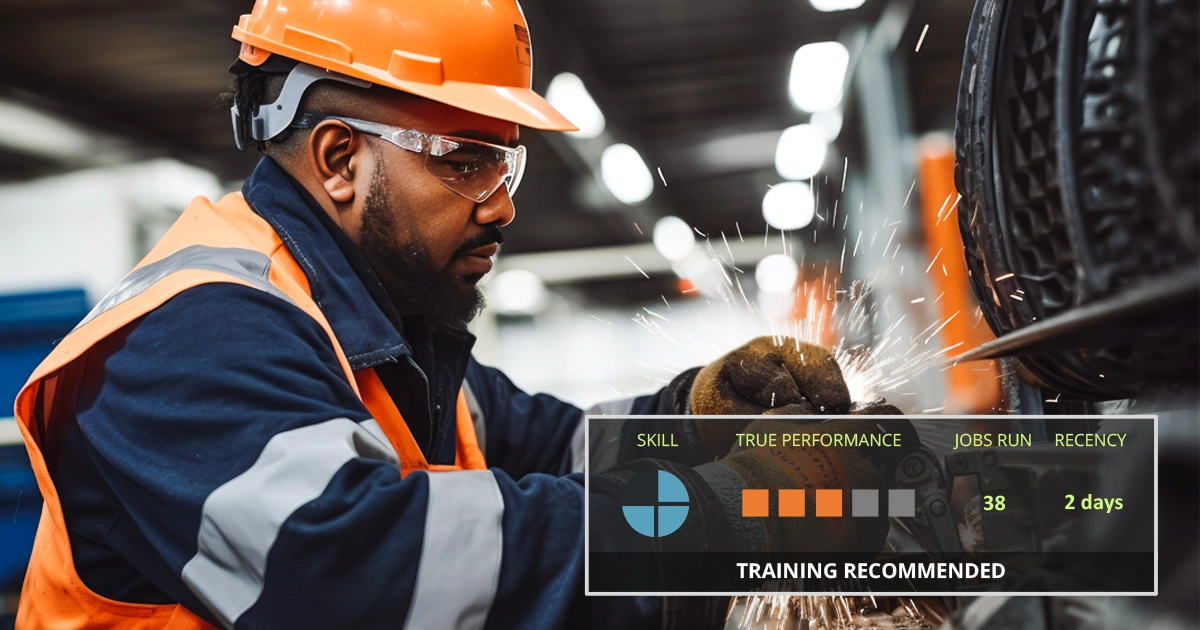
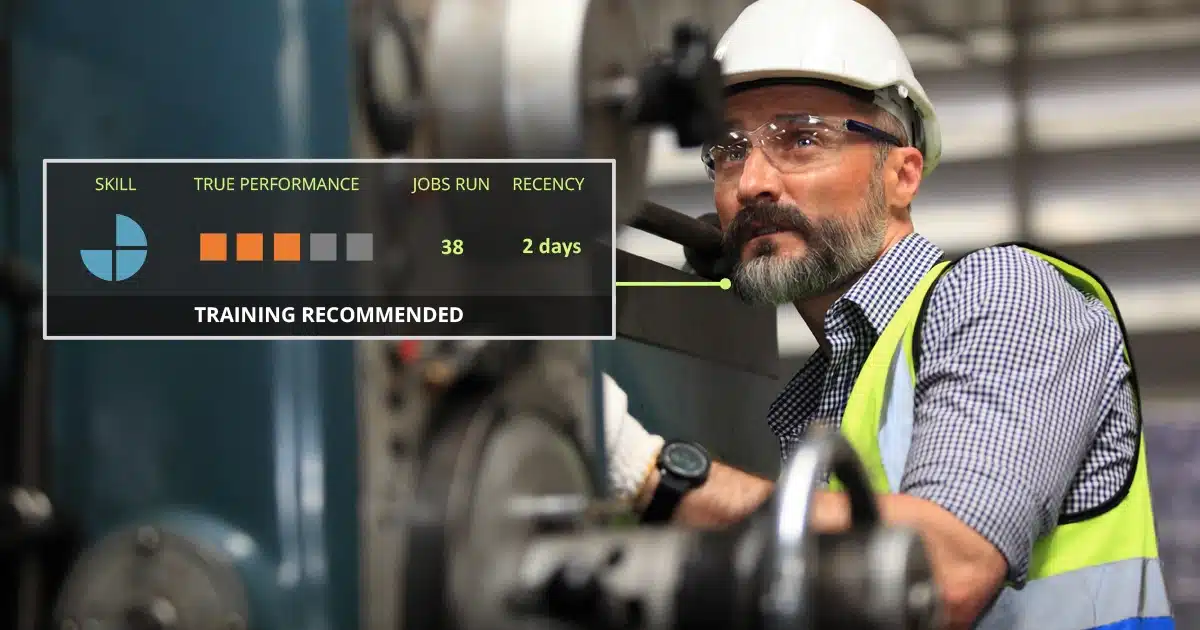
Augmentir is trusted by manufacturing leaders as a digital transformation partner improving training and development, workforce allocation, and operational excellence through our AI-driven True Productivity™ and True Performance™ offerings, as well as digitizing and optimizing complex workflows, skills tracking, and more through our patented smart, connected worker suite. Schedule a live demo today to learn more.
 

See Augmentir in Action
Get in Touch for a Personalized Demo

Learn the difference between skills development and training in manufacturing, how they are important, and how the management of them can be improved through continuous learning methodologies and emerging technology.

At first glance, training and skills development seem synonymous and are often used interchangeably, but they have different purposes and goals. However, despite these differences, both are equally important for every organization, especially in the case of the manufacturing industry. According to Training Magazine, 57% of manufacturing organizations reported training and workforce development budget increases to address the widening skills gap and the skilled labor shortage.

the difference between skills development and training in manufacturing

At the most basic level, training is the process companies use to build the skills of new employees so they’re well-equipped to perform the role that they were hired for. While skills development, on the other hand, includes ongoing education, mentoring, and professional experiences that help employees grow into future roles and opportunities.

Both are extremely valuable to overall organizational growth and success, however, it’s important to apply them at the right time and in the right way. Read more on both skills development and training in manufacturing, why they are important, and how they can be improved and enhanced through the proper application of learning technology:

What is Skills Development in Manufacturing

Skills development goes beyond training by aiming to enhance a broader set of competencies and capabilities. It focuses on building a more well-rounded and adaptable workforce encompassing not only the acquisition of specific skills, but also the improvement of problem-solving abilities, critical thinking, creativity, adaptability, and continuous learning.

Skills development in manufacturing refers to the process of enhancing the knowledge, abilities, and competencies of individuals involved in the manufacturing process. It involves providing training and education to workers, engineers, and technicians to improve their technical, operational, and problem-solving skills. By providing training and development opportunities, manufacturing organizations can ensure that their workforce possesses the necessary skills and knowledge to perform their jobs effectively and efficiently.

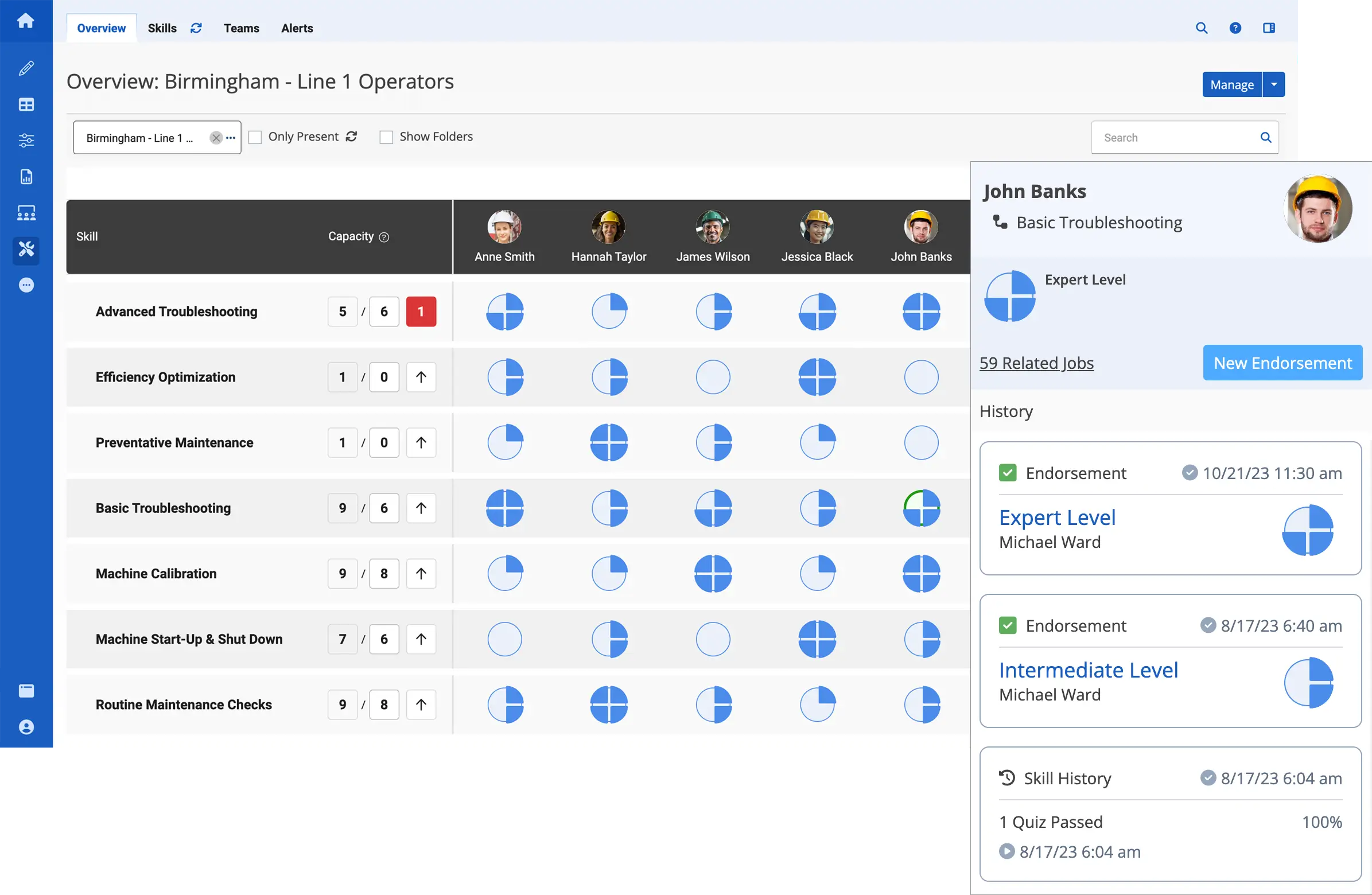
Skills Matrix Template
Free Template
Start tracking worker skills, certifications, development progress, and capacity planning with our free Excel Skills Matrix Template. Download our template to get started, and learn more about tracking and manage your employee skills digitally with Augmentir.


Many manufacturing industries face a shortage of skilled workers. Skills development programs help bridge the gap by training existing employees or new hires in the required competencies.

Overall, skills development in manufacturing is crucial for maintaining competitiveness in a rapidly changing industry. It ensures that the workforce remains adaptable, skilled, and capable of meeting the evolving demands of modern manufacturing processes.

Pro Tip

Implementing skills management software programs allow manufacturing organizations to digitize and effectively track worker skills, development progress, and intelligently assign work based on skills competencies, improving work allocation and workforce utilization.

A

What is Training in Manufacturing

Training in manufacturing primarily focuses on imparting specific knowledge, skills, or information to individuals. It often involves structured and organized programs designed to teach employees how to perform specific tasks or operate machinery and equipment. Training is often of shorter duration and may be task-specific or role-specific. It is designed to quickly bring employees up to a certain proficiency level in their current job.

The specific type of training required in manufacturing depends on the roles and responsibilities of the individuals involved, the company’s processes, and the industry in which they operate. Training in manufacturing is essential for several reasons:

  • Safety: Manufacturing processes often involve machinery, equipment, and materials that can be hazardous. Proper training ensures that employees understand and follow safety protocols, reducing the risk of accidents and injuries.
  • Quality Control: Quality in manufacturing is a critical, essential factor. Training programs teach employees how to maintain consistent product quality through accurate measurements, inspections, and adherence to quality standards.
  • Operational Efficiency: Training helps employees become more efficient in their tasks, reducing downtime, minimizing waste, and optimizing manufacturing processes.
  • Technology: Manufacturing is becoming increasingly technology-driven. Training equips employees with the skills to operate and maintain advanced machinery and systems.
  • Productivity: Engaged workers tend to be more productive, contributing to increased output and profitability for the manufacturing company.
  • Compliance: Manufacturing is subject to various regulations and industry standards. Training ensures that employees understand and comply with these requirements, avoiding legal and regulatory issues.

Effective training programs are designed to align with the organization’s goals and objectives, ensuring that the workforce is well-prepared and capable of contributing to the success of the manufacturing operations.

In summary, training in manufacturing is a subset of skills development, with a narrower and more specific focus on teaching job-related skills and knowledge. Skills development, on the other hand, is a more comprehensive and ongoing process that aims to develop a well-rounded and adaptable workforce capable of meeting the evolving challenges of the manufacturing industry. Both training and skills development are important for the success of a manufacturing organization, and they often complement each other in the development of a skilled and competent workforce.

How Can Technology Improve Manufacturing Skills Development and Training

Technology can significantly enhance manufacturing skills development and training by making the process more efficient, effective, and accessible. Incorporating these technological advancements into manufacturing skills development and training can lead to a more skilled and adaptable workforce, increased safety, reduced training costs, and improved overall manufacturing efficiency.

For example, technology enables experts to remotely assist and guide trainees through complex tasks. Workers can wear smart glasses or use mobile devices to share live video streams and receive real-time instructions. AI-driven connected worker solutions can assist in creating personalized learning paths for trainees based on the work they do, their progress, and their learning style.

Smart connected worker platforms, Learning Management Systems (LMS), and mobile apps can provide access to a wide range of training materials, including video tutorials, interactive modules, and assessments. These platforms allow workers to learn at their own pace and on their schedule, reducing the need for expensive and time-consuming in-person training.

Augmentir is the world’s leading, smart, connected worker solution using the foundational AI technologies underpinning ChatGPT to enhance manufacturing training, onboarding, and skills development. Leading manufacturing organizations are using our smart, connected worker suit and AI-driven insights to foster environments of continuous learning, and make skills development and training processes more personalized, accessible, and effective.

Schedule a live demo to learn why manufacturing leaders are choosing us to improve the training lifecycle with digital skills management tools, real-time insights, and more.


See Augmentir in Action
Get in Touch for a Personalized Demo

Gartner identifies Augmented Connected Workforce initiatives as a top manufacturing technology trend for 2024.

According to Gartner, an Augmented Connected Workforce is the intentional management, deployment, and customization of technology services and applications to support the workforce’s experience, well-being and ability to develop their own skills. It is a revolutionary approach that leverages smart connected worker platforms, artificial intelligence (AI), Internet of Things (IoT) technologies, and other innovative solutions to augment and support frontline workers and create a seamlessly connected and dynamic work environment.

gartner augmented connected workforce

Gartner predicts that through 2027, 50% of Fortune 500 manufacturers will create new positions through innovative engagement models enabled by Augmented Connected Worker strategies.

In manufacturing, specifically, the driving factor behind the rapid increase in Augmented Connected Workforce adoption is the need to accelerate and scale talent. There is a significant gap in the skills of the workforce today and consumer demands are rapidly increasing. Even the World Economic Forum recognizes the benefits an Augmented Connected Workforce brings to the workplace, stating that it:

  • enables workers to acquire new skills and knowledge
  • creates a more accessible and inclusive working environment
  • improves worker well-being and safety
  • increases the efficiency and effectiveness of industrial operations
  • supports human connection and collaboration
  • and more…

Given these benefits it is clear that enabling an Augmented Connected Workforce will be key for manufacturing success going forward.

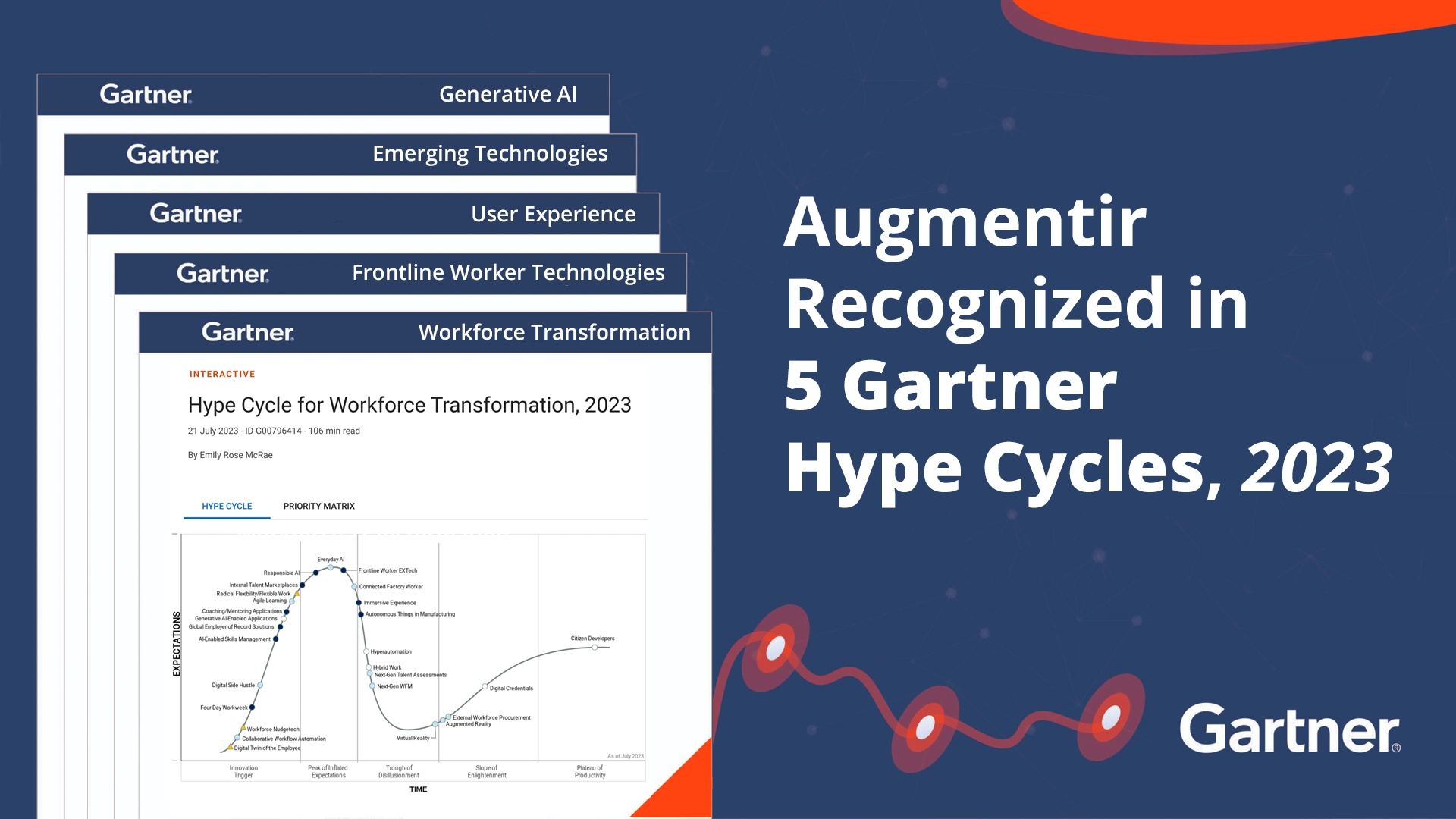
Augmentir Recognized in 5 Gartner Hype Cycles for its Connected Workforce Solution

Augmentir empowers organizations to embrace an Augmented-Connected Workforce by providing a comprehensive platform that combines connected worker and AI technologies. Through Augmentir, companies can seamlessly connect frontline workers with digital tools and knowledge bases, enabling them to access real-time guidance, instructions, and support directly within their workflows. This integrated approach augments frontline workers enhancing their capabilities, productivity, and overall business processes. By leveraging Augmentir’s platform, organizations can enhance productivity, quality, and safety while fostering a culture of continuous learning and innovation within their workforce.

Gartner recently highlighted Augmentir as a key software vendor providing functionalities and features that allow manufacturers to implement an Augmented Connected Workforce and empower frontline workers with AI-driven insights and real-time data for more productive, efficient, and safe frontline activities.

Augmentir was recognized in five separate Gartner Hype Cycle reports covering generative AI and emerging technologies in manufacturing.

augmentir recognized in gartner hype cycles


These five reports include:

  • Hype Cycle for Generative AI
  • Hype Cycle for Emerging Technologies
  • Hype Cycle for User Experience
  • Hype Cycle for Frontline Worker Technologies
  • Hype Cycle for Workforce Transformation

These hype cycle reports and innovation profiles are provided by Gartner to help organizations decide which new innovations and technology to adopt, as well as what value they can provide to their manufacturing operations.

Enabling an Augmented Connected Workforce in Manufacturing

Manufacturing is uniquely situated as an industry to benefit from an Augmented Connected Workforce leveraging AI-powered connected worker solutions for process improvements, quality, management, enhanced training, and more.

As manufacturing workers become more interconnected, organizations gain access to a valuable source of data related to manufacturing activities, execution, and team dynamics. By utilizing emerging AI tools in conjunction with smart connected worker solutions, companies can derive insights that pinpoint areas with significant potential for improvement.

At Augmentir, we believe that a connected worker platform’s purpose goes beyond just delivering instructions and remote support; it should continually optimize the entire connected worker ecosystem. AI plays a crucial role in addressing overarching trends like skills variability and the loss of tribal knowledge within the workforce. It serves as the cornerstone for implementing data-driven improvements in operational performance and continuous enhancement.

For example, after Augmentir is deployed for a period of time, our AI engine will start identifying patterns in the data that will allow manufacturers to focus efforts on the areas that have the biggest customer satisfaction, productivity, and workforce development opportunities. This gives organizations the ability to answer questions like:

  • What areas should they invest in to improve operational performance?
  • Where are their biggest areas of opportunity to improve productivity or quality management?
  • Where do they have skills gaps and what kind of training do their frontline workers need?

Augmentir’s AI continuously updates its insights to enable companies to focus on their largest areas of opportunity, enabling you to deliver year-over-year improvements in key operational metrics.

Interested in learning more?

If you’d like to learn more about Augmentir and see how our AI-powered connected worker platform improves safety, quality, and productivity across your workforce, schedule a demo with one of our product experts.


See Augmentir in Action
Get in Touch for a Personalized Demo