Posts

Smart Skills Management software is helping manufacturers bridge the gap between training, skills, and work to build a more resilient and agile workforce.

Skills management and tracking software helps manufacturers identify and track employee expertise. You can map skills from a centralized library to individual workers, analyze the performance of your teams, and fill any skill gaps that exist.

These smart insights can help businesses improve their talent management strategy, including training and development programs and recruiting opportunities.

If you’re interested in learning how to find the best skills tracking software, explore this article as we cover:

  • Benefits of skill management and tracking software
  • What to look for in tracking software
  • FAQs about skills tracking and management tools
  • Why Augmentir

Benefits of skills tracking and management software

Skills management involves identifying workers’ expertise and experience to determine whether they’re a right fit for a role, which areas need improvement, and how to best facilitate learning opportunities. A reliable skills tracking and management software solution lets you keep track of what your employees can and can’t do, and integrates that information with the actual work being done.

Here are a few reasons why you should invest in a tracking tool:

Enhanced training and development programs: Improve employee engagement by making sure courses and training opportunities are relevant to the jobs they perform. Management software makes it easier to assign employee courses that are appropriate and timely, and then track each individual’s training progress.

A more productive workforce: Employees who have access to training resources can further develop their skills to better perform assigned job duties and maximize output. This will empower workers to strive for continuous improvement and grow in their roles.

Improved retention: Offering continuous development and training programs can help your employees feel appreciated and taken care of. In return, they are more likely to stay and do a good job. Considering that turnover rates cost manufacturing firms an overwhelming amount, it’s critical to invest in programs that will improve retention rates.

What to look for in tracking software

Knowing how to effectively track employee skills can be challenging, but the right software can ease the burden. It makes it easier to identify who is lacking which skills and how to best close the gap.

Unfortunately, standalone skills management software solutions that attempt to automate skills tracking fall short of meeting the needs of today’s manufacturers because they do not connect the “skills that workers know” with the “work being done”. These standalone skills management solutions may have been ideal for the stable, unchanging workforce of the past, but they are not suited for today’s era of high workforce variability.

Skills management solutions that combine skills tracking capabilities with connected worker technology and on-the-job digital guidance can deliver significant additional value. Data from actual work performance can inform workforce development investments allowing you to target your training, reskilling, and upskilling efforts where they have the largest impact.

When looking for the best skill management and tracking software, its critical to make sure it can:

  • Keep a centralized database of competencies
  • Pinpoint worker skill gaps
  • Let management look for employees with specific expertise
  • Track the skills of individual employees in a centralized database
  • Intelligently assign work based on true worker skills and competencies
  • Personalize on-the-job guidance based on worker skills and experience
  • Create reports or dashboards to study competencies and skill gaps across departments

AI-powered software enables managers to filter through employee databases by skill to assemble teams best suited for a project.


skills tracking software


Skill management solutions should also integrate with core human resources software to offer seamless sharing of employee data. Some tools may even work in tandem with corporate learning management systems to provide access to educational content that could help workers develop new abilities.

Lastly, HR can use skill management software to make it easier to follow compliance regulations that require evidence of employee capabilities or certifications. For example, a health manufacturing facility may need workers to upload certain certifications to show proof of compliance.

FAQs about skills tracking and management tools

How do you keep track of employee skills?

You can track employee skills using software that manages worker competencies. These programs should allow you to build customized job profiles, create reports to study competencies, and fill skill gaps.

What is skills software?

Skills software is a tool that helps manage and keep track of worker expertise and experience. It’s used by businesses to optimize job performance and boost worker productivity.

Should I invest in skills tracking software?

Manufacturing facilities can benefit from investing in software that provides an easy-to-use centralized database of worker profiles, training resources, and much more.

Why Augmentir

Augmentir can help manage the skills of your workforce with its AI-powered connected worker solution. Our skills management tools create visibility at all times to optimize training programs, track individual and team progress, and initiate more targeted training. Check out our live demo.


Learn how Smart Skills Management software is helping manufacturers bridge the gap between training, skills, and work to build a more resilient and agile workforce.

Download our latest eBook – The Future of Work: Connecting Skills Management with Standard Work.


Augmentir’s take on the trending Workforce Institute’s staggering survey numbers.

Do you remember when offshoring–the outsourcing of production internationally–was once considered the “gold standard” for manufacturers because of reduced costs? Funny how things change. We can partly thank the global pandemic for this. Reshoring, also referred to as ‘onshoring’, in manufacturing is now the way to go–the apparent panacea to supply chain disruptions and a healthier economy. This should have manufacturers cheering and dancing in the streets, right? Not so fast. We’ve also got a massive labor shortage to deal with. But don’t fret. There are solutions to be found, and they happen to exist in software tools already being embraced by organizations on their journey to digital transformation.

The perks and pressures of onshoring in manufacturing

If your organization isn’t already thinking about onshoring its operations, maybe you should be. Onshoring in manufacturing means greater resiliency, agility, and sustainability by shortening the distances between process and delivery. Less travel means reduced emissions and adherence to ESG standards. Reshoring addresses issues associated with shipping costs, lead times, and new regulations. Working in familiar markets can help identify supply and demand trends more accurately. National employment rates are likely to increase when hiring residents and working with other domestic business partners.

But labor shortages and the variability of today’s workforce have not made reshoring an easy shift. So while there is tremendous opportunity to bring production home, the lack of affordable and skilled labor is having a tremendous impact on our domestic production capacity.

Here’s how you make onshoring work for you. First, stop thinking the old way of recruiting, training, and retaining workers will still work today.

Work with what you’ve got

What’s wrong with training today? Yes, training programs can help improve worker knowledge and skills development. But only if they are meeting the unique needs of individual workers with content-rich, high-impact learning and hands-on training programs. Forget those standard training programs–they are useless in the face of the variable workforce we have available today. The workers you can find are showing up with a mixed bag of experience and skills. That doesn’t have to be a disadvantage anymore. Because there is a smarter way to train and optimize the skills of each of those workers to meet productivity goals individually and fulfill the potential for your organization’s production capacity.

Smart digitization is the ticket to effective onboarding, training, and more–from hire to retire

“The secret of change is to focus all your energy not on fighting the old, but on building the new.” – Socrates

This new era of workforce instability is forcing manufacturers to change. It’s forcing them to turn to digital technology and look at smarter ways to hire, onboard, train, and retain their workers. At Augmentir, we call this Smart Digitization.

What do we mean by ‘smart’ digitization? Smart digitization involves adopting modern, digital tools, mobile technology, and supporting workers throughout their entire lifecycle.

smart digitization throughout worker lifecycle


Modern connected worker tools are at the core of the solution that supports workers throughout their employment, from training to troubleshooting in real-time to ongoing learning and development. If you look at the entire employee lifecycle, this means:

  1. Using software tools to digitize and automate onboarding and skills tracking to help get workers operational faster, regardless of their skill and experience.
  2. Once on the job, digitizing and personalizing work instructions based on the individual needs of the worker – whether they are a novice worker or an expert.
  3. Proving instant access to support, within the flow of work.
  4. And finally, using an AI-based system to analyze how workers are performing on the job, and intelligently targeting upskilling and reskilling based on actual work performance.

Workers have access to a suite of digital tools and knowledge resources at their fingertips – digital work instructions, collaboration, and support tools to guide them on the job and quickly problem-solve complex tasks, allowing them to do their personal best.

For employers, this means not only more engaged and collaborative workers, it also means deeper insights into work performance that can help drive continuous improvement efforts.

skills job proficiency mapping

AI-based smart insights intelligently optimize workers’ performance by identifying and tracking their skills in real-time. Smart insights pull from these performance metrics and learn to prompt workers who need new training programs or work opportunities, continuously upskilling and reskilling.

It’s the advanced medicine needed to maximize productivity and operational health.

So as you plan to bring more of your production back home, make sure you’re ready to seize the opportunity and address the challenges of a restricted labor market at the same time.


Find out how and why so many manufacturers are turning to Augmentir to turn their workers into efficient, productive, and long-term assets for their businesses.

Check out our latest webinar – Smart Digitization of Frontline Workers to learn more.


AI and connected worker technology is helping frontline managers combat employee burnout and improve engagement and retention.

In today’s fast-paced manufacturing industry, staying ahead of the curve is critical to success. To remain competitive, companies must continuously reskill and upskill their workforce. One way to achieve this is to operationalize training and bring it closer to the factory floor using artificial intelligence (AI) and connected worker technology. Operationalizing training means taking a more systematic approach to training and workforce development, rather than treating it as a one-time event.

operationalizing learning

According to a report by McKinsey, companies that embrace AI-powered learning reduced training time by up to 50% and improved learning outcomes by up to 60%.

AI-powered solutions make learning more accessible, engaging, and effective; and by integrating training and learning solutions into the everyday operations of the company, manufacturers can create a culture of continuous learning and improvement. In fact, here at Augmentir we’ve seen manufacturing companies use this approach to reduce new-hire onboarding and training time by up to 72%.

Learning: When and Where it’s Needed

AI has the potential to revolutionize many industries, and manufacturing is no exception. Many workers in the manufacturing industry work in shift-based environments, making it difficult for them to attend traditional classroom-based training sessions.

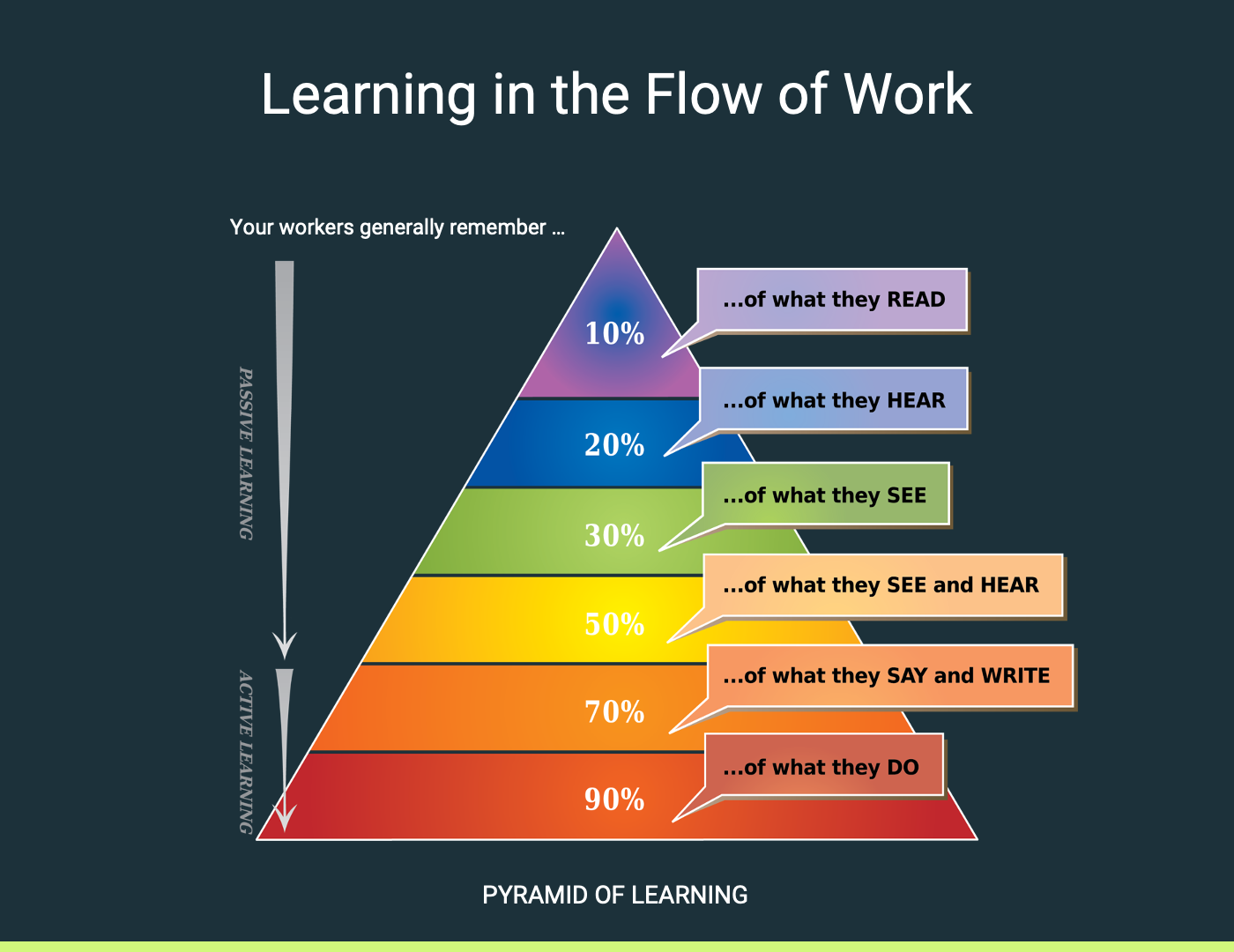
With AI, organizations can incorporate more learning processes into the everyday workday of frontline workers – essentially operationalizing training and bridging the gap between knowing and doing. This “active learning” aligns with the Pyramid of Learning visual model that illustrates the different stages of learning and their relative effectiveness.

pyramid of learning

Active learning involves the learner actively engaging with the material, often through problem-solving, discussion, or application of the knowledge while they are on the job.

In general, active learning (or workflow learning) is considered more effective than passive learning in promoting deep understanding and retention of information. Therefore, learning leaders often strive to design learning experiences that involve higher levels of active learning, moving beyond the lower levels of the pyramid and promoting critical thinking, creativity, and problem-solving skills.

This approach can be implemented with mobile learning solutions that leverage connected worker technology and AI to provide workers with bite-sized, on-demand training modules that they can access on smartphones or tablets. These modules can be customized to each worker’s skill level, making it easier for them to learn at their own pace.

Additionally, AI-driven learning solutions offer:

  • Personalized Learning: AI-powered learning solutions can be customized to each worker’s skill level, making it easier for them to not only learn at their own pace, but also matched to their experience level. For example, novice workers may be required to watch a micro-learning video as a safety prerequisite to performing a task, whereas a more senior worker with the appropriate level of job experience and proficiency may not be required to watch the learning video.
  • Performance-based Learning: AI-powered solutions provide workers with hands-on learning experiences that are customized based on their actual job performance. These experiences can be delivered through a variety of content mediums – rich media, self-help guides, microlearning videos, and even augmented reality (AR) experiences.
  • Real-Time Feedback: AI-powered solutions can monitor worker performance in real-time, providing instant feedback to help workers improve to provide access to content to help resolve issues in the flow of work.

AI can also help with the assessment of employee performance. Traditional performance evaluations often rely on subjective assessments from managers. Conversely, AI-powered performance evaluations can provide a more objective and data-driven assessment of employee performance, while also providing a more accurate picture of an employee’s strengths and weaknesses.

Better Training, Better Work

By implementing AI-based solutions, companies can identify and operationalize training needs across the organization. Using performance data, AI can uncover gaps in knowledge or skills across the workforce, which can then be used to develop targeted training programs to “fill” these gaps.

Once implemented, AI can be used to effectively track and improve learning and training effectiveness, leveraging data on worker performance before and after training to measure impact and refine training programs to ensure that they are delivering the best outcome.

As the manufacturing industry continues to evolve, so must how they approach learning solutions. A recent Deloitte survey found that over 90% of companies believe that AI-powered learning will be important for their organization’s success in the next three years. AI has the potential to operationalize training and transform learning in the manufacturing industry by bringing it closer to the factory floor. By leveraging AI-powered personalized learning, real-time feedback, data-driven performance evaluations, and identifying training needs, industrial organizations can create a more efficient, effective workforce.

Learn about what a skills matrix is, how these can be used and alternatives to help track employee skills.

A skills matrix is a grid that maps employees’ skills and qualifications. Companies use this information to manage, plan, and monitor current and desired skills for a position, team, department, or project.

Having a place to store each employee’s skills and experience level can help managers decide how to divvy up tasks. It’s also a great way to gauge areas of improvement.

A skills matrix is usually managed using a spreadsheet, but there are alternatives to skill matrices. For example, cloud-based skills management software can help identify and track employee competence and correlate it with actual job performance. The software can also help managers filter employee databases by skills to assemble teams or assign work based on specific qualifications.

skills matrix

To help you learn more about the skills matrix and its alternative, this article explores the following topics:

What is a skills matrix?

A skills matrix is a tool used by employers to track workers’ skills and expertise. Typically maintained in spreadsheet format, it usually includes skills that workers already possess, ones that are needed but underdeveloped, and those that are required to complete a project or perform a job function.

Each employee is given a rating on their proficiency in each skill and their interest in developing it. This gives managers great insight into who is qualified to complete certain tasks.

What are the benefits of using a matrix to track employee skills?

A skills matrix offers multiple benefits that can increase team performance and boost productivity. Some of its benefits include:

1) Brings awareness to employee skills

This tool shows what area a team member excels at and where they can improve. This can bring awareness to what skills need to be cultivated and what areas team members are already proficient in.

2) Sets team expectations

With the matrix outlining what skills are needed to complete a project, employees have a better idea of what’s expected and required to be proficient in their roles.

3) Shows where new hires are needed

The matrix gives employers a better idea if someone needs to be hired to fulfill a certain role. Knowing which skills are missing helps managers determine what kind of employee needs to be hired for a specific project.

How do I create a skills matrix?

Creating a skill matrix can provide a wealth of benefits to a business. You can set one up by following the steps below:

  1. Determine which skills are needed for your team based on job function or responsibility.
  2. Evaluate your workers’ skills and qualifications.
  3. Create a grading system to rate each employee’s current skill level.
  4. Fill in the missing criteria and manage the information in a central skills management system.

skills matrix for skills management

How can skills matrices be used in the manufacturing industry?

The manufacturing industry is always seeking skilled employees. Skilled matrices are an excellent way to cultivate the skills of current production plant workers and boost productivity.

This organizational tool also simplifies the hiring process. For example, it gives managers a better sense of what skill areas are lacking and who may be the right fit for the role.

The better equipped an employee is to do their job, the better a company’s bottom line will be.

What are the alternatives to using a spreadsheet for your skills and competency matrix?

If you’re looking for an alternative to using a spreadsheet to manage the skills of your team, consider cloud-based skills management software. These programs help businesses identify and track worker competency.

For example, this software maps skills from a centralized library to job profiles and individual employees to help managers analyze the abilities of their teams, the desired skills for each role and any skill gaps that exist. Learn more about skills management software in our guide.

Furthermore, skills management software not only allows you to efficiently manage skills for your frontline workers, it also enables you to use this skills mapping to intelligently assign work or identify upskilling or reskilling needs.
skills job proficiency mapping


Interested in learning how Augmentir’s connected worker platform can help you digitize and effectively manage skills within your manufacturing operation? Get in touch with us for a free demo.


Learn about the best practices for optimal asset maintenance performance and how to track your assets to ensure that everything is in working condition.

Asset maintenance refers to everything that goes into keeping your manufacturing assets in tip-top shape. With machinery, for example, asset maintenance means conducting frequent inspections and repairs. With office space, this term involves maintaining a clean, safe, and productive workplace. With products, it includes checking finished goods for any deficiencies or errors.

In a nutshell, asset maintenance helps prolong the performance and lifespan of equipment, machinery, goods, and more. Performing this strategy ensures that your essential business resources continue functioning smoothly and properly.

Learn the best practices for increasing asset maintenance performance:

Best practices for optimal asset maintenance performance

Implementing key best practices can improve asset maintenance in manufacturing. We’ve put together five crucial strategies to ensure your manufacturing firm is performing at its best while minimizing costs:

1. Gather as much info as possible

Gathering data on assets can help management make better informed production decisions. Asset tracking is a great technique to accomplish this.

2. Create a preventive maintenance schedule

The data that’s been collected will make it easier to create a preventive maintenance schedule. To create one, start by organizing asset data and analyzing the info you’ve amassed (e.g., how often each item must be checked and maintained). Lastly, prioritize your most important assets and allocate funds to maintain them.

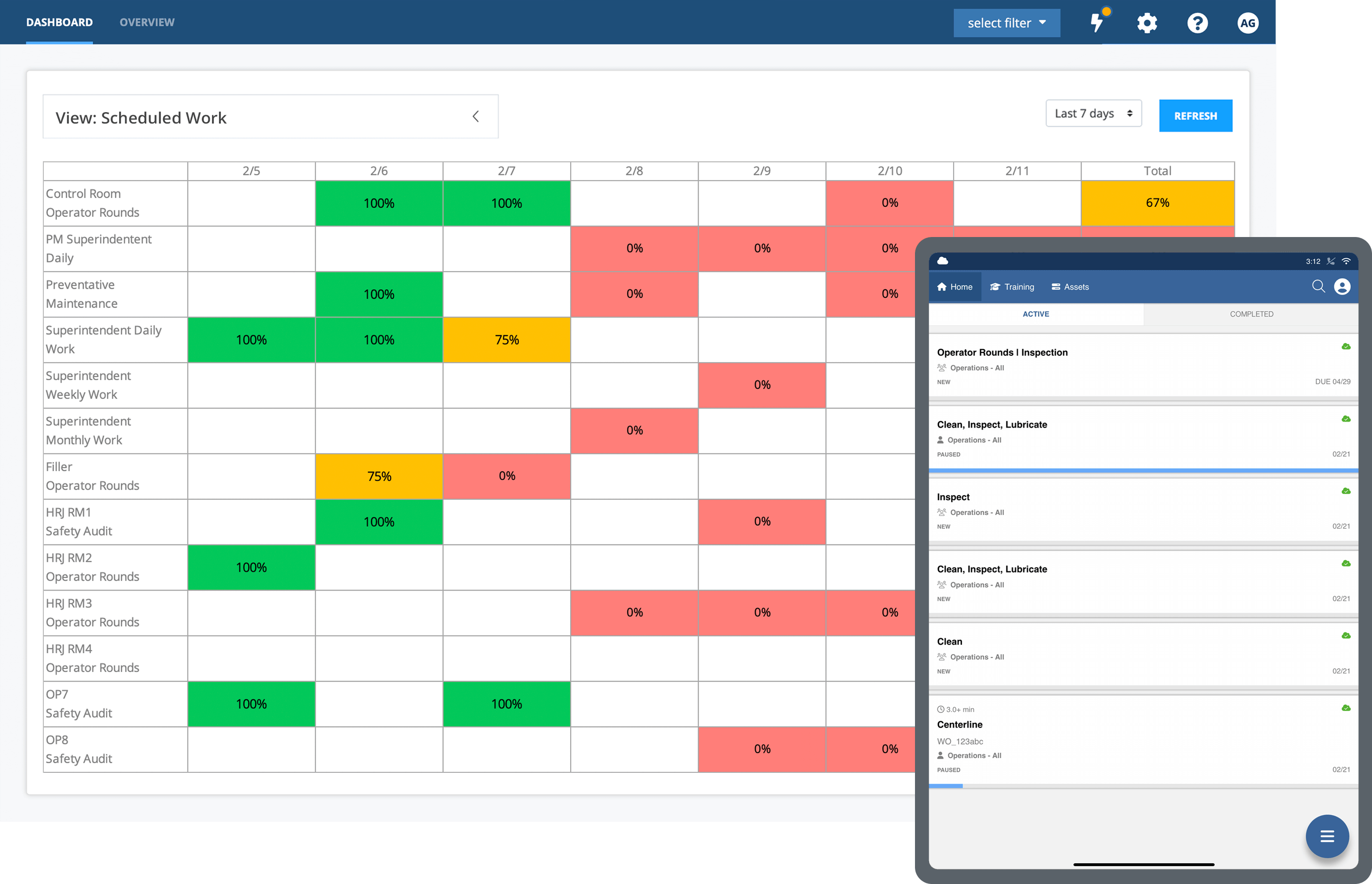
schedule and audit asset maintenance work

3. Train workers

Investing in your employees pays off. Procedural documentation and training will help ensure that all maintenance work is thoroughly performed and recorded. Skills management software can help with ongoing management and tracking of employee skills and training requirements.

4. Apply an inventory tracking system

There is nothing worse than beginning a project only to find out that you don’t have all the moving parts to complete it. An inventory system helps reduce the chances of missing crucial product information and enables you to better track company assets.

5. Track asset maintenance key performance indicators (KPIs)

KPIs such as mean time between failures (MTBF), overall equipment effectiveness (OEE), and work order resolution time can give a performance review on how well your assets are doing. They’re also great at pinpointing which areas could benefit from predictive maintenance, the process of checking for deficiencies to avoid future machine breakdowns.

Pro Tip

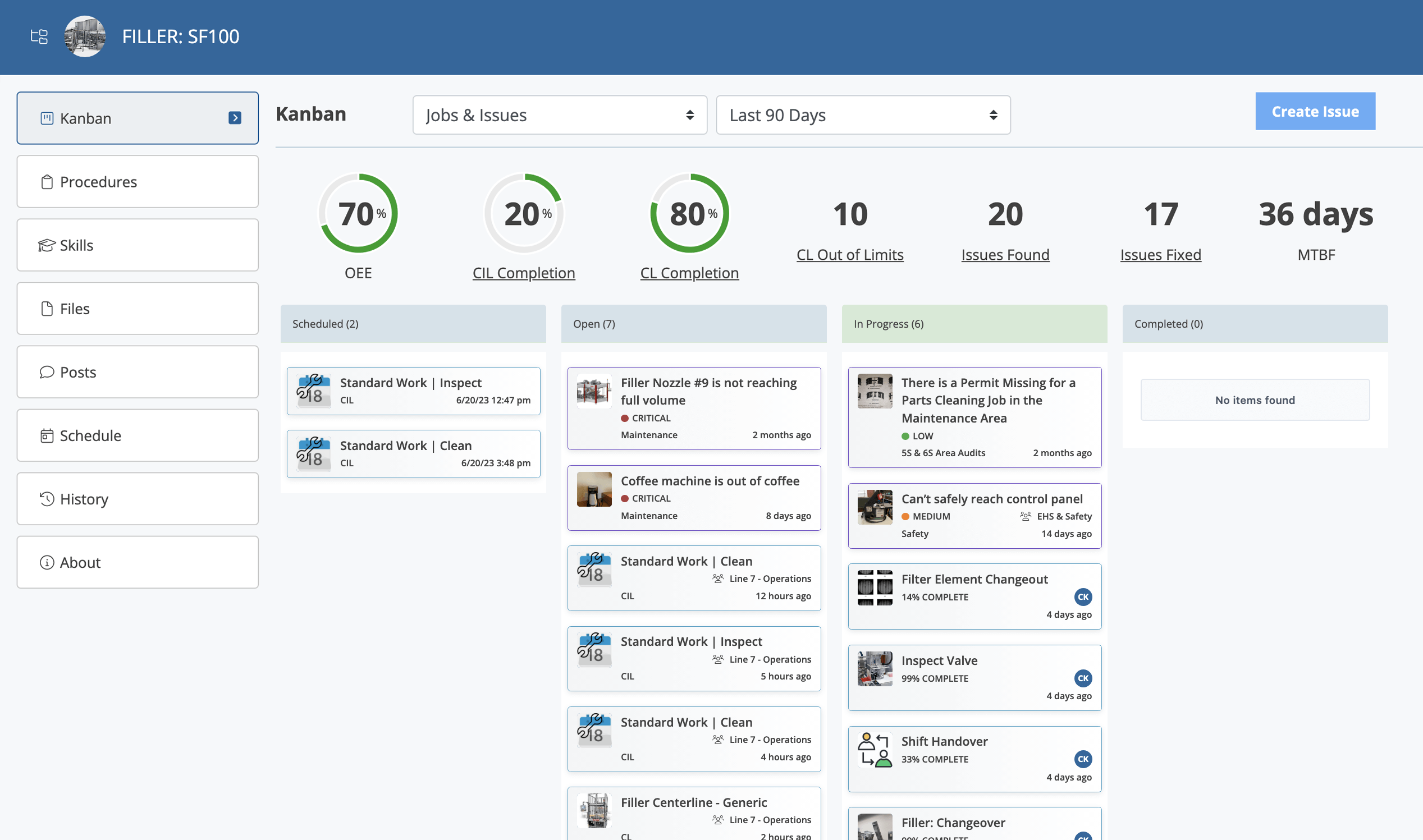
Asset management software like Augmentir’s Connected Worker Solution helps you simplify the operations and maintenance of your facility. Manage work and maintenance procedures, skill requirements, training, KPIs, and preventive maintenance schedules all through a visual interface. Connected worker solutions help integrate your CMMS with your shop floor operations.

A

Advantages of asset maintenance

The maintenance of assets in manufacturing consists of regularly inspecting, repairing, and replacing equipment and other assets to confirm that everything is in workable condition.

Advantages of asset maintenance:

  • Enhanced workplace safety
  • Greater equipment reliability
  • Longer machine lifespan
  • Lower maintenance costs
  • Improved productivity
  • Better regulatory compliance

Asset maintenance tools and how Augmentir can help

Manufacturers are encouraged to manage and track assets to limit product flaws, prevent machine failure, and improve overall productivity. However, in today’s digital age, especially with more mobile devices, complex cloud-based technologies, and software updates, handling assets has become much more complicated.

This is where Augmentir’s AI-powered connected worker solution, or asset management software, comes in. Our solution allows manufacturing facilities to better monitor their assets and manage them effectively with easy-to-use customizable dashboards and real-time insights.

Asset maintenance with Augmentir

Ours is the world’s only connected worker suite that provides an overarching view of an asset’s life cycle. Accurate digital asset records can help manufacturers with resource planning. In addition, our tool helps with asset record keeping so that you don’t have to worry about not meeting regulatory compliance requirements.

Though a manufacturing firm could use a spreadsheet to track its assets, our digital solution gives workers the ability to evaluate asset-specific data and make better decisions about how to manage each one.

Transform how your company runs its maintenance operations. Request a live demo today!


See Augmentir in Action
Get in Touch for a Personalized Demo

AI-powered technology may be the missing puzzle piece for today’s workforce crisis.

Are you still printing work instructions and operating manuals? If so, we need to have a serious chat! Maybe you invested in “going digital” a while back and think your work is done. You’re not alone. It was considered “groundbreaking” when PDF files made their way to the factory floor. 

The first generation of digital work instructions were birthed after learning 46 percent of field technicians claimed paperwork and administrative tasks were the worst part of their day-to-day job. No argument here. Completing and filing paperwork is time-consuming and there is potential for lost information. There was an obvious upside to going digital, except for no longer being able to tell your supervisor that your dog ate your worker performance report. 

But even now that technology is ready for the archives. An estimated $1.3 trillion (and counting!) has been spent on digital transformation initiatives as the online connected workplace and market continue to move at a rapid pace. 

We are no fortune tellers, but studies show that 25 to 31 percent of 3.3. million business service jobs will be automated in the next decade. This doesn’t mean everyone is being replaced by robots. On the contrary. It means technology is improving to help workers do their jobs even better. Manufacturing companies need to be prepared to hop on this next-generation train if they aren’t already.

Move over one-size-fits-all training and work instructions 

The individualized, real-time, connected worker platform is here. Let us emphasize individualized. Connected worker platforms are being implemented in myriad industries, from automotive to food processing. Any industry which is adapting daily to the constant shifts and pressures of the global economy. Regardless of the industry, standard digital work instructions are no longer effective. They do not reflect the real-time changes happening in the operation, such as order fulfilment and materials inventory, or equipment maintenance needs and the capabilities of the workers operating the machines. Imagine working on the manufacturing floor for five years and handed with the same standardized work instructions as the new hire.

Does this make sense? Not anymore. Not when AI-based technology is changing what’s possible. And what’s different about this latest wave of technology that makes it so special? It’s built around optimizing the performance of people (Gasp.)

Change is inevitable. Growth is optional. – John C. Maxwell

A marriage made in heaven–the next generation of workers is ready for a digitally connected workplace

Recruiting and retaining talented workers is one of the greatest challenges facing operations today. We get it. But there’s good news. As one generation of workers readies for retirement, another is stepping up to fill the gap. Gen Z is overflowing with talented innovators in the tech world having grown up surrounded by non-stop advancements and devices. Need one of them to look somebody up in the phone book? Forget it. But need assistance when your home computer suddenly “dies”? These are your people. 

It’s more than video games. Their education has been largely based on a digital foundation. Nearly every function of their daily lives has an element of connectivity to the broader online world. You could say this generation is hardwired to respond best to customized digital learning platforms. It’s their love language. And so the potential to drastically improve productivity is real.

The beauty of the digitally connected worker–could they be “the One”?

The digitally connected worker has all the right stuff for a long-lasting relationship with your operation. The digital training and work instruction platform holds their unique inventory of skills, goals, and performance history, and works with them to become a better version of themselves on the floor. Workers whose individual needs are supported are better, more engaged employees. They have the self-confidence – as well as the tools and specific instructions – to address problems head on when they arise. An investment in AI-powered technology is an investment in a stable, adaptable, and reliable workforce.

Are you and your workforce ready to take this next step in digitization? Contact Augmentir to start the conversation. Together let’s step into the full potential that this generation has to offer to improve your operational efficiency.

Today’s industrial workforce is changing in real-time – who shows up, what their skills are, what jobs they need to do, is a constantly moving target. The traditional “one size fits all” approach to training, guidance, and performance support is fundamentally incapable of enabling today’s workers to function at their individual peak of safety, quality […]

Today’s industrial workforce is changing in real-time – who shows up, what their skills are, what jobs they need to do, is a constantly moving target. The traditional “one size fits all” approach to training, guidance, and performance support is fundamentally incapable of enabling today’s workers to function at their individual peak of safety, quality and productivity.

Watch the recording of our recent virtual roundtable of industry leaders as they discussed proven approaches to delivering performance support and modern training approaches for today’s industrial workforce.