Posts

Learn how connected worker technology can help you standardize and digitize layered process audits for improved accuracy and better quality results.

Digitized Layered Process Audits (LPAs) are important in manufacturing for establishing and enhancing process standardization, quality management, multi-level workforce engagement, risk mitigation, and quality standards compliance. The primary function of a Layered Process Audit is to focus on observing and validating how products are made to ensure process and product quality. This effectively protects manufacturers and frontline manufacturing personnel from defects and process issues before they can do any damage.

digital layered process audits

Many crucial manufacturing processes are still carried out using outdated pen-and-paper methods; and as the industry continues to evolve, digitization is essential to remain competitive and maintain proper quality and safety standards. Layered Process Audits are no exception, with digitized layered process audits now a necessity, rather than a luxury, for organizations looking to keep pace, elevate their audit processes, and meet the demands of the evolving industry.

Learn more about how to streamline LPAs with connected worker technology, implement digital LPAs, and the benefits of AI-powered analytics for digitized LPAs and overall quality management excellence in manufacturing below.

Benefits of a Digitized Layered Process Audit

Connected worker platforms allow manufacturers to replace paper-based audit forms (like a layered process audit) with digital checklists that can be accessed and completed on mobile devices, allowing for:

  • Standardized audit formats and best practices across audit layers
  • Real-time data collection and improved audit tracking
  • Mobile access to information and knowledge including relevant documents, procedures, and historical data
  • Automated audit scheduling and notifications for consistent audit frequency across layers and reduced administrative burden
  • Real-time issue reporting and escalation for faster response and issue resolution
  • Improved data analytics and reporting to generate and apply insights as well as identify recurring issues and root causes
  • Overall system integrations with things like ERP, MES, and CMMS

These abilities offer a significant boost to manufacturers in terms of operational efficiency, risk mitigation, workforce development, and cost reduction.

Implementing Digital Layered Process Audits

Manufacturers can digitize LPAs and streamline their quality management processes through AI-powered connected worker technologies, improving data quality and driving faster, more effective quality improvements across the organization.
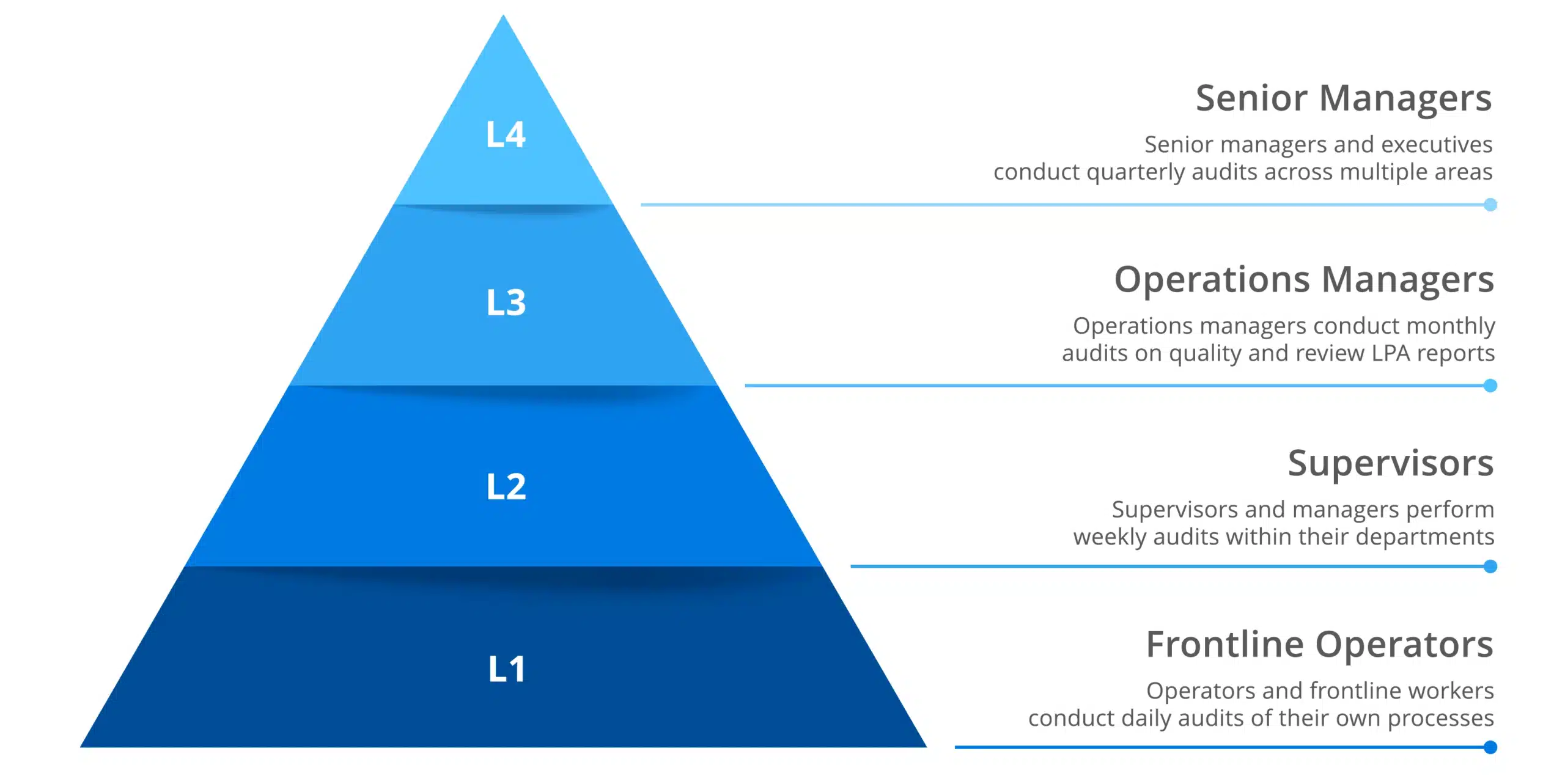
layered process audit framework

Implementing digital Layered Process Audits (LPAs) involves several steps, from selecting the right platform to engaging the team and ensuring proper integration with existing systems. Below is a step-by-step guide to implementing digital LPAs effectively:

1. Choose the right Digital LPA Platform

Research and select a digital LPA platform that meets your organization’s needs. Consider factors like:

  • Ease of use (especially for mobile devices)
  • Customizability (to fit your audit checklist and process requirements)
  • Integration with existing systems (e.g., ERP, quality management systems)
  • Reporting and analytics capabilities
  • Scalability for future needs

2. Develop and Digitize Audit Checklists

  • Standardize Audit Checklists: Create or review the audit checklists for each layer of the audit process. Ensure they are aligned with your goals, operational requirements, and industry standards (e.g., ISO, IATF).
  • Digitize the Checklists: Input these checklists into the digital platform. Ensure that they are tailored to different levels of the audit process, from shop floor employees to higher-level management.
  • Customize Alerts and Criteria: Set up criteria for success/failure and alerts for non-conformance. This can include conditional triggers where a failed audit automatically prompts corrective actions.
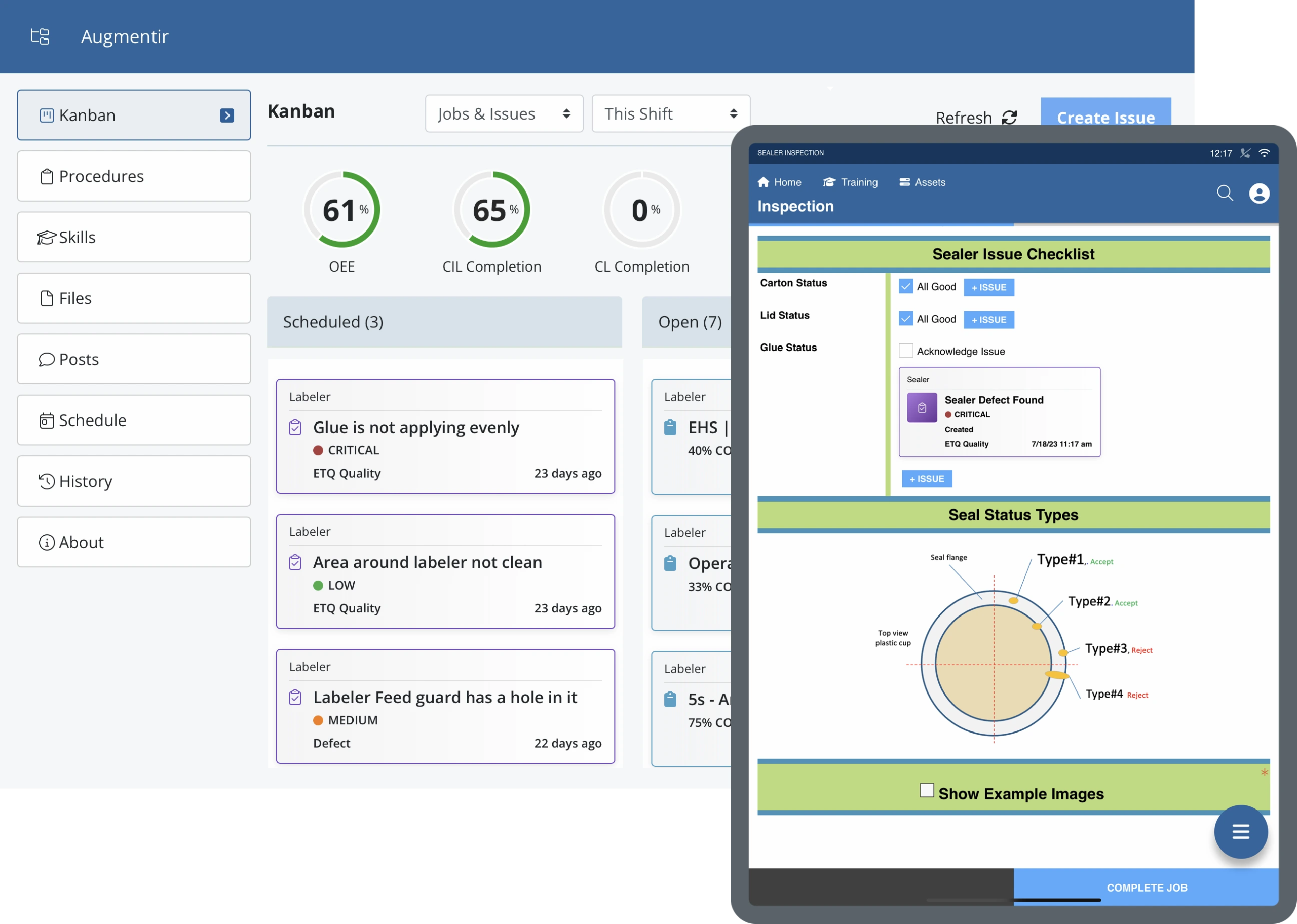
digitized layered process audit LPA with augmentir quality control checklist

3. Integrate with Other Systems

  • Link to Quality Management Systems (QMS): Integrate the LPA platform with your existing QMS, ERP, or other relevant systems to streamline data sharing and analysis.
  • Automate Corrective Action Processes: Ensure that non-conformance findings in the audit automatically trigger corrective action workflows, and link them to task management or follow-up procedures.

4. Monitor, Analyze, and Improve

  • Track Real-time Results: Use the platform’s dashboards and analytics features to monitor performance metrics, such as audit completion rates, non-conformance trends, and the time taken to close corrective actions.
  • Conduct Regular Reviews: Hold periodic review meetings with the audit team and management to discuss audit findings and trends. Use this information to drive continuous improvement in processes.
  • Make Adjustments: Based on the insights from the audits, adjust the audit checklists, procedures, and corrective action plans as needed.

5. Foster a Culture of Continuous Improvement

  • Encourage Engagement: Foster a culture where employees see the value in LPAs and actively participate in the process. Offer incentives or recognition for high levels of engagement or process improvements resulting from audits.
  • Regularly Update the System: Keep the digital platform and audit processes updated to reflect changes in standards, regulations, or internal processes.
  • Leverage Advanced Analytics: Over time, use advanced analytics and machine learning (if available) to predict potential non-conformance areas and further streamline corrective actions.

By following these steps, you can effectively implement a digital Layered Process Audit system that enhances visibility, accountability, and process control across your organization.

Driving Continuous Quality Improvement with Digitized LPAs

Excellence in quality management drives success in manufacturing. Digitizing and updating old processes with AI, connected worker platforms, and even simple digital layered process audit software allows manufacturing organizations to better identify and prevent defects at their source and protect against rework, customer complaints, costly product recalls, and reputational damage.

Recent innovations in AI technology and applications caused an explosion of growth all across the world and in various industries. Manufacturing is uniquely situated to adopt these technologies for massive growth. One valuable use case is the use of AI to optimize quality management, specifically to optimize audit processes like LPAs for drastically improved results and insights that simply weren’t possible previously.

AI analytics combined with connected worker technologies digitize and streamline layered process audits allowing manufacturers to capitalize on shop floor data data capture for:

  • Trend analysis across different audit layers, departments, and locations
  • Automated population of audit forms with relevant data
  • Seamless creation of digital work instructions from audit findings
  • Application of cobots, generative AI assistants, or AI copilot technologies to support auditors and workers alike.

But this does not stop there, according to a study by McKinsey & Company, companies that prioritize quality management achieve higher levels of employee engagement. Engaged employees are more likely to be committed to producing high-quality products, resulting in increased productivity and customer satisfaction. The addition of AI to capitalize on connected worker data and feedback to generate insights, support enhanced decision-making, and create better processes offers manufacturers a path forward into the future with a better-equipped and supported frontline workforce.

Interested in learning more?

If you’d like to learn more about how Augmentir streamlines and optimizes quality management processes like digital layered process audits and more, schedule a demo with one of our produce experts.
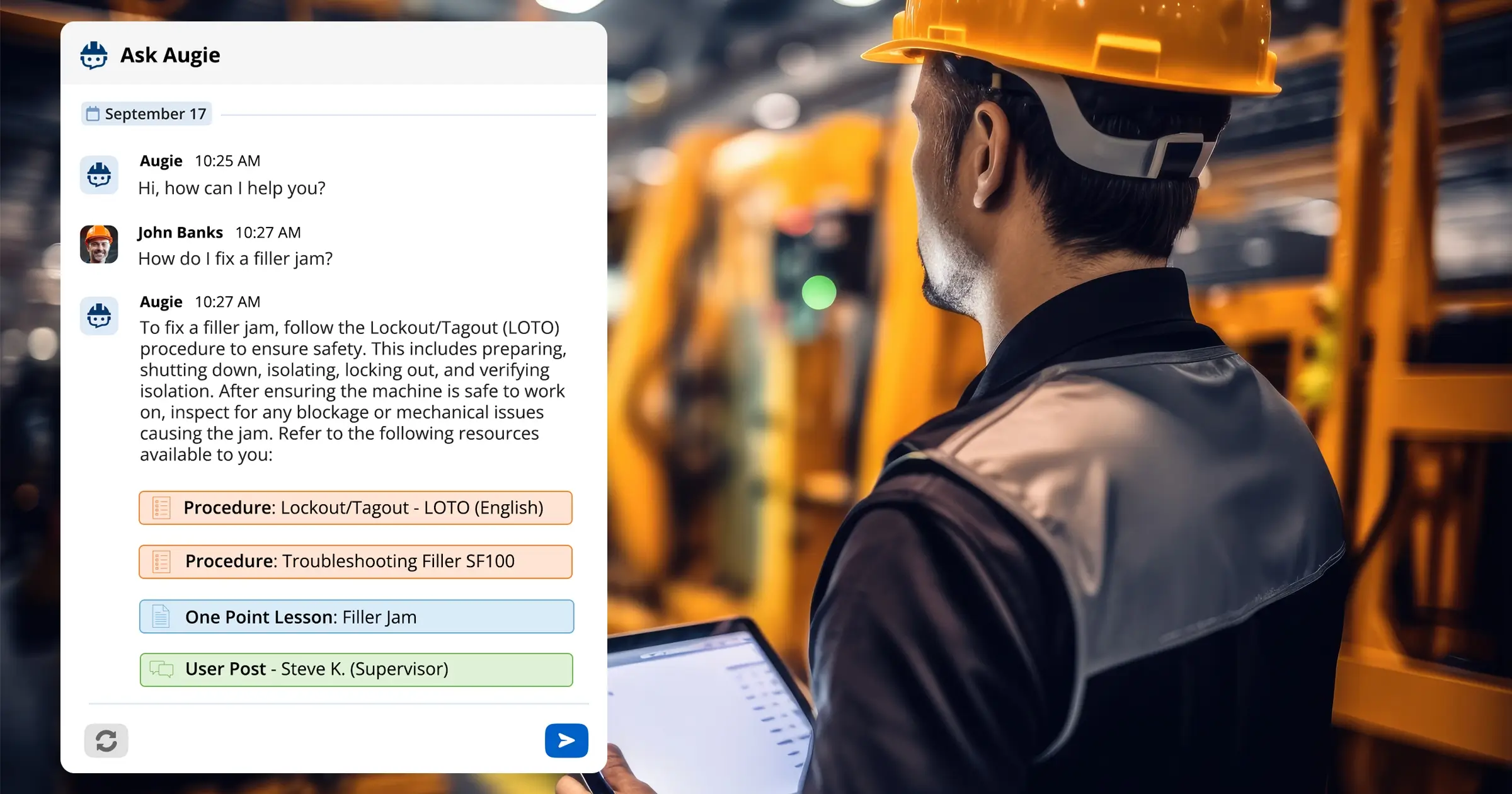

 

See Augmentir in Action
Get in Touch for a Personalized Demo

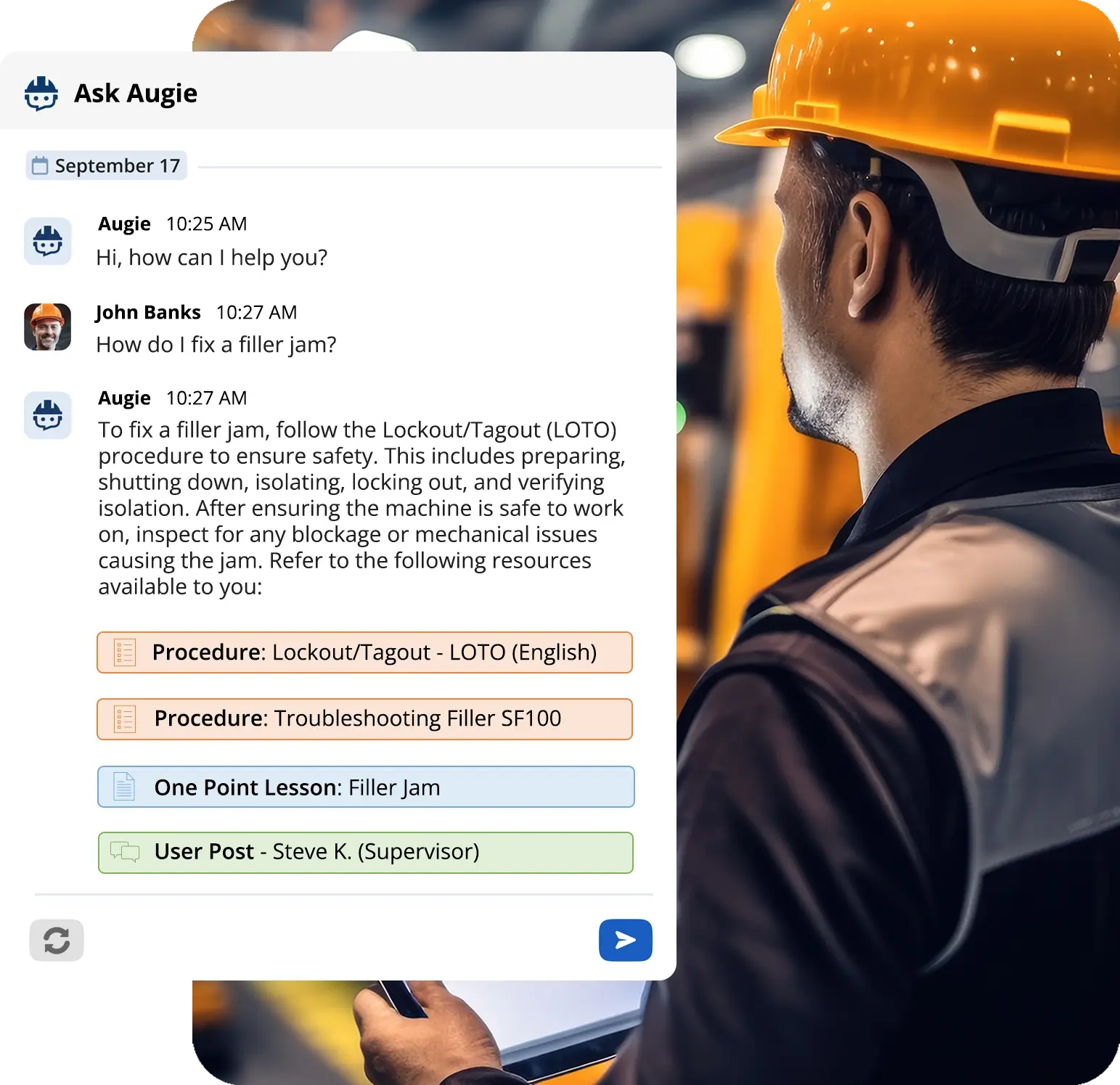
Discover how Augmentir’s Gen AI Suite and Augie transforms how manufacturers support frontline activities and personnel.

We recently unveiled a watershed moment in connected worker technology history with updates and expansions to Augie, our generative AI assistant for industrial work. This expansion drastically improves the breadth and reach of Augie’s capabilities, enhancing the already powerful tool even more and creating a generative AI suite of tools and assistants for frontline industrial work. This first-of-its-kind Augie GenAI Suite, redefines the future of manufacturing, empowering frontline workers everywhere with unmatched AI-driven tools.

But what does this mean for manufacturers and industrial organizations looking to improve their operations and how can Augie help you?

augie industrial generative ai assistant manufacturing

Basically, this suite of generative AI assistants includes dedicated capabilities for companies to enhance their Troubleshooting, Operations, Data Insights, and Content Creation; and even introduces a GenAI-as-a-Service option. This expands on Augie’s existing capabilities for advanced troubleshooting and real-time digital assistance to frontline workers and adds further abilities for advanced safety/risk mitigation, worker compliance, workforce development, knowledge management and training, quality management, and more.

Read below to learn more about the new Augie GenAI Suite, what it can do, what it means for the future of manufacturing work, and how it can help you.

Augie’s Expanded Suite of GenAI Assistants

The Augie suite transforms frontline manufacturing like never before – giving teams instant access to expert knowledge, next-level data insights, and seamless operational support. From troubleshooting to operations and content creation, the possibilities are endless.

Introducing a first-of-its-kind GenAI Suite for industrial work:

Augie Industrial Assistant 2.0

Enhancements include support for dozens of new content types, the addition of patented-pending prompt enrichment, and superior prioritization, resulting in increased accuracy and actionability.

Augie Content Assistant

Automatically convert existing digital content (Word Excel, PDF, etc.) into native Augmentir Work instructions, SOPs, OPLs, CILs, Checklists, etc., accelerating deployment. Generate Training, Checklists, and Quizzes from a wide range of source types including images, manuals, free-form tests, etc., to streamline worker training and onboarding.

Augie Data Assistant

Augie provides insights from any source of operational data, including standard data sets such as Skills, Standard Work, Safety, and Work Execution, as well as customer-specific datasets generated through Augmentir’s report configurator. Augie eliminates/reduces the need for “report writing” and, through its conversational interface, answers questions, performs math, and generates graphical reports, increasing responsiveness.

Augie Extensibility Assistant

The Extensibility Assistant increases the productivity of developers building new and supporting existing user-defined functions in Augmentir’s extensibility framework. Augmentir’s unique Platform-as-a-Service capabilities enable customers and partners to create unique capabilities to solve important business problems, a capability not available elsewhere in the market

Augie Industrial GenAI-as-a-Service

As an industry first, Augie exposes its GenAI capabilities as APIs in Augmentir’s extensibility framework, enabling companies and partners to utilize Industrial genAI within innovative, company or vertical-specific use cases. Commonly used APIs include translateText enabling on-the-fly translation of dynamic content, and imageQA, enabling direct comparison or summarization of images, supporting critical applications in Quality, Safety, and Operations.

This is a true game-changer for frontline manufacturing personnel, equipping them with expert knowledge, advanced tools, and intuitive support like nothing has before. But more than that, these are not just simple upgrades, this is the future of manufacturing, right at the fingertips of those who matter most – frontline personnel.

Advantages of Generative AI Assistants in Manufacturing

Generative AI assistants in manufacturing streamline production by automating repetitive tasks, reducing human error, and optimizing workflows. They enhance decision-making through real-time data analysis, leading to increased efficiency and cost savings. Augie is unique among other smart manufacturing assistants in that it leverages proprietary fit-for-purpose, pre-trained LLMs and generative AI, coupled with robust security and permissions, to help factory managers, operators, and engineers improve efficiency, resolve issues faster, and prevent downtime.

Through Augie, manufacturers can instantly:

  • Close skills and experience gaps with personalized support
  • Gain insights into Leader Standard Work
  • Gain new insights into skills inventories
  • Convert Tribal Knowledge into Digital Corporate Assets
  • Identify opportunities for continuous improvement
  • Forecast potential operational issues

The expansion of the Augie tool kit further enhances these capabilities, allowing for more advanced and adaptable functions such as those described above. With the Augie GenAI suite by your side, the potential for improved frontline support, optimized manufacturing operations, and the empowerment of frontline industrial workforces is limitless.

Supporting Frontline Workers with GenAI Assistants

Augmentir introduced Augie in early 2023, becoming the first software provider in the manufacturing sector to offer a generative AI solution focused on the industrial frontline workforce.

Since its launch, Augie has seen massive support from leading manufacturing organizations. It has been applied by these global leaders across all manufacturing and production types, helping prevent safety and quality issues at the point of work, driving operational efficiency, and giving frontline workers the tools, guidance, and support they need to do their best work.

Augie’s generative AI capabilities are built into the core of the Augmentir platform, so users can quickly and securely leverage the latest AI advances within the framework of digital collaboration, skills management, and work execution. This allows frontline users and other manufacturing personnel to leverage existing data, documents, applications, and their existing tribal knowledge, increasing their ROI.

Interested in learning more?

To learn more about Augie and how it has the potential to transform and augment your frontline workers and activities with patented AI-driven insights and to learn why Augmentir is trusted by leading manufacturers as a reliable digital transformation partner – schedule a demo with one of our product experts.


See Augmentir in Action
Get in Touch for a Personalized Demo

Learn how manufacturers combat the manufacturing skilled labor shortage and close skills gaps with an Augmented Connected Workforce (ACWF).

An Augmented Connected Workforce (ACWF) offers manufacturing and other industrial organizations a powerful solution to combat the ever-worsening skilled labor shortage and skills gap. According to a report by Deloitte and the Manufacturing Institute, an estimated 2.1 million manufacturing jobs could go unfilled by 2030 and the cost of those missing jobs could potentially total $1 trillion in 2030 alone.

augmented connected workforce acwf manufacturing

By integrating advanced technologies like artificial intelligence (AI), connected worker platforms, and other emerging solutions manufacturers can enhance the capabilities of their existing workforce and bridge skill gaps. Connected worker tools offer real-time monitoring of your frontline workforce, ensuring seamless operations. Moreover, connectivity enables remote collaboration, allowing experts to assist frontline workers from anywhere in the world. This interconnected ecosystem empowers workers with the tools they need to succeed and attracts new talent by showcasing a commitment to innovation and technology-driven growth.

Through an ACWF, manufacturers can effectively combat the manufacturing skilled labor shortage and close the skills gap while driving productivity, innovation, and remaining competitive. Read more about ACWF in manufacturing below:

Implementing an ACWF in Manufacturing

A critical element of transitioning from a traditional workforce to an Augmented Connected Workforce (ACWF) is implementing and adopting new technologies and processes. Here are a few steps that can help with the adoption of ACWF technologies and smooth transitions in industrial settings:

  • Step 1: Assess Current Processes – Organizations must understand existing workflows and identify areas where AI, connected worker platforms, and other ACWF technology can replace paper-based and manual processes to enhance efficiency and productivity.
  • Step 2: Invest in Technology – Procure  AI-driven analytics platforms, mobile technology, and wearable technology to enable real-time data collection and remote collaboration.
  • Step 3: Training and Onboarding – Provide comprehensive training programs to familiarize workers with new technologies and workflows. Emphasize the importance of safety protocols and data privacy.
  • Step 4: Pilot Programs – Start with small-scale pilot programs to test the effectiveness of the implemented technologies in real-world manufacturing environments. Target high-value use cases that can benefit from a transition from paper to digital.
  • Step 5: Continuous Improvement – Gather feedback from workers and supervisors during pilot programs and adapt implementation initiatives based on their input. Continuously optimize processes and technologies for maximum effectiveness.

By following these steps, manufacturers can smooth the transition from a traditional manufacturing workforce to an ACWF, empowering their frontline workers with improved capabilities, skills, and overall operational excellence.

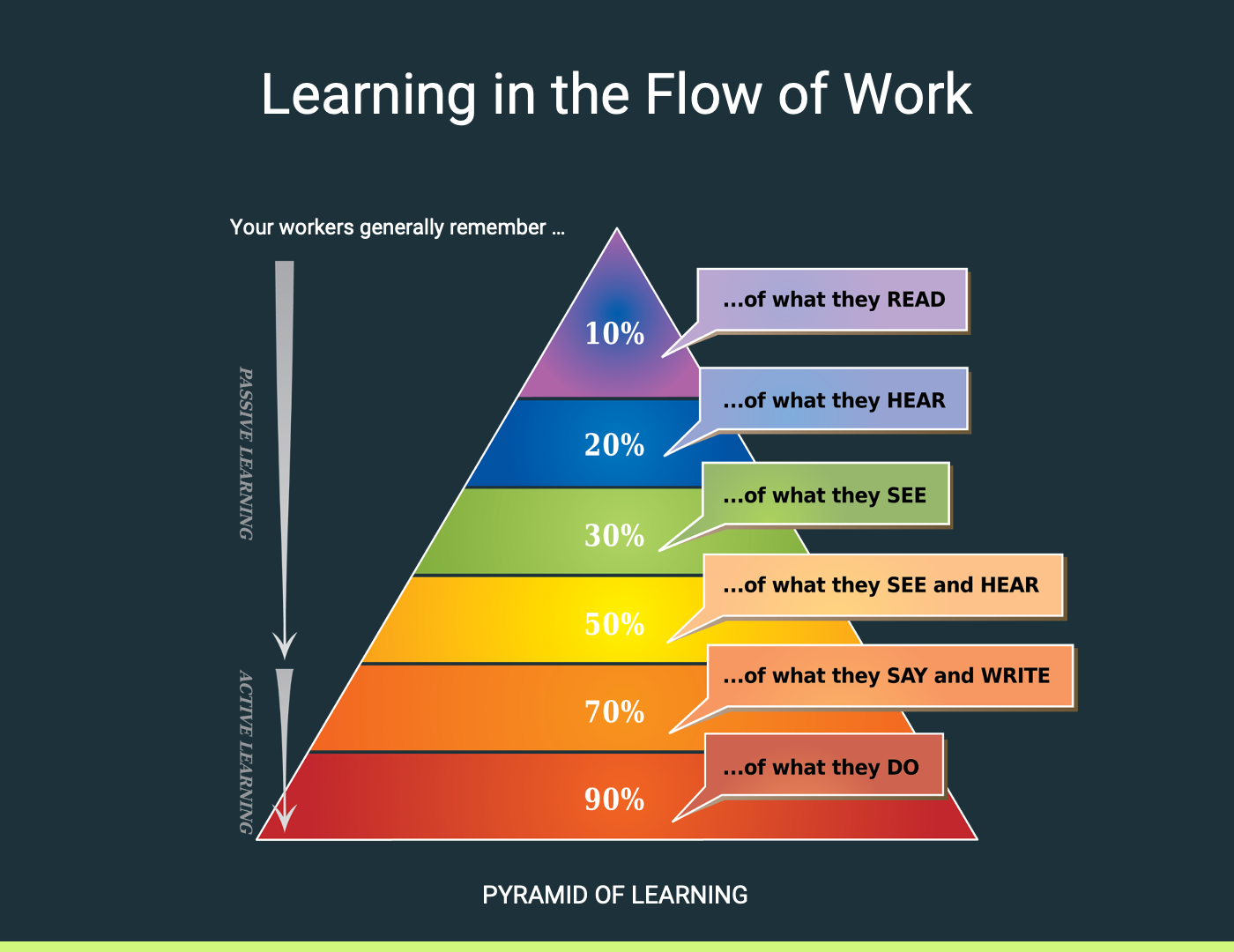
Supporting Learning in the Flow of Work

Augmented Connected Workforce (ACWF) technologies allow for increased frontline support and for new processes around learning and training to strategically upskill and reskill, reduce time to competency for new workers, and to combat the skilled labor shortage in manufacturing and more. Connected worker tools, such as wearable devices and IoT sensors, enable real-time monitoring of worker performance and environmental conditions, ensuring safety and efficiency on the factory floor.

pyramid of learning

An ACWF also allows for improved workflow learning capabilities giving frontline workers access to expert guidance, remote assistance and collaboration, microlearning, and other learning in the flow of work options regardless of the worker’s location.

ACWF tools further enhance frontline activities through:

  • Digital work instructions and guidance: Smart, connected worker platforms provide digital work instructions, procedures, and visual guidance easily accessible to workers on mobile devices.
  • Digital mentors and training: Some ACWFs incorporate “digital mentors” – GenAI-powered industrial assistants that can provide step-by-step guidance to workers, especially new hires.
  • Knowledge capture and sharing: Connected frontline worker applications serve as knowledge sharing platforms, capturing data and insights from frontline workers, which can then be analyzed by AI software and used to improve processes, update work instructions, and share knowledge across the organization
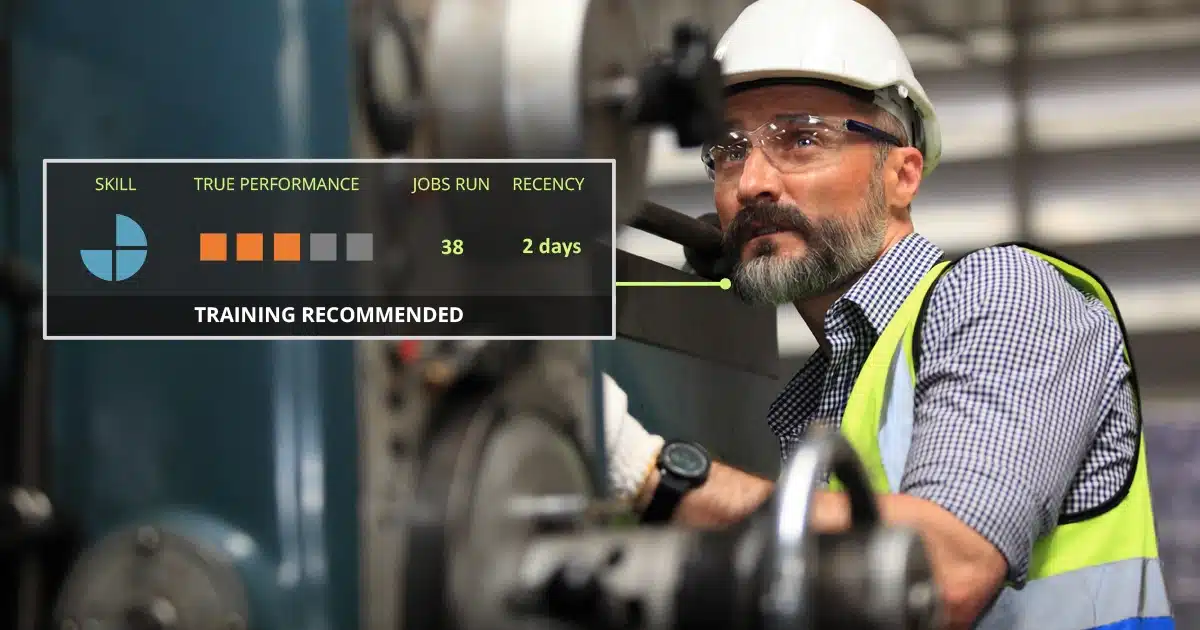
  • Performance monitoring and feedback: ACWF solutions provide visibility into worker performance, allowing managers to identify areas where additional training or support is needed.

augmented connected workforce in manufacturing

In summary, ACWF initiatives empower frontline workers with the digital tools, knowledge, and support they need to learn and improve their skills directly within their daily workflows, rather than relying solely on formal training programs. This helps close skills gaps and drive continuous improvement.

Future-proofing Manufacturing Operations with an ACWF

Adopting an Augmented Connected Workforce (ACWF) approach centered around augmenting frontline workers with mobile technology, immersive training, collaborative decision-making, and continuous improvement, allows manufacturers to future-proof their operations and gain a sustainable competitive advantage. This concept empowers employees with powerful tools that augment and enhance their capabilities, productivity, and overall business processes by accessing critical information and fostering collaboration

AI-powered software can analyze vast amounts of data to optimize production processes and predict workforce development needs. At the same time, connected frontline worker solutions enable the integration of mobile and wearable technologies and provide real-time data insights, aiding in optimizing factory operations and adapting to evolving industry trends.

For an Augmented Connected Workforce, integrating AI and connected worker technologies serves as a vital strategy for manufacturers navigating the skilled labor crisis. Augmentir encourages organizations to embrace ACWF transformations and expedites adoption through a comprehensive connected worker platform leveraging the combined benefits of connected worker and AI technologies.

With Augmentir, frontline workers can access critical information, real-time data and insights, and expert advice and guidance all in the flow of work preventing lost time and improving both efficiency and productivity. Schedule a live demo to learn more about how an Augmented Connected Workforce future-proofs manufacturing operations and enhances frontline activities.


See Augmentir in Action
Get in Touch for a Personalized Demo

Explore the fundamentals of continuous improvement, the challenges of traditional CI methods, and how technologies like Augmentir are transforming continuous improvement in modern manufacturing.

In today’s competitive global market, manufacturers are under constant pressure to produce more efficiently, reduce costs, and deliver higher-quality products—faster than ever before. To stay ahead, continuous improvement is no longer optional; it is essential. This methodology, rooted in principles like Lean Manufacturing, Six Sigma, and Kaizen, focuses on incremental and ongoing enhancements in processes, productivity, and quality. But what sets the leaders apart in the modern era is how they leverage technology to drive and sustain these improvements at scale.

continuous improvement in manufacturing

In this article, we explore the fundamentals of continuous improvement, examine the challenges of traditional CI methods, and highlight how technologies like Augmentir are transforming continuous improvement in modern manufacturing.

The Core of Continuous Improvement

Continuous improvement (CI) in manufacturing involves systematically identifying, analyzing, and enhancing production processes. It is not just about big innovations; often, the smallest tweaks—reducing downtime, improving machine reliability, or streamlining communication—can yield significant ROI.

Key principles include:

  • Employee Involvement: Workers on the shop floor often have the most direct insights into inefficiencies and can be powerful agents of change.
  • Data-Driven Decisions: Improvements should be driven by measurable performance indicators.
  • Standardization and Feedback Loops: Once better methods are discovered, they need to be adopted, documented, and continuously reassessed.

While the philosophy is sound, many manufacturers struggle with implementation. And that’s where the problems begin.

The Problems with Traditional CI Programs

Despite decades of focus on Lean and Six Sigma, many CI initiatives fall short. Why? Because traditional CI programs are often hampered by outdated practices, lack of engagement, and poor data visibility. Here are some of the most common issues:

1. Siloed and Manual Processes

In many plants, improvement efforts are manually tracked—on paper, spreadsheets, or disconnected systems. This siloed data leads to slow feedback loops and inconsistent execution across shifts or facilities.

2. One-Size-Fits-All Approaches

Traditional CI programs often rely on standardized procedures that assume all workers have the same skills and experience. This ignores the wide variation in frontline worker proficiency and limits personalization in training or task guidance.

3. Lack of Real-Time Data

Many organizations make decisions based on lagging indicators like end-of-month scrap reports or audits. Without real-time insight into what’s happening on the floor, it’s impossible to react swiftly or identify the root cause of issues as they emerge.

4. Low Frontline Engagement

CI often becomes a top-down initiative driven by managers and engineers, rather than frontline workers. When operators aren’t empowered or incentivized to contribute, critical on-the-ground insights are lost.

5. Sustainability Challenges

Even when initial improvements are made, organizations often struggle to sustain gains. Without built-in systems for reinforcement, training, and measurement, improvements fade, and old habits resurface.

These problems don’t mean CI is broken—they highlight the need for modernization. That’s where connected technologies and AI come in.

Technologies Fueling Modern Continuous Improvement

To accelerate continuous improvement, modern manufacturers are increasingly embracing Industry 4.0 technologies—an approach popularized by German engineer and economist Klaus Schwab in his 2016 book The Fourth Industrial Revolution. This movement is reshaping manufacturing by integrating smart technologies that optimize production processes and enhance decision-making. Among the most impactful advancements are Connected Worker Platforms and Artificial Intelligence (AI), both of which are transforming how work is executed and improved on the shop floor.

the connected worker lifecycle and continuous improvement in manufacturing

Connected Worker Platforms

Connected worker platforms provide real-time visibility and data from the shop floor. These platforms link frontline workers with digital tools that enhance communication, guide tasks, and collect performance data. Key benefits include:

  • Standardized Work Instructions
  • Real-Time Communication and Support
  • Digital Training approaches that enhance corporate training methodologies, such as Training Within Industry (TWI)
  • Performance Data for Targeted Improvements

Artificial Intelligence (AI)

AI takes CI to the next level by analyzing massive amounts of operational data—spotting trends, predicting outcomes, and recommending optimizations. Benefits include:

  • Root Cause Analysis
  • Predictive Maintenance and Forecasting
  • Intelligent Guidance for Tasks and Training

Together, these technologies enable a dynamic, responsive CI process that adapts to real-world conditions and human variability.

Augmentir: Elevating Continuous Improvement with AI-Powered Connected Work

In the modern manufacturing landscape, tools that enhance worker productivity, decision-making, and operational visibility are essential. That’s where Augmentir stands out. As a next-generation Smart Connected Worker Platform, Augmentir is uniquely designed to empower frontline workers and enable continuous improvement at scale—using the power of artificial intelligence.

Unlike traditional connected worker solutions that merely digitize paper-based processes, Augmentir goes further. It not only captures data from the frontline—it makes that data intelligent, actionable, and personalized. With built-in AI capabilities, Augmentir helps manufacturers bridge the gap between people, processes, and performance improvement.

What Makes Augmentir Different?

At its core, Augmentir offers a suite of tools that digitize, guide, and optimize frontline work:

Personalized Digital Work Instructions

Augmentir enables the creation and deployment of dynamic, multimedia-rich work instructions. These are personalized based on worker proficiency, reducing errors and improving quality.

connected worker technology for safety compliance


Smart Workforce Management

With real-time skill tracking and performance analytics, Augmentir ensures that the right task is assigned to the right worker—improving efficiency and safety.


Industrial Collaboration

With manufacturing collaboration software from Augmentir, frontline teams can effectively collaborate and share information across across shifts, plants, and languages.

manufacturing collaboration software from augmentir for continuous improvement in manufacturing

Operational Visibility

Every interaction on the shop floor is captured and analyzed to surface trends, bottlenecks, and areas for improvement. Unlike traditional audits or passive reports, Augmentir offers continuous, real-time insights.

workforce performance insights with augmentir ai platform

Generative AI Assistant

Augie, Augmentir’s generative AI assistant, accelerates continuous improvement by delivering real-time insights, generating digital SOPs, and offering intelligent recommendations based on frontline data. By transforming operational activity into actionable guidance, Augie empowers teams to identify inefficiencies, reduce errors, and drive faster, more effective improvements.

augie generative ai assistant for manufacturing standard work

Continuous improvement is the heartbeat of modern manufacturing excellence. But in today’s environment, traditional methods alone are not enough. The path forward lies in combining proven CI philosophies with digital innovation.

With platforms like Augmentir, and tools like Augie, manufacturers can move from reactive problem-solving to proactive performance enhancement—empowering workers, accelerating learning, and ensuring sustainable results.

The future of manufacturing is connected, intelligent, and continuously improving.


See Augmentir in Action
Get in Touch for a Personalized Demo

In conversations with our customers, a recurring theme emerges when discussing their transition to digital processes: the largest cost and burden often lies in the time and effort required to digitize existing paper-based materials.

In conversations we have with manufacturing companies, a recurring theme emerges when discussing their transition to a paperless operation: the largest cost and burden often lies in the time and effort required to digitize existing paper-based materials.

digitizing frontline work with the augie gen ai suite

Standard Operating Procedures (SOPs), work instructions, and checklists are typically built over years, representing a significant repository of organizational knowledge. Converting these into digital formats while maintaining accuracy and accessibility can be daunting.

Customers frequently express concerns about the resource-intensive nature of this transformation. It’s not just about scanning documents; it’s about rethinking and structuring them for digital workflows. Many find themselves needing to allocate substantial time to review, update, and adapt content to ensure it aligns with current operational realities and integrates seamlessly into new platforms.


This challenge is real for any industrial company undergoing a transformation to digital manufacturing. It also represents an opportunity … and this is exactly why we created Augie.

The Power of GenAI in Digitizing Content

Generative AI (GenAI) has transformative potential for digitizing content by automating the conversion of paper-based materials into structured, digital formats. It can analyze and extract information from documents like SOPs, work instructions, or checklists, quickly translating them into editable, standardized templates. GenAI also enables content enhancement, such as rewriting for clarity, integrating visuals, language translation, or adapting content for specific workflows. By accelerating the digitization process and reducing manual effort, GenAI empowers organizations to transition to digital systems more efficiently and cost-effectively.

Augie, a suite of Industrial Generative AI tools from Augmentir, revolutionizes industrial digital transformation by combining advanced AI capabilities with practical, human-centric applications. Augie uses generative AI and the power of advanced Large Language Models (LLMs) to transform digital content creation, create adaptive workflows, provide real-time worker guidance, and analyze data to deliver actionable insights.


Augie has been instrumental in helping us quickly transform our existing paper-based SOPs and training documents into interactive digital work instructions and learning tools. We’ve reduced our digitization effort from months down to days. This has streamlined our processes, reduced errors, and accelerated the upskilling of our workforce.

Digital Transformation Lead
Fortune 100 Food & Beverage Manufacturer


Augie for Procedure Creation

Augie is a powerful tool for accelerating the transition from paper-based to digital operations in manufacturing and industrial settings.

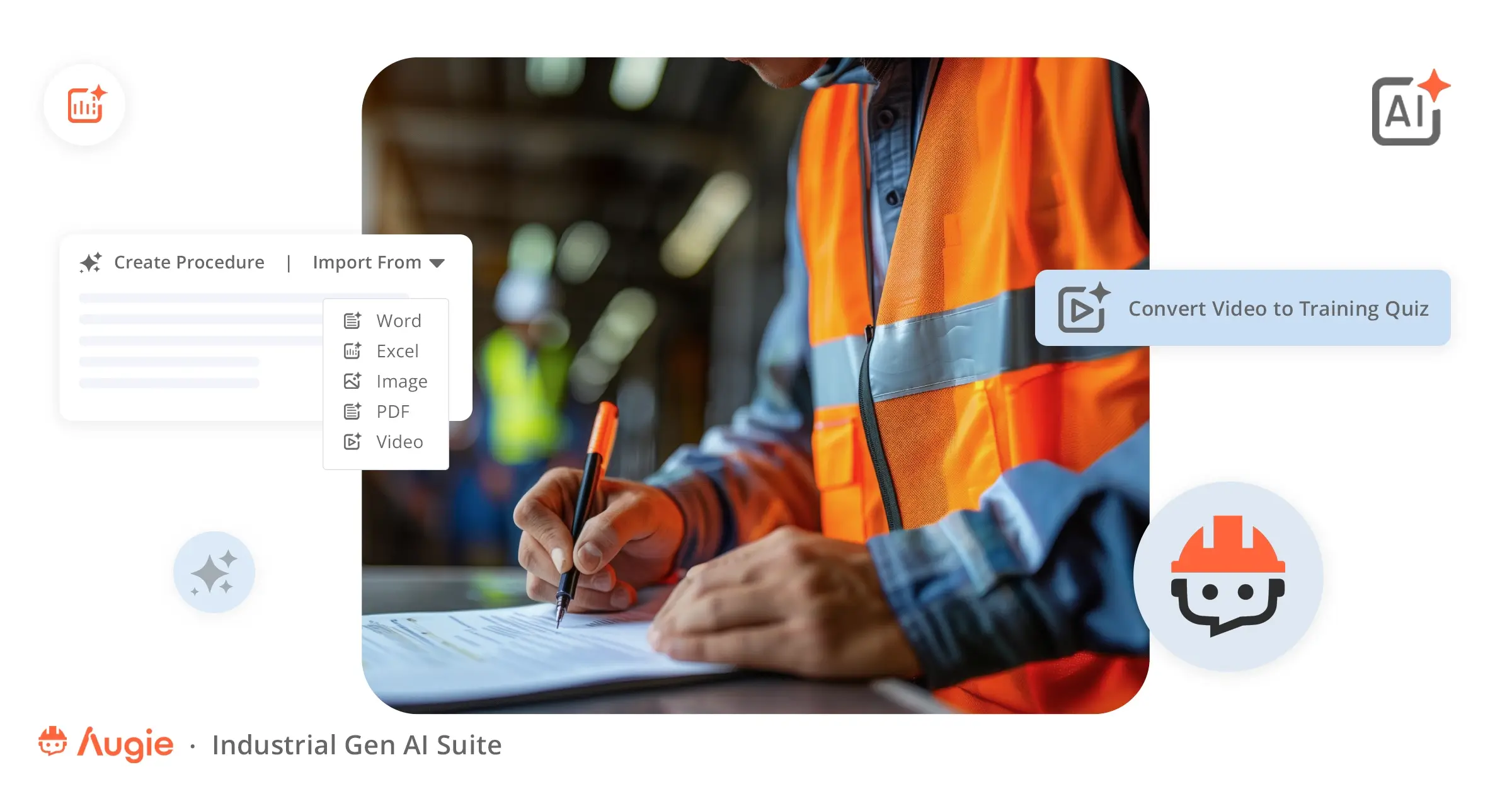
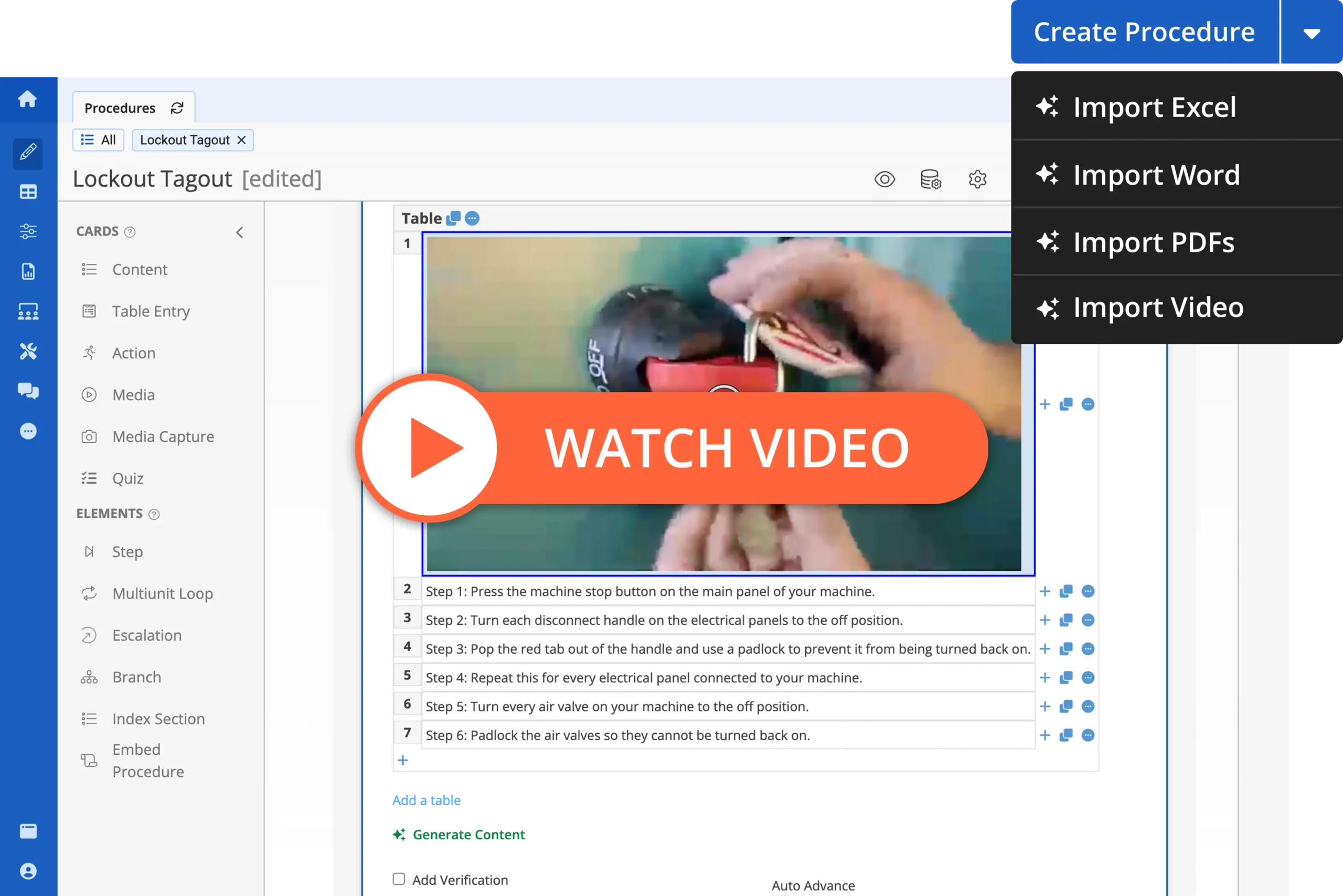
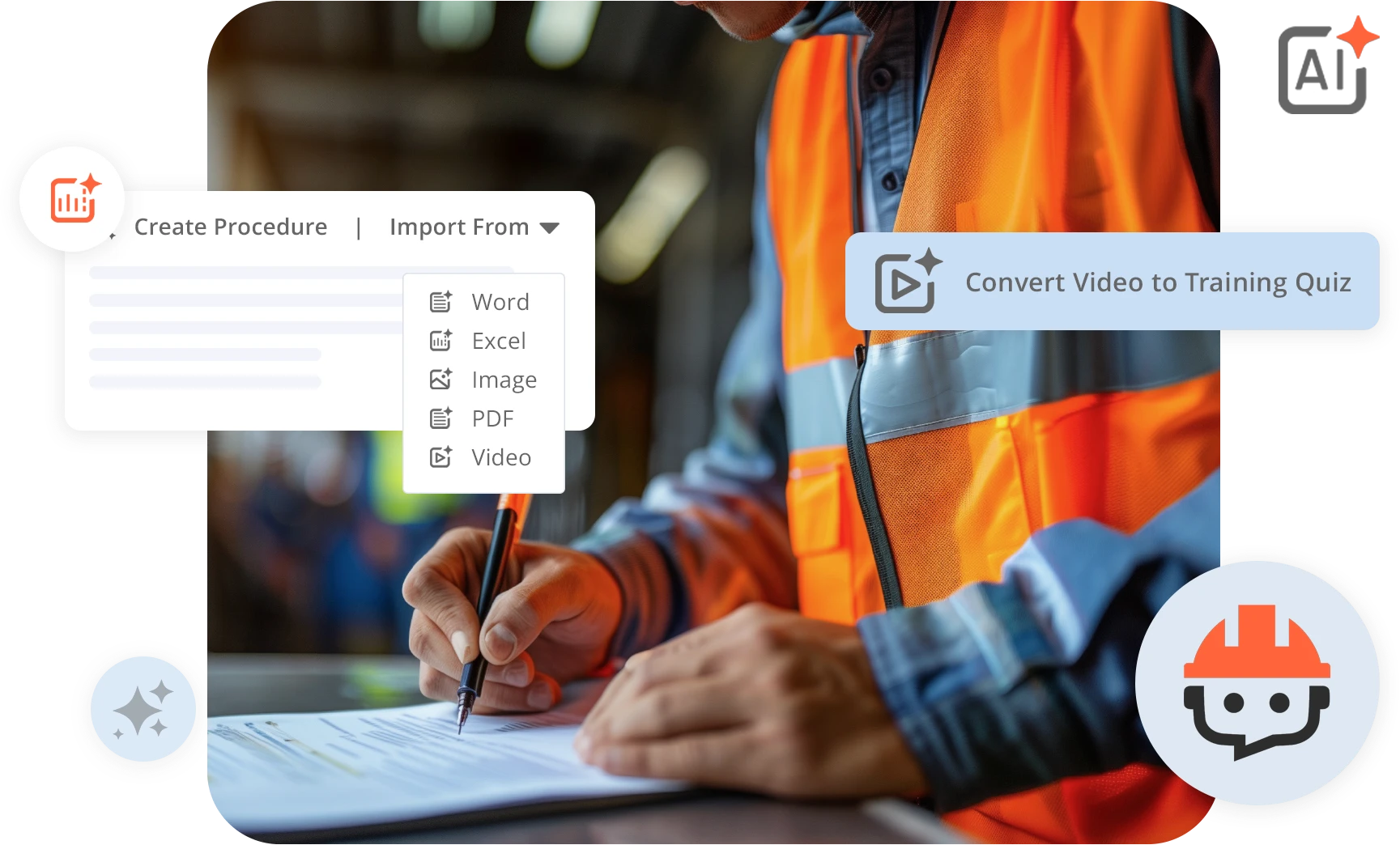
Quickly generate standard work procedures from Excel, Word, PDFs, images, or videos. The Augie Content Assistant takes your existing content and generates digital smart forms, checklists, and digital work instructions. Augie can summarize the exchange of tribal knowledge via collaboration and convert these to scalable, curated digital assets that can be shared instantly across your organization.

augie gen ai content assistant - convert video to procedure

Augie for Training Content

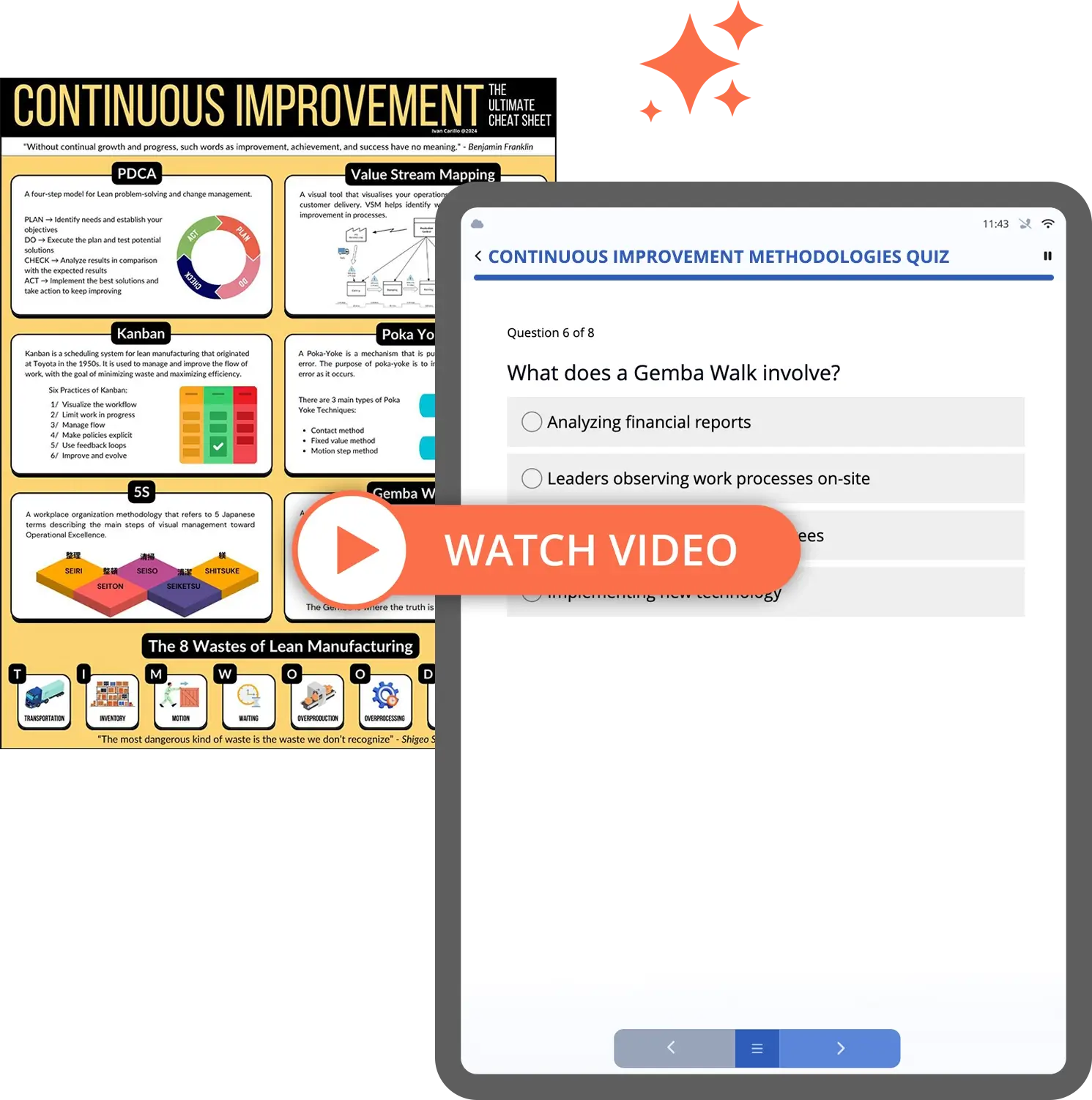
Augie, Augmentir’s GenAI assistant, makes it easier to convert paper-based information into tailored training content and quizzes for today’s less experienced frontline workforce. Augie automatically analyzes SOPs, work instructions, and other documents to create clear, simplified training modules. It generates interactive quizzes to reinforce key concepts and adapts learning materials to individual skill levels, ensuring workers engage with relevant content.

augie industrial copilot generative ai assistant for training and quiz creation

By streamlining this process, Augie reduces the effort and time required to create effective, hands-on training tools for workforce development.

Augie for Content Localization

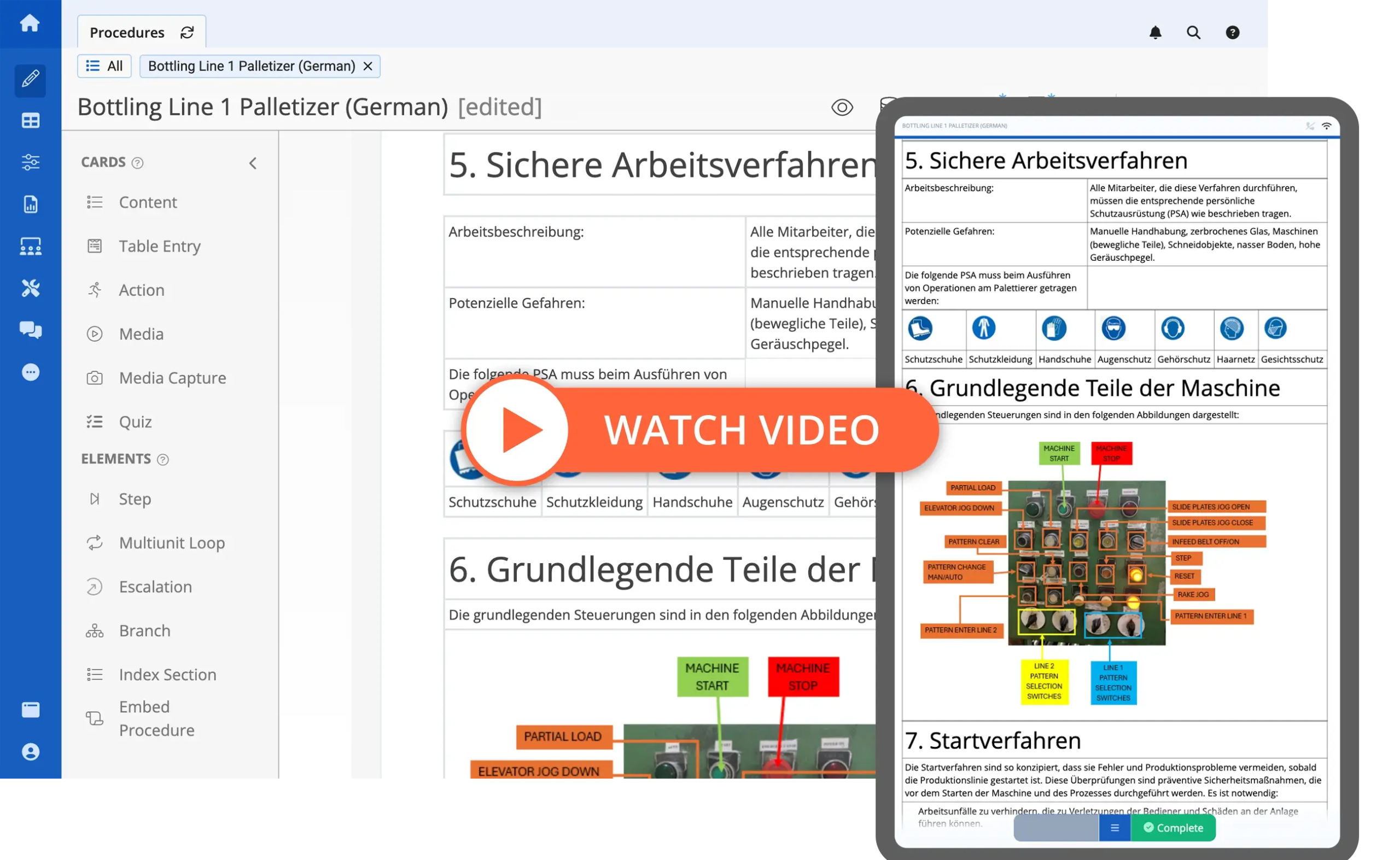
Language translation and localization are crucial for ensuring work instructions and training materials are effective and accessible for frontline workers in manufacturing and any industrial setting. Providing materials in a worker’s native language increases comprehension, reduces errors, and enhances safety.

With Augie, content localization is easy. Augie’s content localization tools make work instructions and training materials more relatable and actionable. This investment fosters better workforce performance, inclusivity, and compliance with global standards.

augie gen ai suite assistant for content localization

The Next Phase of AI in Manufacturing is Here

Augie redefines the next phase of AI in manufacturing by seamlessly integrating generative AI into frontline operations to accelerate digitization, as well as enhance productivity and worker empowerment. Augie includes a complete suite of AI-powered assistants and AI services that help bridge the skills gap, accelerate onboarding, and ensure frontline workers are equipped with the knowledge they need to succeed.

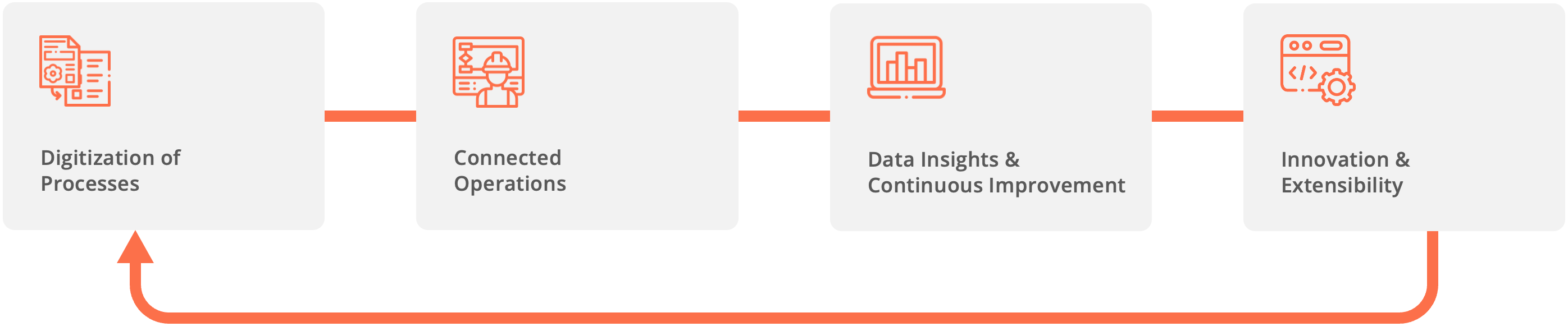
The Augie Industrial Gen AI Suite transforms every stage of the Connected Worker Journey.


augie transforms your connected worker journey


Augie transforms every stage of the connected worker journey by providing a complete suite of AI tools that evolves alongside an organization’s needs. It begins with the digitization of processes and the conversion of static, paper-based content into dynamic, interactive digital workflows, making operations more accessible and efficient for frontline workers. As operations become connected, Augie leverages real-time data to deliver actionable insights, enabling companies to identify inefficiencies, improve workflows, and drive continuous improvement.

Beyond operational enhancements, Augie fosters continuous innovation through its extensibility and seamless integrations with other enterprise systems, creating a unified, scalable ecosystem that adapts to new challenges and opportunities. By addressing every phase of the connected worker journey, Augie empowers organizations to not only modernize their operations but also build a foundation for long-term success and innovation.


Now is the time to embrace the future of manufacturing—don’t miss out on the opportunity to empower your workforce and elevate your operations with Augie. Take the first step toward a smarter, more efficient manufacturing environment today.


See Augmentir in Action
Get in Touch for a Personalized Demo

Discover how Augmentir’s AI transforms the connected worker journey—boosting training, productivity, and continuous improvement across operations.

In an era defined by digital transformation and workforce disruption, industrial companies are reimagining how they support their frontline teams. At the heart of this shift is the Connected Worker—a worker empowered by technology to perform safely, efficiently, and with confidence.

But enabling a connected workforce requires more than just digitizing procedures or implementing standalone tools. It demands intelligence embedded throughout the entire worker lifecycle.

the connected worker journey - powered by augmentir ai

That’s where Augmentir’s AI-powered Connected Worker platform shines. By infusing intelligence into every phase of the connected worker journey—from content creation to onboarding, daily operations, and continuous improvement—Augmentir delivers measurable gains in productivity, safety, and workforce engagement.

A Framework for Transformation: The Connected Worker Journey

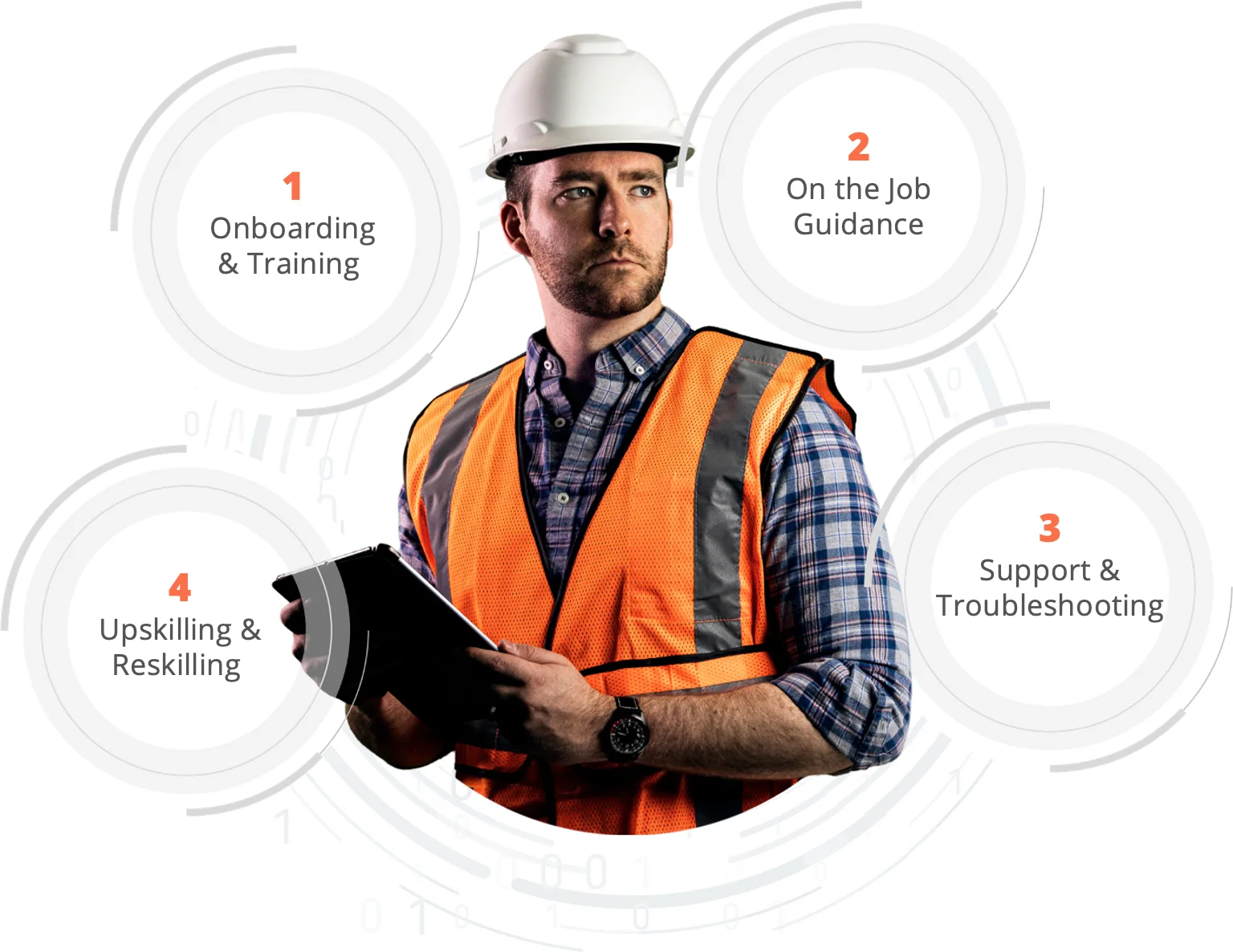
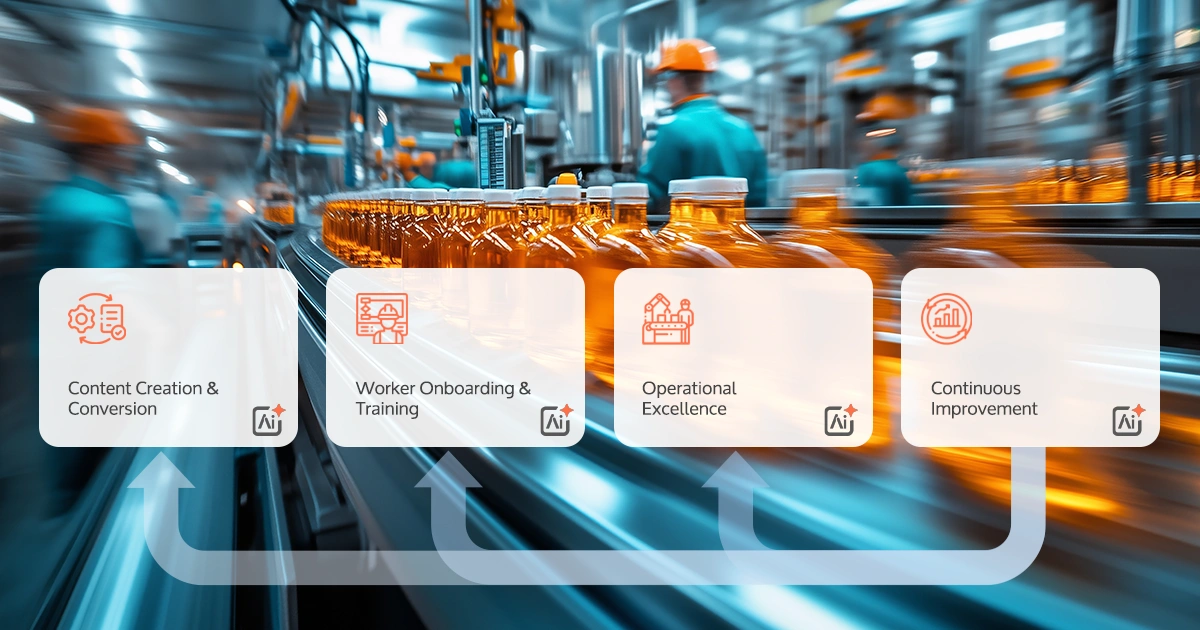
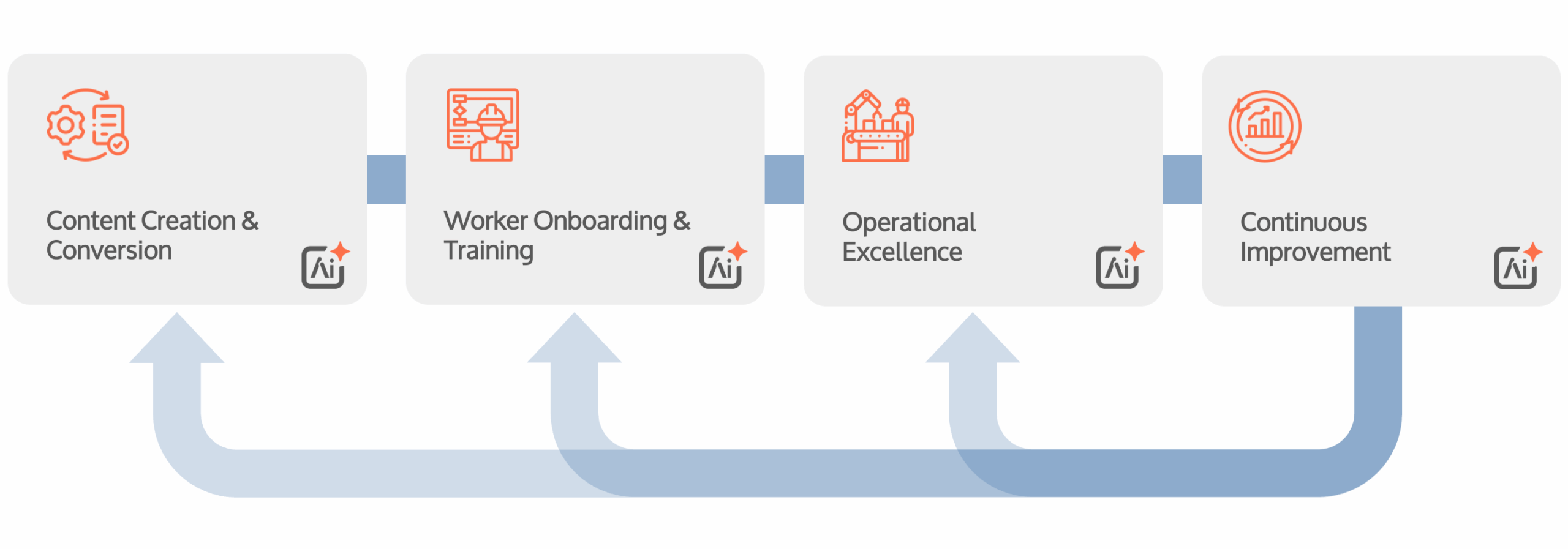
The Connected Worker Journey consists of four critical, interrelated stages:

  1. Content Conversion & Creation
  2. Worker Onboarding & Training
  3. Operational Excellence
  4. Continuous Improvement

connected worker journey

At each phase, Augmentir’s embedded AI transforms outdated processes into intelligent workflows—helping organizations streamline deployment, scale training, and drive continuous value.

Let’s explore how.

1. Content Conversion & Creation

Laying the Foundation for Frontline Intelligence

Deploying modern Connected Worker software delivers ROI through a combination of features that support data collection, compliance, auditability, and data visibility for enabling continuous improvement.

For all companies, the Connected Worker journey begins with transforming legacy documents—SOPs, work instructions, training manuals, checklists, videos, and more—into structured, digital-ready formats that support the requirements above.

This means converting thousands (to tens of thousands) of legacy documents trapped in PDFs, Word docs, Excel files, Powerpoints, videos, and proprietary systems, all while trying to preserve their structure, intent, and compliance relevance. In the past, this process was typically manual, becoming one of the costliest and longest phases in the Connected Worker journey.

Augmentir, even prior to Generative AI (GenAI) era, has been a pioneer in providing tools to significantly reduce this effort even while meeting the three fundamental requirements of conversion:

  • Maintain the integrity of the form design: the format of legacy documents did not arrive by chance, rather they were the result of serious considerations for human factors. Arbitrarily changing these designs results in significant retraining of the frontline workforce, loss of usability, and potentially, significant operational qualification costs in regulated use cases.
  • Simplify the addition of data collection: make incorporating data collection throughout the form simple, efficient, and smart. Data collection offers the opportunity for smart validation, data driven conditional workflows, escalation, and continuous improvement.
  • Embed granular event tracking: Connected Worker ROI depends on the ability to provide compliance and auditability, which is enabled through granular event tracking. Additionally, continuous improvement relies on AI-optimized data from digital time and motion studies, which is automatically captured and processed through Augmentir’s patented True Productivity™ algorithm.

Today, general purpose GenAI tools offer the tantalizing vision that they can transform this process by accelerating the conversion of legacy digital content into, structured content suitable for Connected Worker use cases. There are examples where GenAI has been demonstrated as a general purpose solution to performing these conversions. Unfortunately, in each of the examples that Augmentir has reviewed, these tools met none of the fundamental conversion requirements.

create and convert content with augie as a first step in your connected worker journey

Included in Augmentir’s suite of Industrial GenAI tools, is Augie™ Content Assistant, which is purpose-built for Connected Worker use cases. Augie has been built with domain specific tooling which, when combined with advanced large language models (LLMs), delivers intelligent content that meets the foundational requirements of the Connected Worker space.

With the Augie Content Assistant, Augmentir turns the challenge of content digitization into a fast, AI-driven advantage:

  • 91% faster content conversion: What used to take hours now takes just minutes to convert a single document. When scaled across an organization’s entire repository of SOPs, work instructions, training materials, and more, this reduces the overall content conversion effort from months down to days.
  • Multi-format compatibility: Word, Excel, PowerPoint, PDFs, images, and narrated videos are seamlessly converted into native Augmentir content, complete with data collection and high resolution embedded event tracking.
  • Fidelity preserved: Structure, logic, and intent are maintained through AI-optimized prompts. This ensures that converted content mirrors the original format workers are familiar with—helping reduce change fatigue and making it easier for frontline teams to adopt digital workflows with minimal disruption.
  • Instant translation: Localize content quickly without compromising compliance or clarity.

augie gen ai content assistant - convert video to procedure

This is more than digitization—it’s intelligent transformation that enables data collection, auditability, and operational scalability from day one.

2. Worker Onboarding & Training

Adaptive Support That Accelerates Learning

Once your content foundation is in place, the next challenge is onboarding and upskilling your workforce. Traditional methods are static, generic, and fail to reflect real-time needs.

With Augmentir’s Augie Training Assistant and AI Agents, onboarding becomes a personalized, dynamic experience:

  • Tailored workflows: New hires are guided step-by-step based on their role, skill level, and assigned tasks.
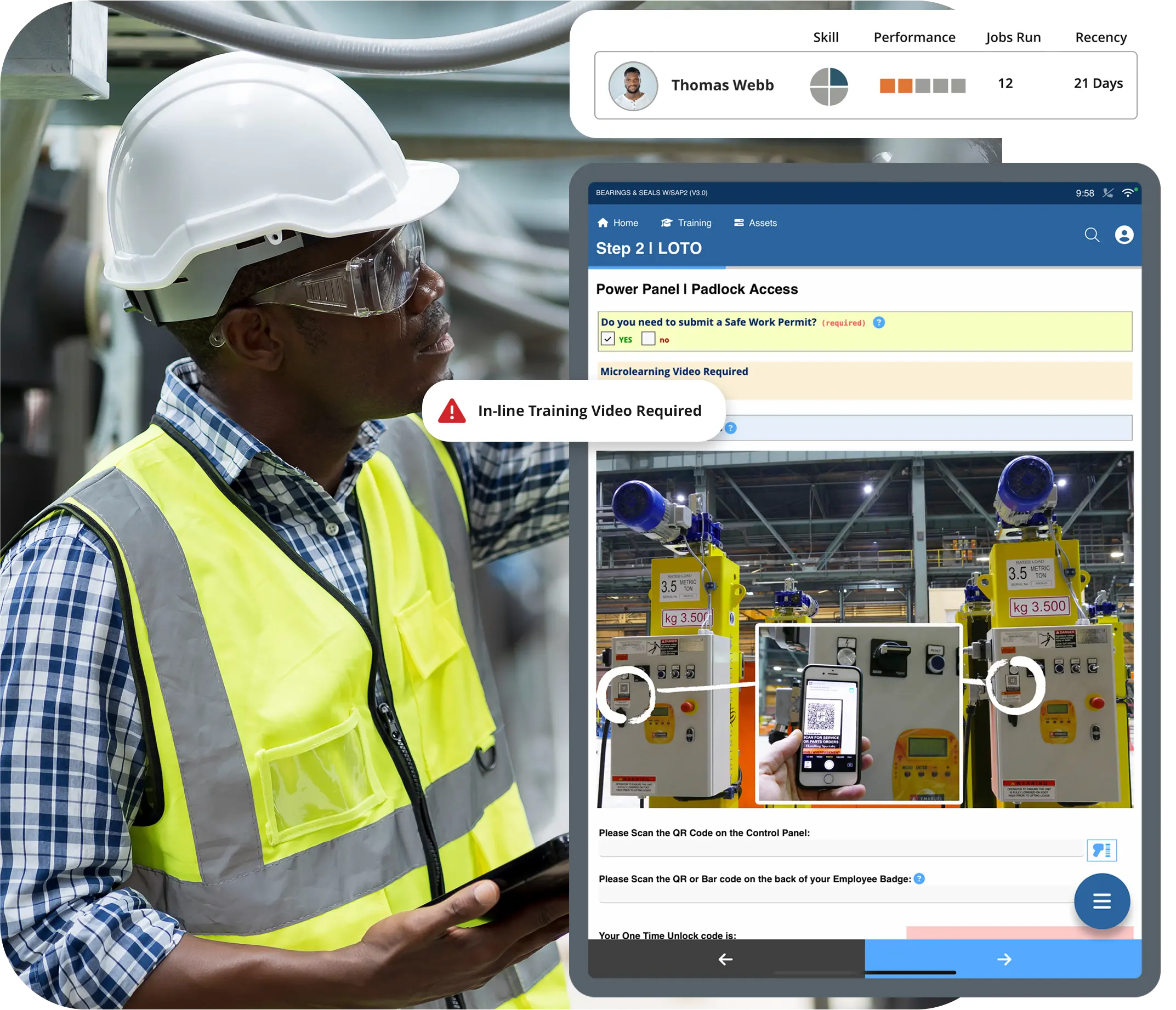
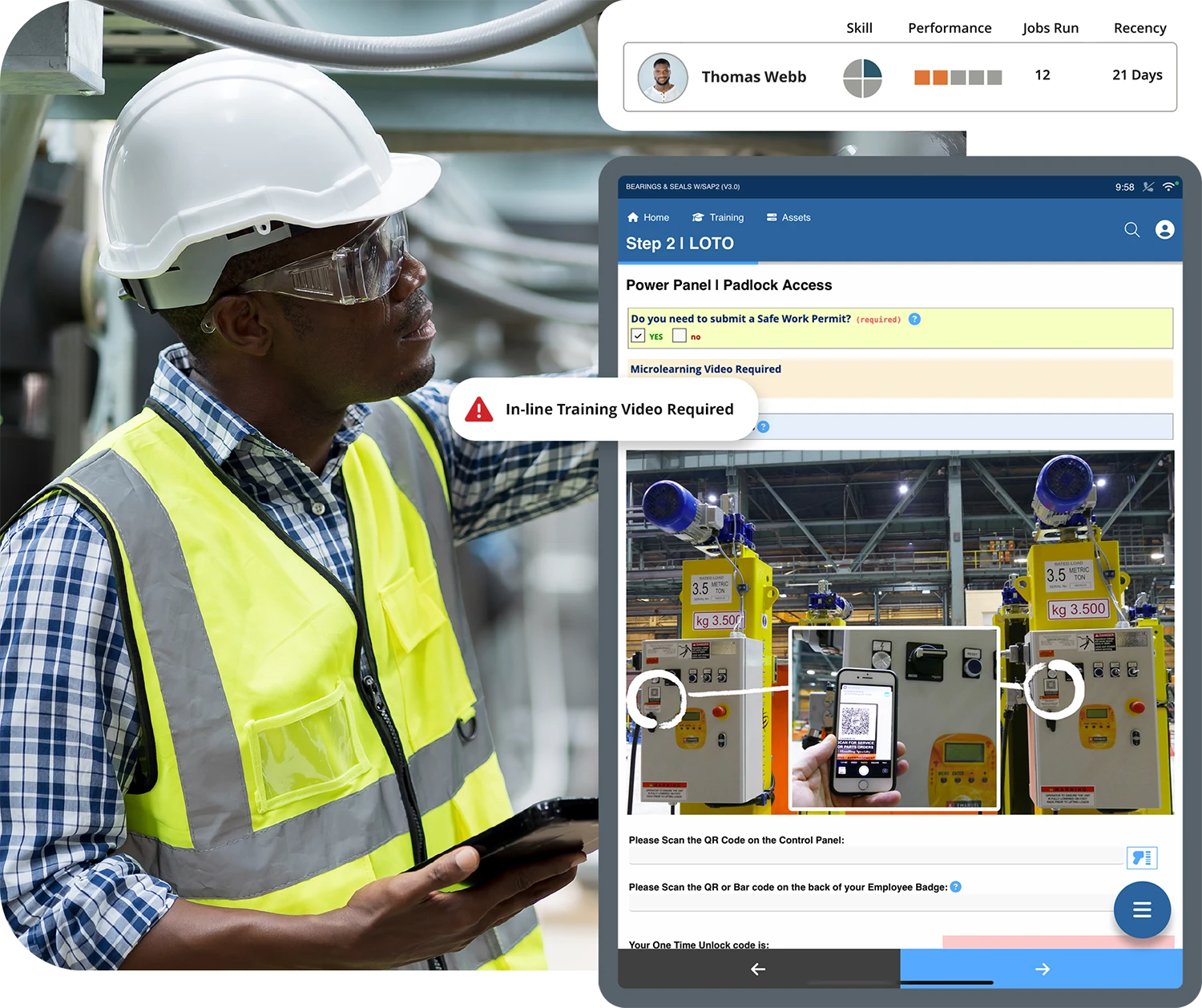
  • Training in the flow of work: Instruction happens in real time, with guidance delivered during actual task execution.
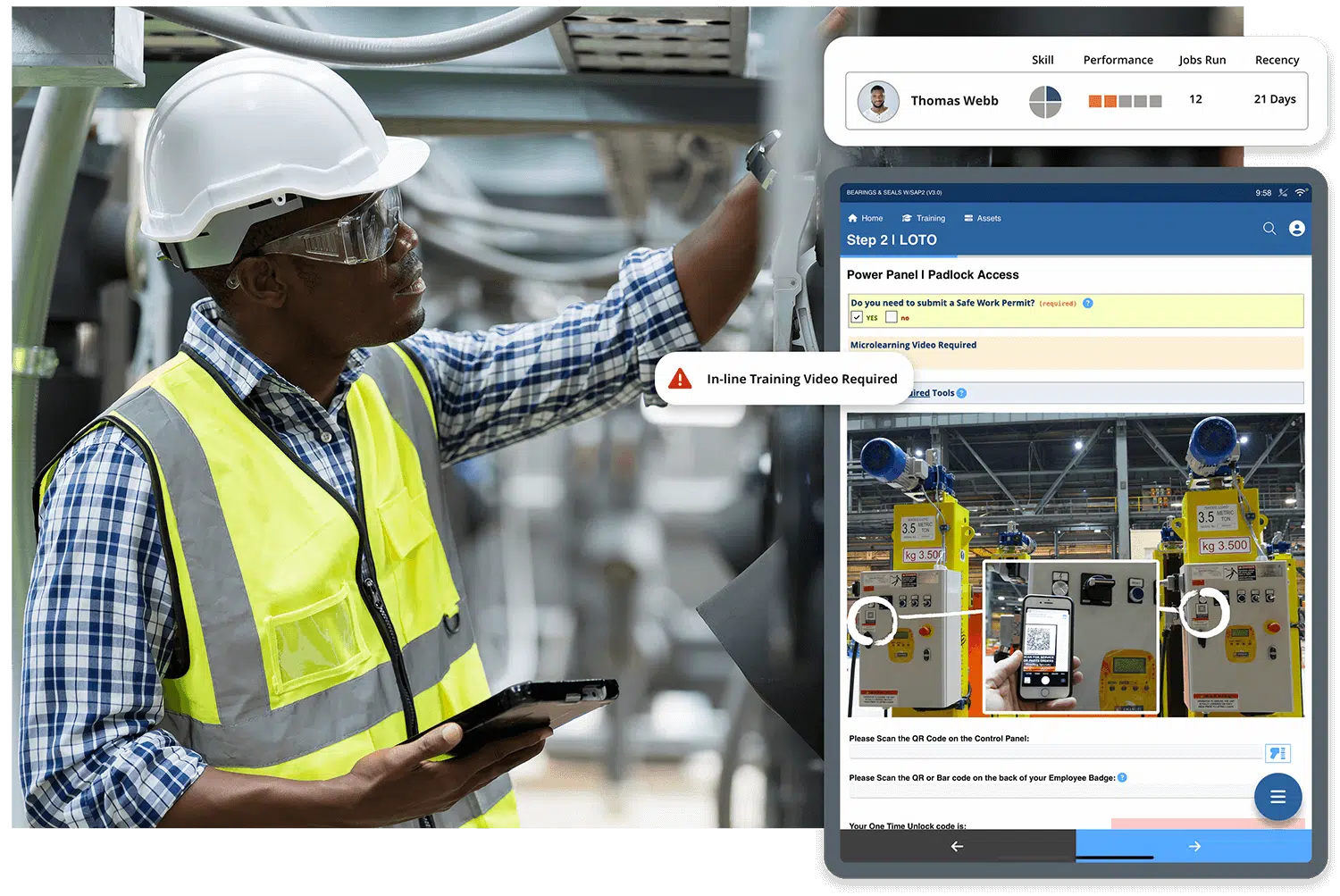
  • Digital assistants ensure worker safety and compliance: Workers have natural language access to digital assistants to guide and support them while they work—enforcing safety, quality, and best practices.
  • Continuous adaptation: Augmentir’s True Opportunity™ AI continuously monitors skilling and reskilling performance and adjusts training content based on worker feedback and progression.

using AI for worker onboarding and training as part of the connected worker journey

This ensures faster ramp-up times, better comprehension, and more confident employees from day one.

3. Operational Excellence

Smarter, Safer, More Productive Frontline Work

With your workforce engaged and trained, the next step is supporting them during everyday operations. Here, Augmentir’s AI becomes a digital copilot—delivering real-time, personalized support in the flow of work.

With your workforce engaged and trained, the next step is supporting them during everyday operations. Here, Augie Work Assistant, which is fully customizable and extensible by customers, becomes a role-specific digital copilot—delivering real-time, personalized support in the flow of work.

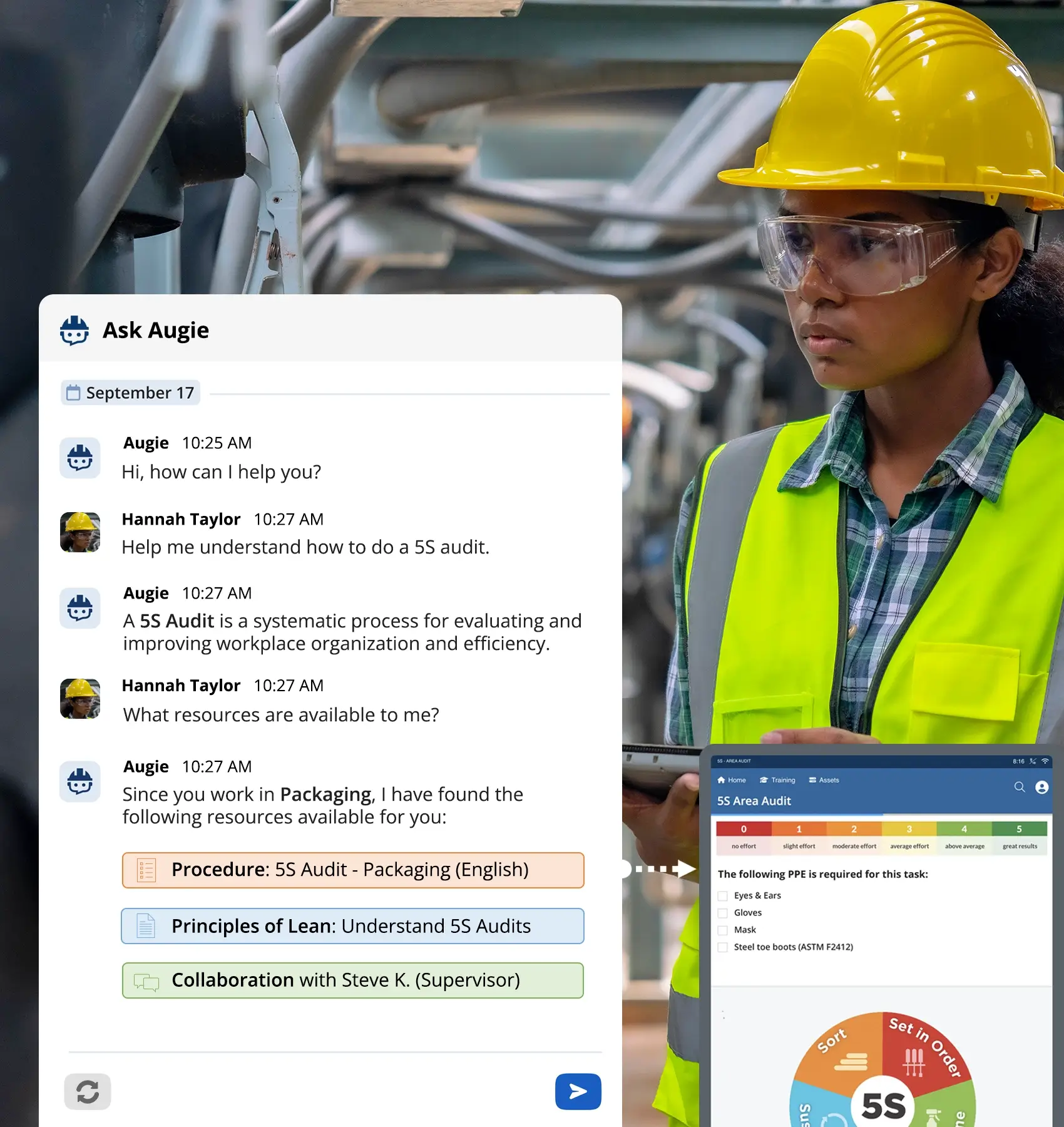
augie industrial generative ai assistant

Key capabilities include:

  • Task-specific guidance: Augie delivers insight tailored to the person, the task, and the real-time conditions.
  • Role-Specific Digital SME: The Augie Work Assistant can be configured at the role level, provides always-on expertise that is tuned to needs to each person in each role—answering questions, flagging issues, and improving accuracy.
  • AI-powered integration: Embedded AI APIs automate documentation, resolve issues in real time, and enable intelligent quality checks.

The result? Fewer errors, faster resolutions, and safer, more confident workers.

4. Continuous Improvement

Closing the Loop with Actionable Insights

Continuous improvement (CI) doesn’t just happen—it requires the right data, insights, and tools to identify what matters most. Augmentir empowers teams to move from guesswork to precision by surfacing opportunities directly from real-world operations.

the difference between skills development and training in manufacturing

AI-powered tools include:

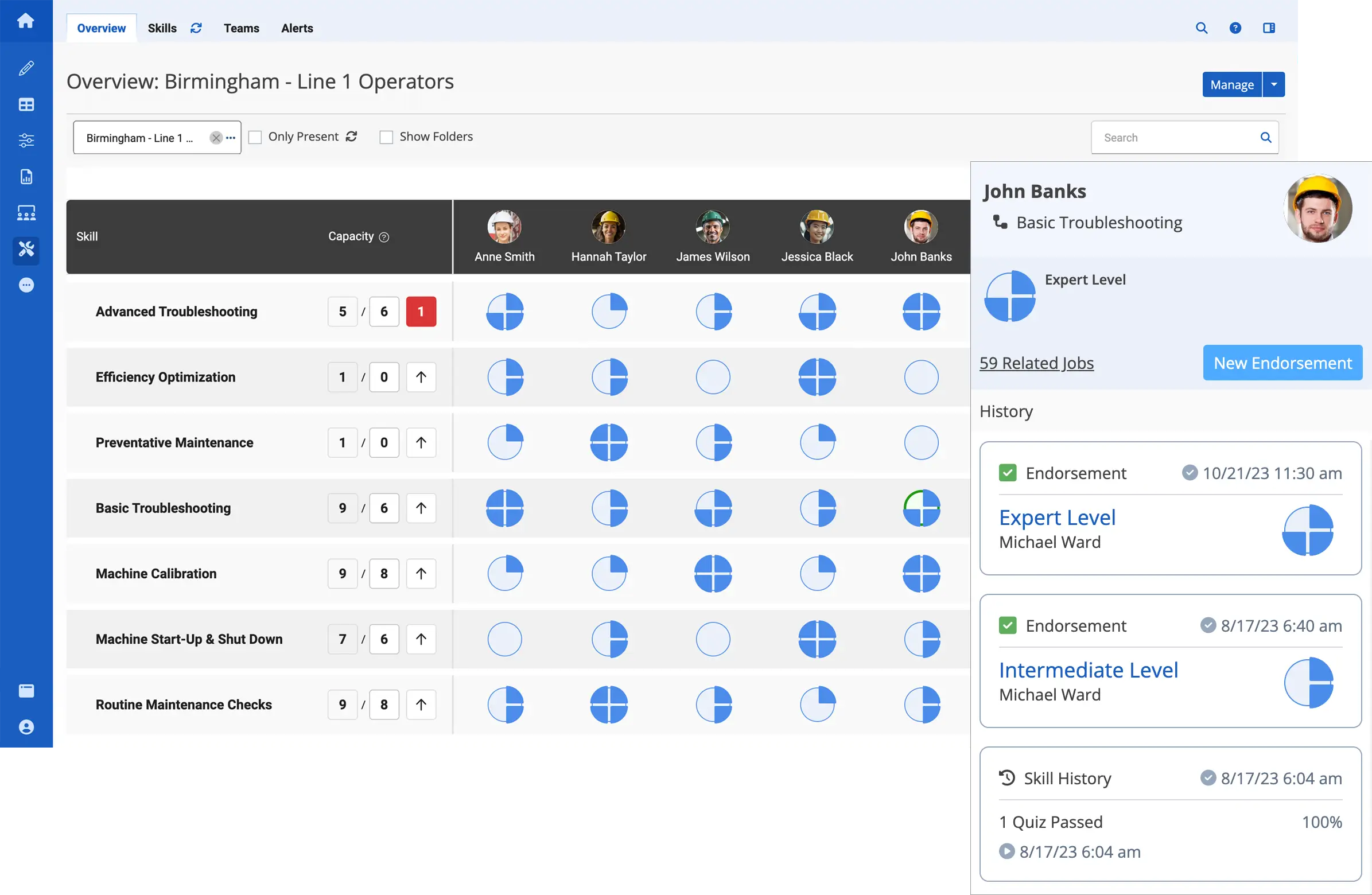
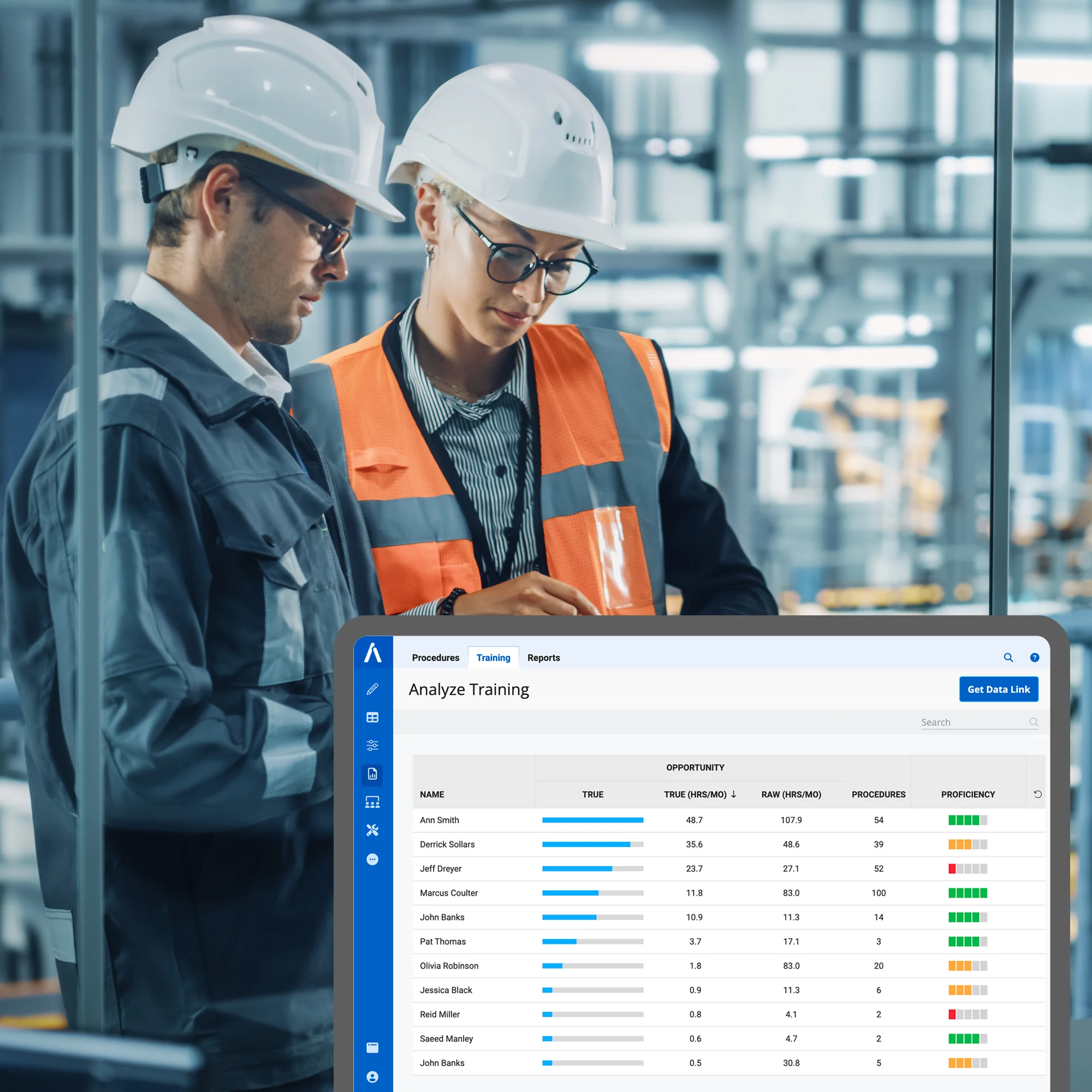
  • True Proficiency: Aligns training and performance data to uncover skill gaps and enhance learning programs.
  • True Opportunity: Pinpoints the highest-impact areas for improving quality, productivity, and safety.
  • Augie Data Assistant: Enables natural-language queries to quickly reveal trends, inefficiencies, or outliers.
  • Augie Content Assistant: Capture & Convert tribal knowledge embedded in informal collaboration into formal, reusable SOPs.
  • Augie Autonomous Agents: Automate repetitive tasks, monitor KPIs, and trigger proactive CI actions.

workforce performance insights with augmentir ai platform

Together, these tools ensure that continuous improvement isn’t a periodic initiative—it’s built into the fabric of daily operations.

AI That Delivers Real-World Value

Augmentir’s AI doesn’t just digitize work—it reimagines it. By embedding intelligence throughout the entire Connected Worker Journey, the platform empowers frontline teams to:

  • Onboard faster
  • Work safer and smarter
  • Learn continuously
  • Drive real business outcomes

With Augmentir, companies move beyond digital transformation toward AI-driven workforce transformation—turning every worker into a connected, empowered, and continuously improving contributor to operational excellence.


See Augmentir in Action
Get in Touch for a Personalized Demo

Daily Management helps track today — but it’s not enough. Discover why top manufacturers are turning to Integrated Work Systems to drive continuous improvement.

Walk into any modern manufacturing facility and you’ll likely see some form of Daily Management in action — shift handovers taking place, whiteboards filled with KPIs, supervisors tracking downtime or productivity issues. For many factories, this is the heartbeat of frontline operations. And rightly so — Daily Management plays a critical role in keeping teams aligned and performance on track.

But here’s the thing: Daily Management is not enough.

thinking beyond daily management - iws strategy

More and more manufacturers are realizing that simply tracking what happened today — and reacting to it — doesn’t drive long-term improvement. It doesn’t prevent breakdowns. It doesn’t fix the root cause of recurring quality issues. And it certainly doesn’t help build a digitally enabled, agile, and resilient operation.

If you’re searching for a Daily Management System or software tool to better manage frontline tasks, that’s a great first step. But don’t stop there. Because the real value lies in thinking bigger — in building an Integrated Work System (IWS) that brings all the moving parts of your frontline operations together.

Let’s unpack why.

The Daily Management Trap

At its core, Daily Management helps answer the question: “How are we doing today?”

It gives your team structure — a cadence of check-ins, dashboards, and updates. But the more you rely on it as your primary tool, the more you risk getting stuck in a reactive loop:

  • Downtime occurred? Log it and move on.
  • A defect showed up again? Note it and check the box.
  • A shift fell short of the target? Talk about it and try again tomorrow.

The result? Problems keep resurfacing. Equipment ages faster than it should. Tribal knowledge stays in workers’ heads. And improvement efforts feel like a game of whack-a-mole.

Daily Management shines a light on the symptoms — but an Integrated Work System tackles the root causes.

The Bigger Picture: What’s Missing?

What separates top-performing factories from the rest isn’t just how well they manage today — it’s how they build systems to improve tomorrow.

As highlighted by Ernst & Young, in collaboration with Procter & Gamble, leading manufacturers are moving beyond reactive daily routines and embracing integrated digital systems that connect operations, empower frontline teams, and enable continuous improvement across all use cases that are critical to frontline operations.

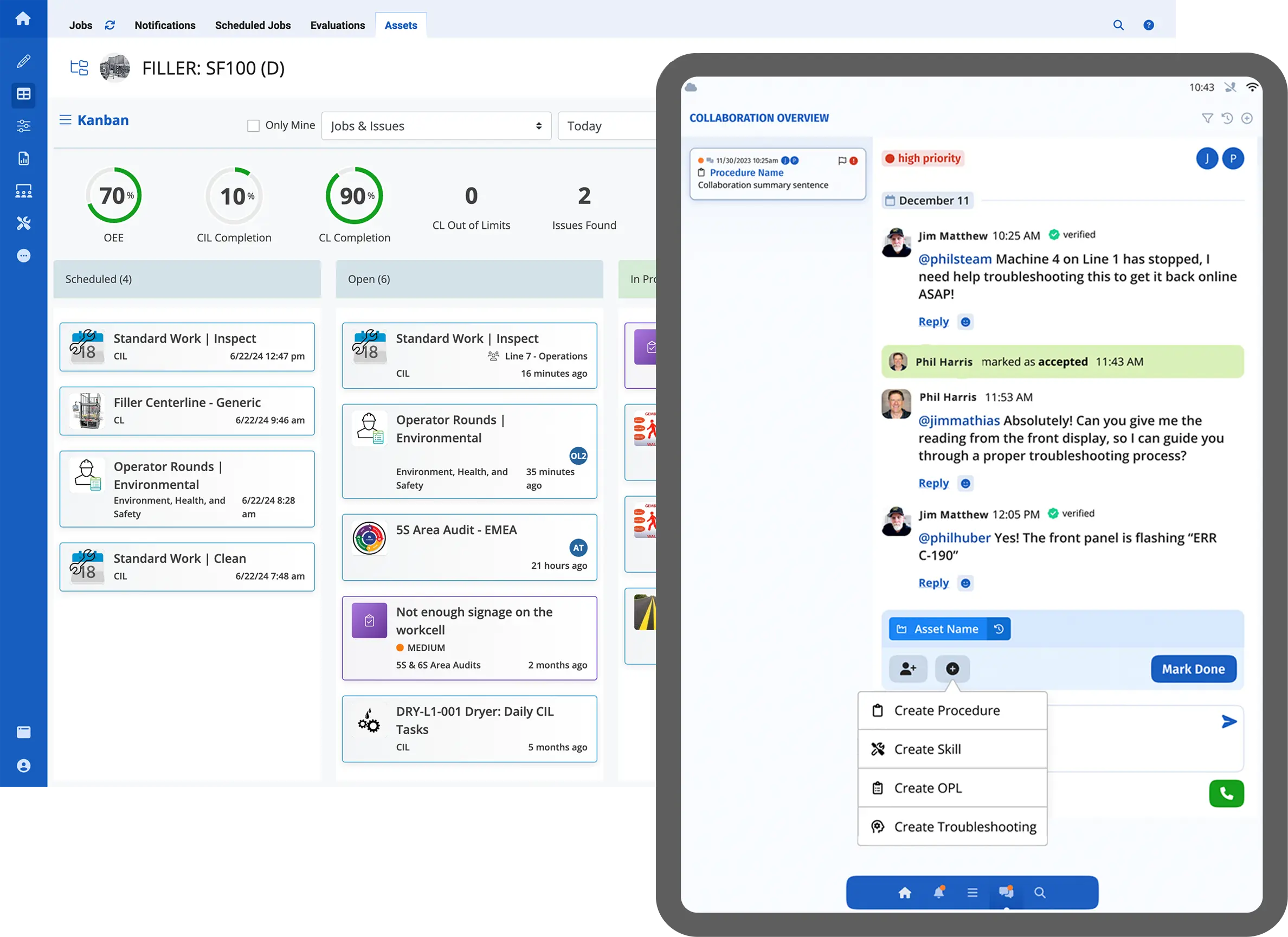
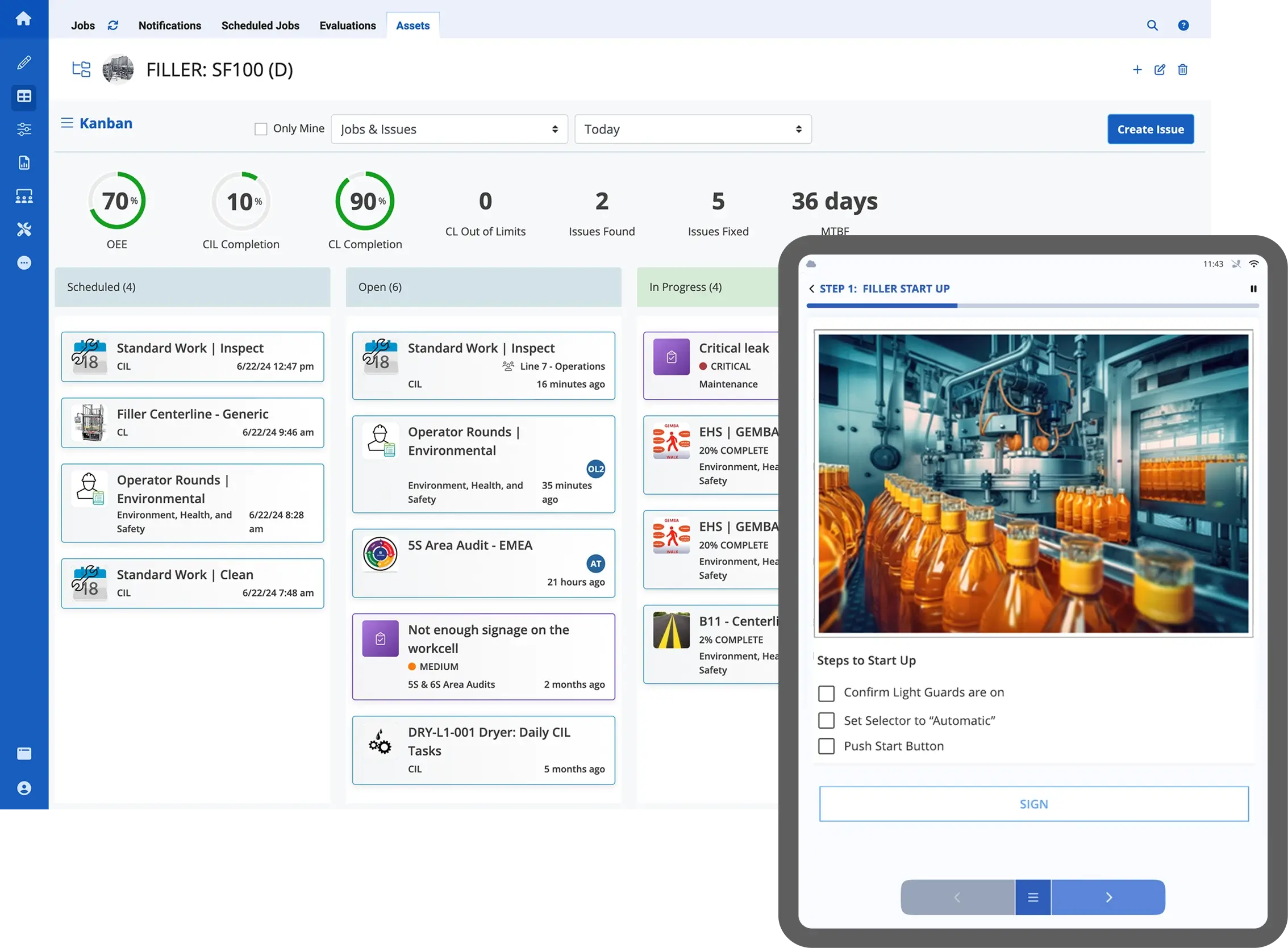
augmentir connected worker platform – digital frontline operating system for iws

Here are just a few critical areas that often extend beyond traditional daily management:

  • Issue Management: Logging problems is easy. Solving them — through root cause analysis, countermeasures, and tracking — requires structure.
  • Autonomous Maintenance: Operators should be empowered to care for their equipment, not just report when it fails.
  • CILs (Cleaning, Inspection, Lubrication): These are the fundamentals of machine reliability — yet many teams lack standard routines.
  • Changeovers: Transitioning between products or shifts introduces variability. Standardizing this is key to minimizing downtime.
  • Centerline Management: Decrease product and procedure inconsistencies by optimizing machine effectiveness.
  • Breakdown Elimination: Recurring failures don’t go away by chance. They go away when someone owns them — and has the tools to eliminate them.
  • Manufacturing Collaboration: Improvements aren’t made in isolation. Visibility, communication, and shared accountability are critical.
  • 5S Audits and Layered Process Audits: Safety and quality audits should be woven into the flow of work — not tacked on as separate compliance exercises.

Individually, these areas may seem like “extra” layers. But together, they form the foundation of an Integrated Work System.

From Managing the Day to Managing the Work

An Integrated Work System doesn’t just organize tasks — it connects the work, the people, and the insights needed to operate at a higher level.

Instead of fragmented tools and outdated spreadsheets, IWS brings everything into one unified approach — so your team can:

  • Identify issues in real-time
  • Standardize best practices
  • Eliminate variability and waste
  • Collaborate across shifts and functions
  • Improve continuously — not just reactively

It’s a shift from firefighting to problem-solving. From knowing what happened to knowing why it happened — and preventing it from happening again.

Technology That Supports the Shift

Of course, none of this is possible with whiteboards and paper checklists. Manufacturers need modern tools that support the reality of the factory floor — and help bring Integrated Work Systems to life.

That’s where connected worker technology comes in.

integrated work system iws total productive maintenance

Platforms like Augmentir give manufacturers the digital foundation they need to:

  • Turn SOPs, audits, and maintenance routines into smart digital workflows
  • Capture real-time data from the frontline without adding admin overhead
  • Personalize guidance and support for each worker based on skill level and performance
  • Analyze trends and surface insights using AI — so you can focus improvement where it matters most

Augmentir helps you go beyond daily visibility. It helps you build a connected, data-driven, and continuously improving frontline operation.

Think Bigger Than Daily

Yes, you need a system to manage the day — but you also need a system to manage improvement.

A Daily Management System may be the entry point, but don’t let it be the end goal. Start thinking holistically about your operations. Ask the hard questions. Look at the gaps between your teams. Audit the processes that break down too often. And most importantly, give your workers the tools they need to contribute — not just comply.

The future of manufacturing isn’t just about managing tasks. It’s about connecting work, people, and performance.

That’s the promise of an Integrated Work System.

That’s where real transformation begins.

And with solutions like Augmentir, it’s never been more achievable.

See Augmentir in Action
Get in Touch for a Personalized Demo

Supercharge your IWS strategy with Augmentir’s AI-powered platform. Digitize work, upskill workers, and drive continuous improvement in manufacturing.

An Integrated Work System (IWS) strategy is essential for driving continuous improvement and achieving world-class manufacturing performance. Originally developed by Procter & Gamble (P&G), IWS is a comprehensive approach to optimizing operations by aligning people, processes, technology, and culture. It focuses on improving manufacturing reliability, reducing costs, and increasing productivity through standardization, capability building, and a relentless focus on continuous improvement.

iws strategy with augmentir

But even the best-designed IWS strategies can fall short without the right tools to support execution and sustain momentum. That’s where Augmentir comes in.

Augmentir is an AI-powered connected worker platform that supercharges your IWS strategy by digitizing, guiding, and optimizing frontline operations. From standard work execution and skills development to real-time performance insights, Augmentir enhances every IWS pillar — making your system smarter, more agile, and more effective.

Digitize and Standardize Work Processes

At the heart of IWS is a commitment to standardized work — clearly defined, repeatable processes that reduce variation and waste. Augmentir makes it easy to digitize and deploy standardized work instructions across your organization. With intuitive, no-code tools, you can rapidly create digital workflows that are accessible on any device, ensuring consistency and adherence to best practices.

integrated work system iws total productive maintenance

Digitize Total Productive Maintenance and Asset Management with Augmentir

But Augmentir goes a step further. It doesn’t just digitize your SOPs — it continuously improves them. Through built-in AI, Augmentir identifies where processes break down, which steps cause the most errors, and how top performers complete tasks more efficiently. This gives you a data-driven foundation for refining your standards and driving continuous improvement.

Empower and Upskill Frontline Workers

A successful IWS strategy empowers every employee to contribute to performance gains. Augmentir’s connected worker platform personalizes the work experience for each operator. Whether it’s delivering real-time guidance based on current skill level or surfacing just-in-time training content, Augmentir helps close skill gaps and build workforce capability on the job.

using ai to improve manufacturing training

With Augmentir’s integrated skills management system, you get a live view of workforce readiness across your lines, shifts, and sites. You can align training investments with actual performance needs, monitor certification status, and track progress against capability-building goals — all within the same platform.

Enhance Autonomous Maintenance and Problem Solving

Autonomous maintenance is a key component of IWS, empowering operators to identify and resolve issues at the source. Augmentir supports these initiatives by guiding workers through inspection, lubrication, and minor maintenance tasks with step-by-step digital instructions. Workers can capture and report issues on the spot, while supervisors gain visibility into completion rates and problem trends.

What’s more, Augmentir facilitates structured problem solving by giving teams the tools to document root causes, track countermeasures, and share lessons learned — all within the context of day-to-day operations.

Streamlined Daily Management and Shift Handovers

Augmentir supports a company’s Integrated Work System (IWS) strategy by enhancing key elements of frontline operations such as daily management, direction setting, and shift handovers. By digitizing and standardizing these workflows, Augmentir ensures that critical information is captured, shared, and acted upon consistently across teams and shifts. This not only drives operational discipline but also aligns frontline activity with strategic objectives.

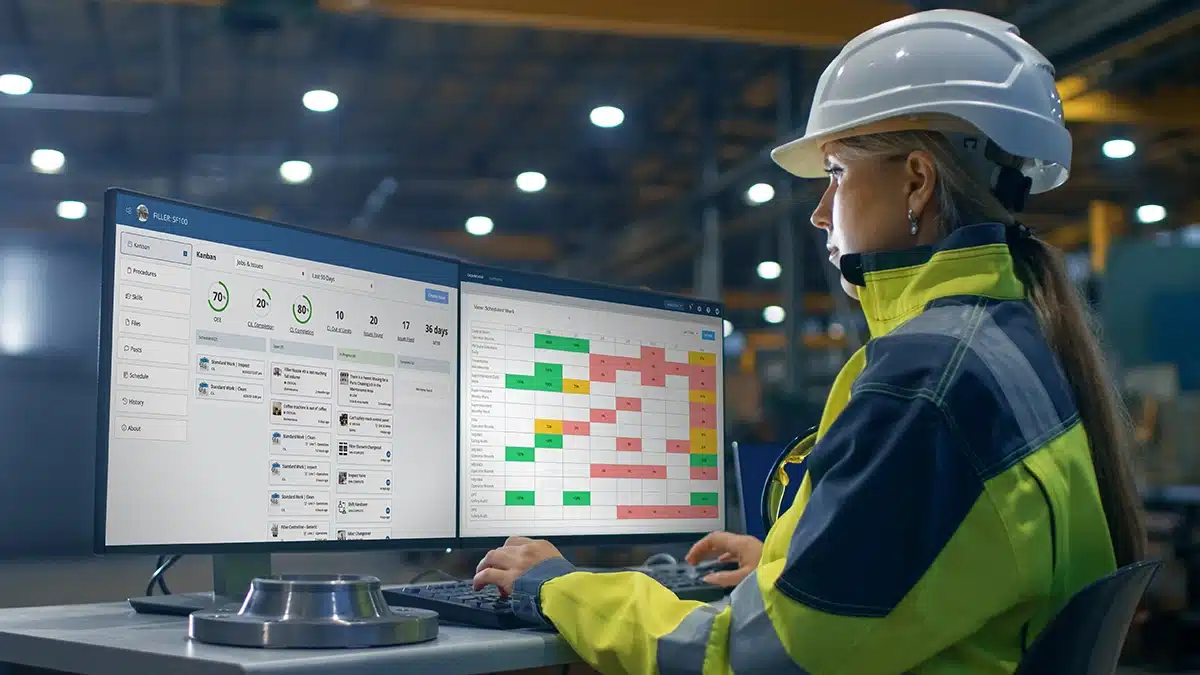
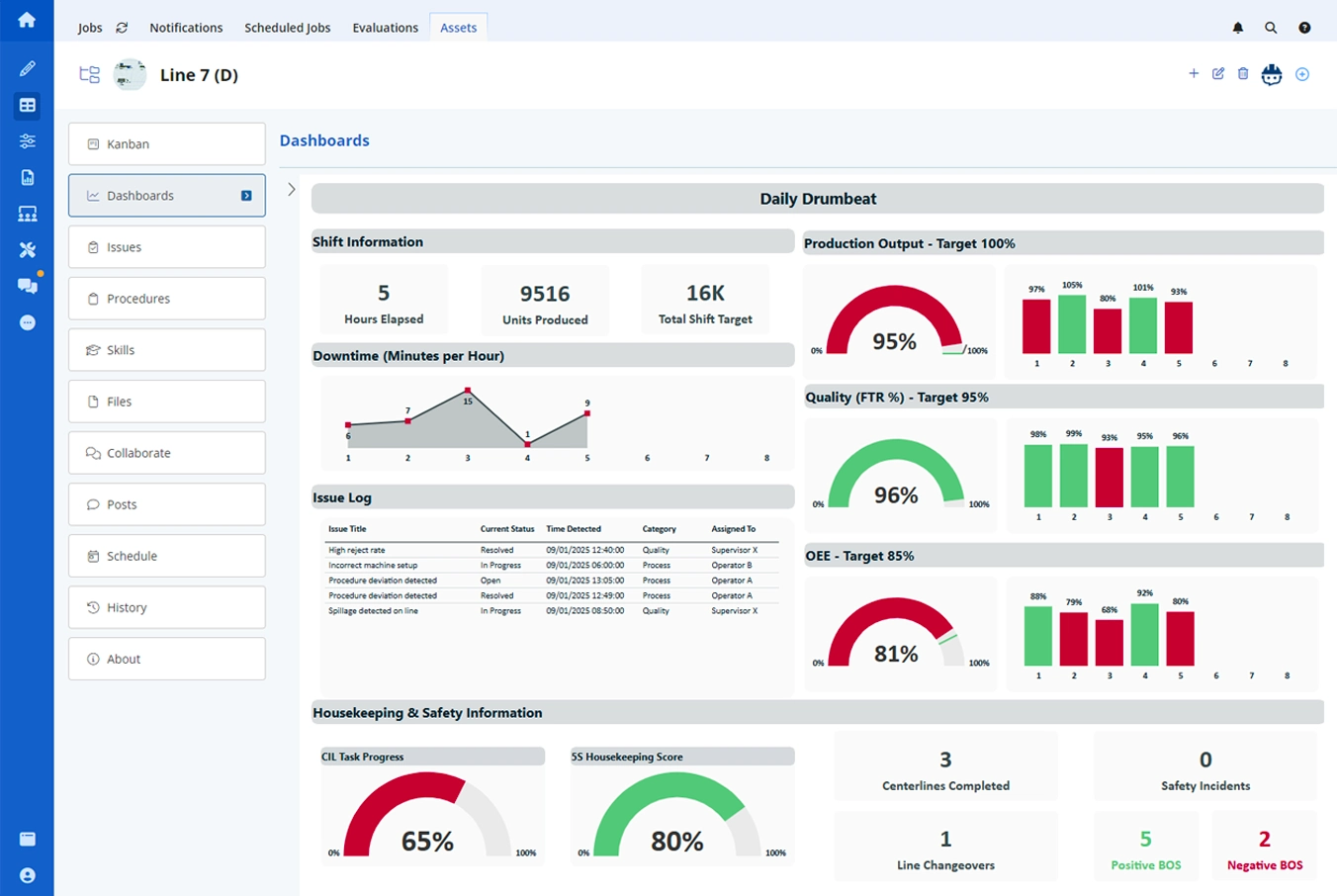
lean daily management system

Daily direction setting becomes significantly more effective with Augmentir’s digital tools. Supervisors can rapidly communicate goals, identify production variances, and prioritize actions using real-time data from the shop floor. Augmentir’s connected worker platform ensures that frontline teams are equipped with clear, up-to-date instructions that reflect current conditions, reducing downtime and enabling more agile responses to issues.

Additionally, Augmentir streamlines shift handovers by providing a structured, digital record of shift activities, issues, and resolutions. This eliminates the information gaps and miscommunications that often occur during manual handovers, ensuring continuity and faster problem resolution.

shift handover report - golden hour in manufacturing

By integrating seamlessly into IWS frameworks, Augmentir empowers companies to build a more proactive, data-driven, and aligned frontline workforce.

Unlock Continuous Improvement with Data and AI

IWS relies on data to drive informed decision-making and continuous improvement. Augmentir captures rich, real-time data from every task completed by your frontline teams. Its AI engine then analyzes this data to uncover hidden inefficiencies, suggest targeted improvements, and recommend actions that directly impact OEE and operational KPIs.

Instead of relying on assumptions or static audits, Augmentir enables a dynamic, data-driven improvement loop — where insights are generated in real time, and decisions are based on actual shop floor behavior.

A Foundation for Sustainable Operational Excellence

An IWS strategy is not a one-time project — it’s a long-term commitment to operational excellence. Augmentir helps sustain that journey by aligning your people, processes, and technology through a single, AI-driven platform. By providing data visibility, enabling a culture of ownership, and continuously optimizing workflows, Augmentir ensures that your IWS system doesn’t just run — it evolves.

Start Building a Smarter IWS with Augmentir

Whether you’re just beginning your IWS journey or looking to accelerate existing initiatives, Augmentir gives you the digital backbone you need. From standard work and skills development to continuous improvement and performance tracking, Augmentir is purpose-built to support and scale IWS strategies in modern manufacturing environments.

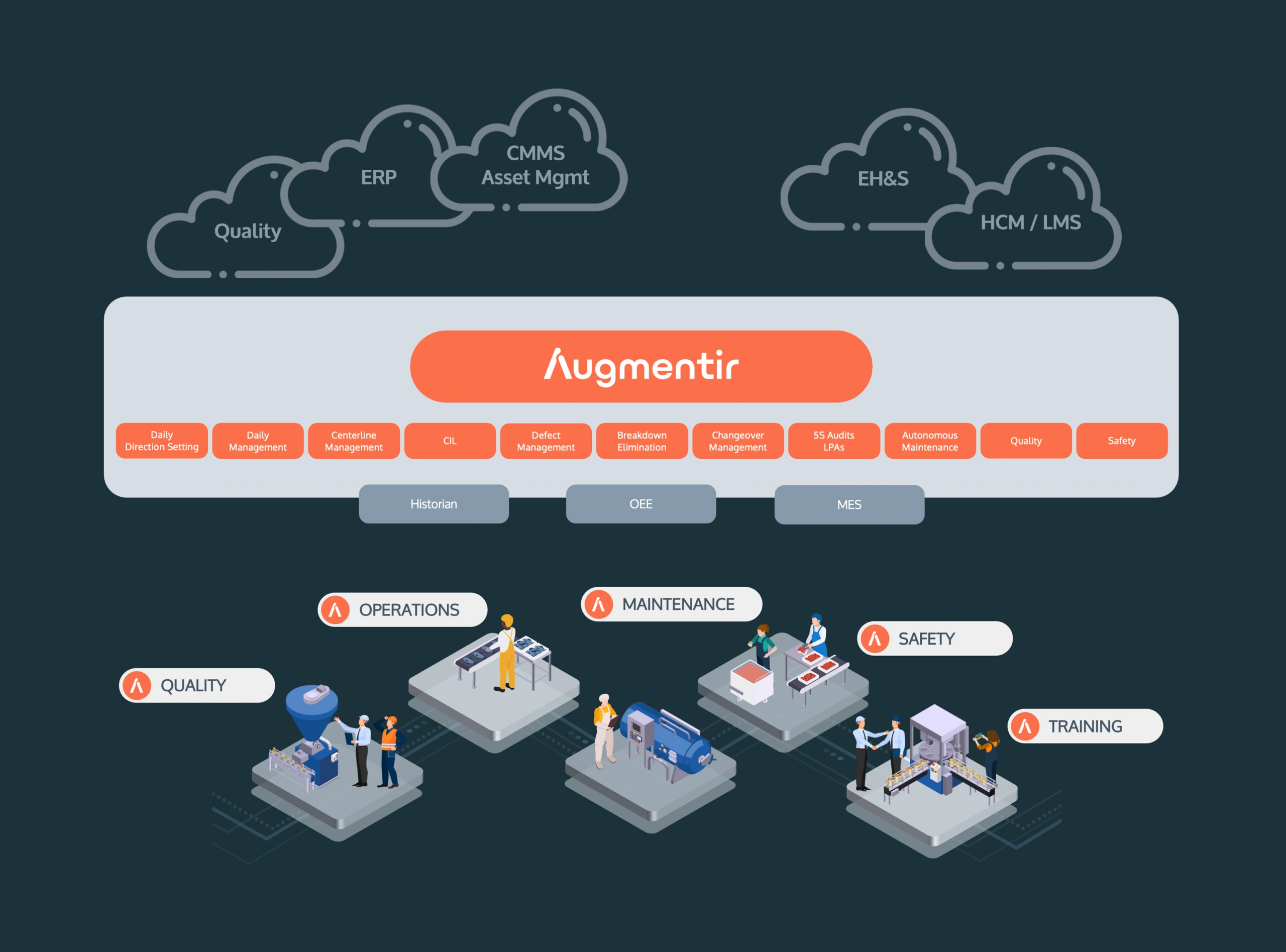
Augmentir supports your IWS strategy by acting as a single pane of glass for your frontline operations. With Augmentir, you can digitize, manage, and optimize all aspects of your frontline operation:

  • Daily Direction Setting (DDS)
  • Daily Management System (DMS)
  • Centerline Management
  • Clean, Inspect, Lubricate processes
  • Defect Management
  • Breakdown Elimination
  • Changeover Management
  • Shift Handover
  • 5S and Layered Process Audits
  • Quality Management on the Shop Floor
  • Safety
  • Maintenance

augmentir connected worker platform – digital frontline operating system for iws

Let Augmentir be your partner in transforming how work gets done — and in unlocking the full potential of your IWS strategy.

See Augmentir in Action
Get in Touch for a Personalized Demo