Discover how Augmentir’s Gen AI Suite and Augie transforms how manufacturers support frontline activities and personnel.

We recently unveiled a watershed moment in connected worker technology history with updates and expansions to Augie, our generative AI assistant for industrial work. This expansion drastically improves the breadth and reach of Augie’s capabilities, enhancing the already powerful tool even more and creating a generative AI suite of tools and assistants for frontline industrial work. This first-of-its-kind Augie GenAI Suite, redefines the future of manufacturing, empowering frontline workers everywhere with unmatched AI-driven tools.

But what does this mean for manufacturers and industrial organizations looking to improve their operations and how can Augie help you?

augie industrial generative ai assistant manufacturing

Basically, this suite of generative AI assistants includes dedicated capabilities for companies to enhance their Troubleshooting, Operations, Data Insights, and Content Creation; and even introduces a GenAI-as-a-Service option. This expands on Augie’s existing capabilities for advanced troubleshooting and real-time digital assistance to frontline workers and adds further abilities for advanced safety/risk mitigation, worker compliance, workforce development, knowledge management and training, quality management, and more.

Read below to learn more about the new Augie GenAI Suite, what it can do, what it means for the future of manufacturing work, and how it can help you.

Augie’s Expanded Suite of GenAI Assistants

The Augie suite transforms frontline manufacturing like never before – giving teams instant access to expert knowledge, next-level data insights, and seamless operational support. From troubleshooting to operations and content creation, the possibilities are endless.

Introducing a first-of-its-kind GenAI Suite for industrial work:

Augie Industrial Assistant 2.0

Enhancements include support for dozens of new content types, the addition of patented-pending prompt enrichment, and superior prioritization, resulting in increased accuracy and actionability.

Augie Content Assistant

Automatically convert existing digital content (Word Excel, PDF, etc.) into native Augmentir Work instructions, SOPs, OPLs, CILs, Checklists, etc., accelerating deployment. Generate Training, Checklists, and Quizzes from a wide range of source types including images, manuals, free-form tests, etc., to streamline worker training and onboarding.

Augie Data Assistant

Augie provides insights from any source of operational data, including standard data sets such as Skills, Standard Work, Safety, and Work Execution, as well as customer-specific datasets generated through Augmentir’s report configurator. Augie eliminates/reduces the need for “report writing” and, through its conversational interface, answers questions, performs math, and generates graphical reports, increasing responsiveness.

Augie Extensibility Assistant

The Extensibility Assistant increases the productivity of developers building new and supporting existing user-defined functions in Augmentir’s extensibility framework. Augmentir’s unique Platform-as-a-Service capabilities enable customers and partners to create unique capabilities to solve important business problems, a capability not available elsewhere in the market

Augie Industrial GenAI-as-a-Service

As an industry first, Augie exposes its GenAI capabilities as APIs in Augmentir’s extensibility framework, enabling companies and partners to utilize Industrial genAI within innovative, company or vertical-specific use cases. Commonly used APIs include translateText enabling on-the-fly translation of dynamic content, and imageQA, enabling direct comparison or summarization of images, supporting critical applications in Quality, Safety, and Operations.

This is a true game-changer for frontline manufacturing personnel, equipping them with expert knowledge, advanced tools, and intuitive support like nothing has before. But more than that, these are not just simple upgrades, this is the future of manufacturing, right at the fingertips of those who matter most – frontline personnel.

Advantages of Generative AI Assistants in Manufacturing

Generative AI assistants in manufacturing streamline production by automating repetitive tasks, reducing human error, and optimizing workflows. They enhance decision-making through real-time data analysis, leading to increased efficiency and cost savings. Augie is unique among other smart manufacturing assistants in that it leverages proprietary fit-for-purpose, pre-trained LLMs and generative AI, coupled with robust security and permissions, to help factory managers, operators, and engineers improve efficiency, resolve issues faster, and prevent downtime.

Through Augie, manufacturers can instantly:

  • Close skills and experience gaps with personalized support
  • Gain insights into Leader Standard Work
  • Gain new insights into skills inventories
  • Convert Tribal Knowledge into Digital Corporate Assets
  • Identify opportunities for continuous improvement
  • Forecast potential operational issues

The expansion of the Augie tool kit further enhances these capabilities, allowing for more advanced and adaptable functions such as those described above. With the Augie GenAI suite by your side, the potential for improved frontline support, optimized manufacturing operations, and the empowerment of frontline industrial workforces is limitless.

Supporting Frontline Workers with GenAI Assistants

Augmentir introduced Augie in early 2023, becoming the first software provider in the manufacturing sector to offer a generative AI solution focused on the industrial frontline workforce.

Since its launch, Augie has seen massive support from leading manufacturing organizations. It has been applied by these global leaders across all manufacturing and production types, helping prevent safety and quality issues at the point of work, driving operational efficiency, and giving frontline workers the tools, guidance, and support they need to do their best work.

Augie’s generative AI capabilities are built into the core of the Augmentir platform, so users can quickly and securely leverage the latest AI advances within the framework of digital collaboration, skills management, and work execution. This allows frontline users and other manufacturing personnel to leverage existing data, documents, applications, and their existing tribal knowledge, increasing their ROI.

Interested in learning more?

To learn more about Augie and how it has the potential to transform and augment your frontline workers and activities with patented AI-driven insights and to learn why Augmentir is trusted by leading manufacturers as a reliable digital transformation partner – schedule a demo with one of our product experts.


See Augmentir in Action
Get in Touch for a Personalized Demo

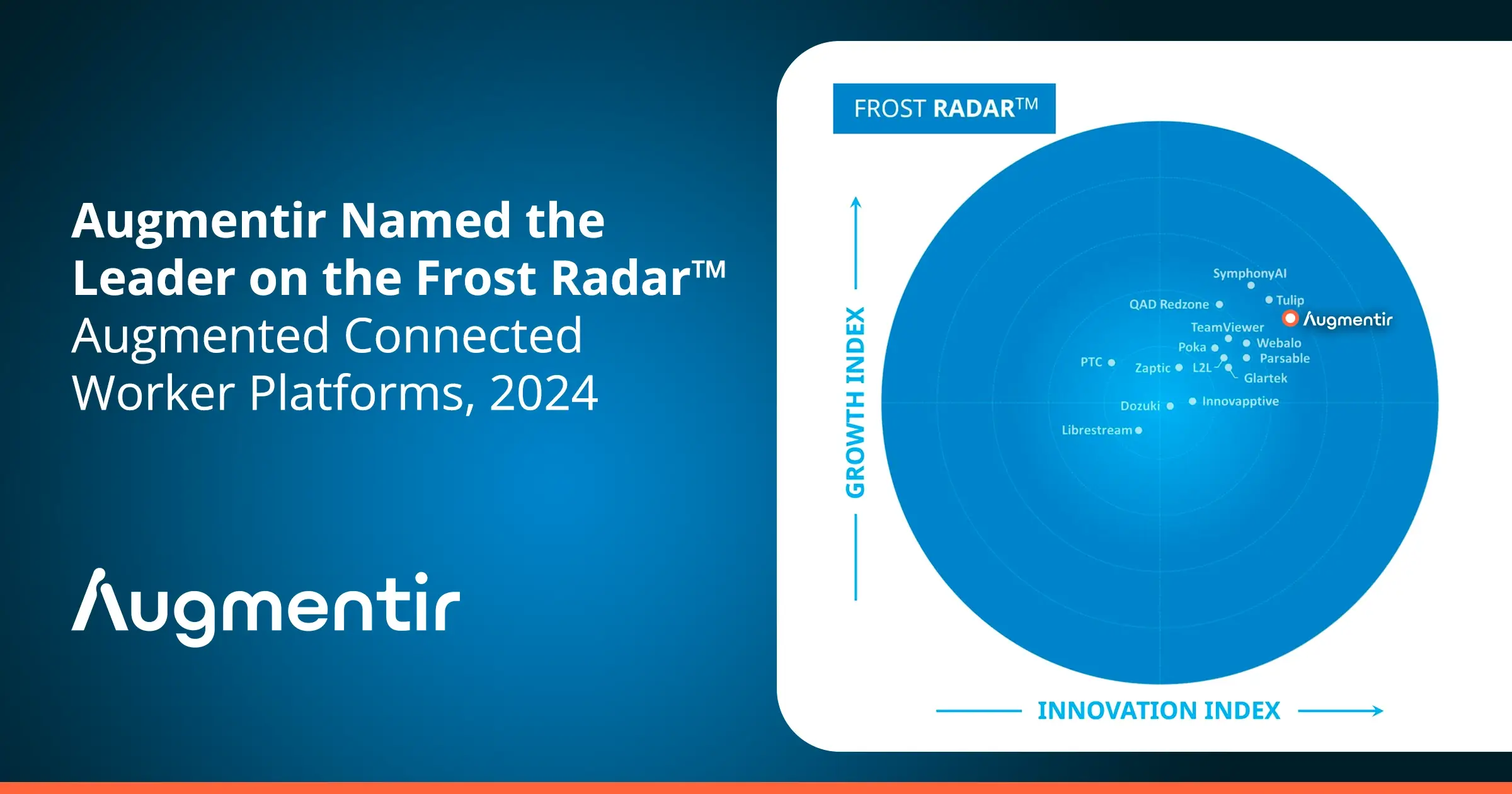
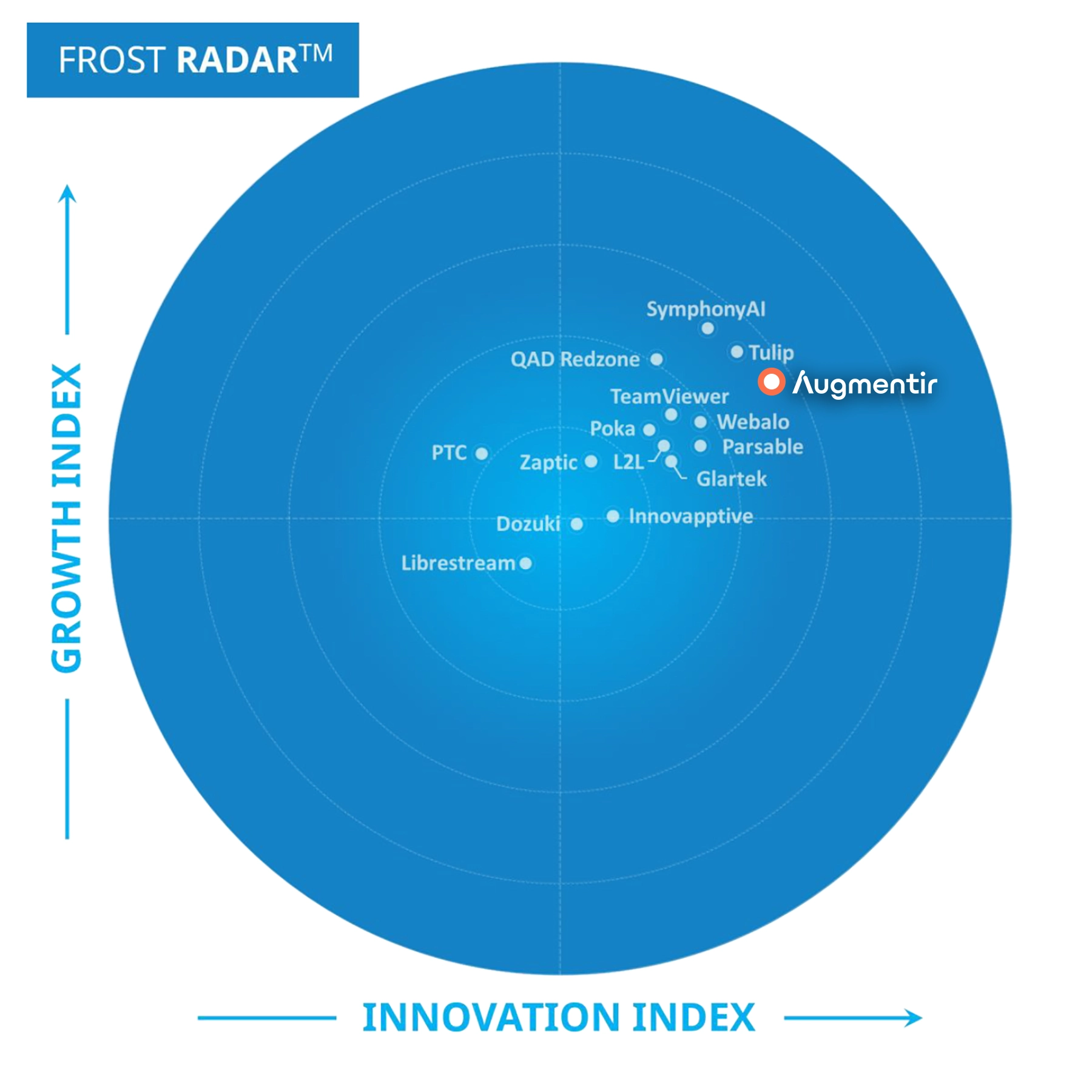
The latest Frost & Sullivan Radar report recognizes Augmentir as the Leading Augmented Connected Worker Platform.

Augmented Connected Worker (ACW) solutions revolutionize manufacturing and industrial operations and Augmentir is leading the way!

The recent Frost & Sullivan Radar report recognized Augmentir as the Leading ACW Solution with our AI-powered connected worker platform. AWC is a concept that combines the methodologies behind connected worker and augmented worker initiatives to provide a clearer, more accurate picture of what the future of manufacturing work looks like.

augmentir named the leader in frost radar for augmented connected worker platforms 2024

Read below to learn more about Augmentir in the Frost Radar report and how ACW technologies benefit both manufacturers and their workers alike.

The Frost & Sullivan Augmented Connected Worker Radar Report 2024

The Frost & Sullivan Radar Report, or Frost Radar™, is an analytical tool that benchmarks the future growth of leading organizations across multiple industries. Through careful selection and research across criteria that encompasses 2 major indices and 10 evaluation criteria, analysts select organizations that will be able to successfully support users into the future.

This edition of the Frost Radar, ranked Augmentir #1 out of all the ACW vendors. Augmentir empowers organizations to embrace Augmented Connected Worker initiatives through a comprehensive platform that combines connected worker and AI technologies to connect and support frontline workers like never before.

frost radar augmented connected worker platforms

As manufacturing workers become more interconnected, they can use AI tools in conjunction with smart connected worker solutions to gain insights that pinpoint areas with significant potential for improvement, this allows them to truly augment their workforces equipping them with the knowledge and abilities to complete their work safely and competently.

For more information on the Frost Radar, and the evaluation methodology used by Frost & Sullivan, click here.

Augmentir Ranked #1 Connected Worker Platform, Most Complete Solution on the Market

Frost & Sullivan has identified nine functionalities that are essential for a complete ACW solution.

  1. Knowledge and data management. The solution serves as a repository of knowledge.
  2. Work assistance and productivity. It provides digital tools to enhance frontline workers’ tasks, such as digital work instructions, digital Kanban boards, and navigation guidance.
  3. Seamless experience. The solution must be easily accessible from available devices (phones, tablets, wearables) to integrate seamlessly into everyday operations.
  4. Skills management. This serves as an extension for learning management systems (LMS) and provides supervisors and plant managers the necessary tools to upskill the workforce.
  5. Channel for communication. The solution offers native features to enable collaboration across operations, such as remote assistance, multi-site or multi-team workflows, and news feeds.
  6. Reporting and analytics. This refers to pre-built dashboards with workforce and task execution data. The ACW platform can also provide tools for configuring custom dashboards and integrating data from other systems.
  7. Integrations. The solution comes with a variety of pre-built connectors and tools to easily build new integrations to common systems.
  8. Platform capabilities. NC and LC development environments allow the building of digital procedures, workflows, training programs, and dashboards. Standard templates are available to accelerate time to value and the default deployment option is cloud-based.
  9. Integrated AI. The solution leverages AI in one or more ways. AI-enabled features include predictive maintenance, automatic creation of workflows/digital work instructions/troubleshooting procedures based on video or worker input, automatic analysis and optimization recommendations for processes, AI-powered search engines, copilots, live translations, and more.

Frost & Sullivan ranked Augmentir as a Leader in both innovation and growth within the ACW solution landscape.

According to Frost & Sullivan:

Augmentir offers one of the most comprehensive ACW solutions in the market. Its new AI copilot sets it apart from most other products in the market by covering a variety of use cases. The company’s plans to leverage engagement data from the workforce is a unique initiative in the current market. All these factors contribute to making Augmentir the leader in the Frost Radar Innovation Index.

Augmenting Frontline Workers with an AI Platform for Connected Work

Manufacturing is uniquely situated as an industry to benefit from Augmented Connected Worker solutions leveraging AI-powered connected worker technology for process improvements, quality, management, enhanced training, and more. ACW initiatives facilitate faster onboarding, increased workforce flexibility, and the retention of essential knowledge.

augmentir connected worker platform

AI – including generative AI tools, software, and assistants – plays a crucial role in ACW initiatives, addressing overarching trends like skills variability and the loss of tribal knowledge within the workforce. It serves as the cornerstone for implementing data-driven improvements in operational performance and continuous enhancement.

At Augmentir, we believe that a connected worker platform’s purpose goes beyond just delivering instructions and remote support; it should continually optimize the entire connected worker ecosystem and augment the capabilities of frontline workers. With this in mind, we introduced Augie™ – our generative AI assistant for industrial work, in early 2023.

With Augie, manufacturers can unlock previously untapped potential in their frontline personnel and operations. Our recent expansion and enhancements now offer the first-ever suite of dedicated GenAI assistants for manufacturing enterprises covering anything from Troubleshooting, Operations, and Data Insights, to Content Creation and even GenAI-as-a-Service.

Interested in learning more?

If you’d like to learn more about Augmentir and see how our AI-powered connected worker platform enables Augmented Connected Worker initiatives to improve safety, quality, and productivity across your workforce, schedule a demo with one of our product experts.


See Augmentir in Action
Get in Touch for a Personalized Demo

Learn how to improve manufacturing shift handover with our downloadable template and AI-powered connected worker solution.

Improving shift handover in manufacturing involves implementing strategies to enhance communication, streamline processes, and ensure a smooth transition between shifts. These strategies can include creating a shift handover template (shift handoff template), implementing digital processes with a connected worker platform, and establishing standardized shift handover protocols.

shift handoff shift handover in manufacturing

Encouraging active participation and engagement from both incoming and outgoing personnel fosters a culture of accountability and collaboration. Regular training sessions and feedback mechanisms enable teams to continuously refine their handoff procedures and address any challenges. By prioritizing clear communication, standardized processes, and ongoing improvement efforts, manufacturing facilities can optimize shift handoff practices and maximize operational efficiency.

Read below to learn why shift handover is important, how to standardize shift handoffs for safer operations, examples of shift handover templates (shift handoff templates), and how to digitize shift handoffs with connected worker software tools.


Shift Handover Template
Free Template
Streamline the process of shift handoff with our free Shift Handover Template. Download our PDF template to get started, and learn more about digitizing your shift handover process with Augmentir.
Pro Tip

You can now import existing PDF, Word, or Excel documents (just like the PDF above) directly into Augmentir create digital, interactive work procedures and checklists using Augie™, a Generative AI content creation tool from Augmentir. Learn more about Augie – your industrial Generative AI Assistant.

A

Why are shift handovers important?

Shift handoff in manufacturing is a critical process where incoming and outgoing personnel exchange information, ensuring continuity and efficiency in production operations. During this transition, which is often referred to as the golden hour in manufacturing, essential details such as production status, equipment condition, safety concerns, and any ongoing issues are communicated to ensure a seamless transfer of responsibility.

The consequences of improper shift handover communication and processes can be devastating. For example, a U.S. Chemical Safety and Hazard Identification Board investigation found that a series of shift communication mistakes beginning five days before an incident led to the release of nearly 24,000 pounds of methyl mercaptan, a toxic chemical. This caused not only OSHA fines over $270,000, but also the death of four employees who inhaled the toxic fumes.

Effective communication during shift handoff is paramount to effective daily management, enabling the incoming team to understand the current state of affairs, anticipate potential challenges, and maintain productivity levels. By prioritizing clear communication and thorough documentation, manufacturing facilities can enhance operational effectiveness and maintain high standards of safety and quality across shifts. Additionally, documenting key information facilitates future reference and aids in problem-solving.

Standardizing Shift Handovers for Safer Operations

Pen and paper shift handover reports and verbal handoffs are often ineffective due to a lack of structured communication between shifts, other departments/teams, and reports that lack crucial details. Data is often exchanged verbally, through emails, and physical notes that can be misinterpreted or misunderstood by the next person or by a later shift. This process can be streamlined through standardization, saving time and effort.

Standardized work is a core pillar of operational safety excellence, in essence, it is the process of completing repetitive activities in a consistent way to ensure optimal outcomes. Applying this concept to shift handoffs and shift handover reports creates efficient methods for communicating and collaborating across shifts ensuring smoother handovers, improved responses, and increased safety.

Shift Handover Template Examples

Regardless of industry, creating a shift handover template (shift handoff template) is a best practice that can have a big impact on productivity, satisfaction, and safety. The following is an example of a shift handover templates that can be modified to fit organizational needs:


Shift Handover Template
Free Template
Streamline the process of shift handoff with our free Shift Handover Template. Download our PDF template to get started, and learn more about digitizing your shift handover process with Augmentir.


Not all shift handover reports will look the same, they will vary from industry to industry, department to department, and company to company. However, the example above captures the essence and key elements needed in a shift handoff report.

Pro Tip

Shift handover templates need to be comprehensive yet to the point. Keeping it simple, asking for the relevant information, and refraining from lengthy or tedious forms will help ensure completion and participation from frontline workers.

A


Digital Shift Handover with Connected Worker Software

Leveraging smart connected worker tools to create digital shift handovers is revolutionizing the traditional manufacturing shift handoff process. Using connected worker solutions manufacturers facilitate real-time communication, improved data sharing, and enhanced task management between shifts. By incorporating features such as mobile and wearable devices, cloud-based platforms, and GenAI assistants, digital shift handovers enable seamless information exchange regardless of location, improving accessibility and efficiency.

Augmentir’s connected worker platform and suite of connected worker tools help manufacturers standardize work and continually improve operations. Import existing PDF, Word, or Excel documents directly into Augmentir and create digital, interactive work procedures and checklists using Augie™, a Generative AI content creation tool from Augmentir.  Once digitized, workers can easily access shift reports, production metrics, equipment status updates, and safety protocols from mobile or wearable devices – ensuring continuity and transparency across shifts.

Moreover, smart connected worker tools facilitate proactive problem-solving and provide instant notifications for abnormalities or maintenance requirements, empowering teams to address issues promptly and prevent downtime.

Contact us to learn more about why Augmentir is trusted by leading manufacturers to transform their daily management and improve:

  • Issue and Activity Management and Tracking
  • Standard Work Audits and Scheduling
  • Smart Forms and Checklists
  • Smart Collaboration and Communication
  • Closed-loop Worker Performance Support
  • and more…


See Augmentir in Action
Get in Touch for a Personalized Demo

Learn how digital and mobile operator rounds make manufacturing inspections safer and enhance overall operational excellence.

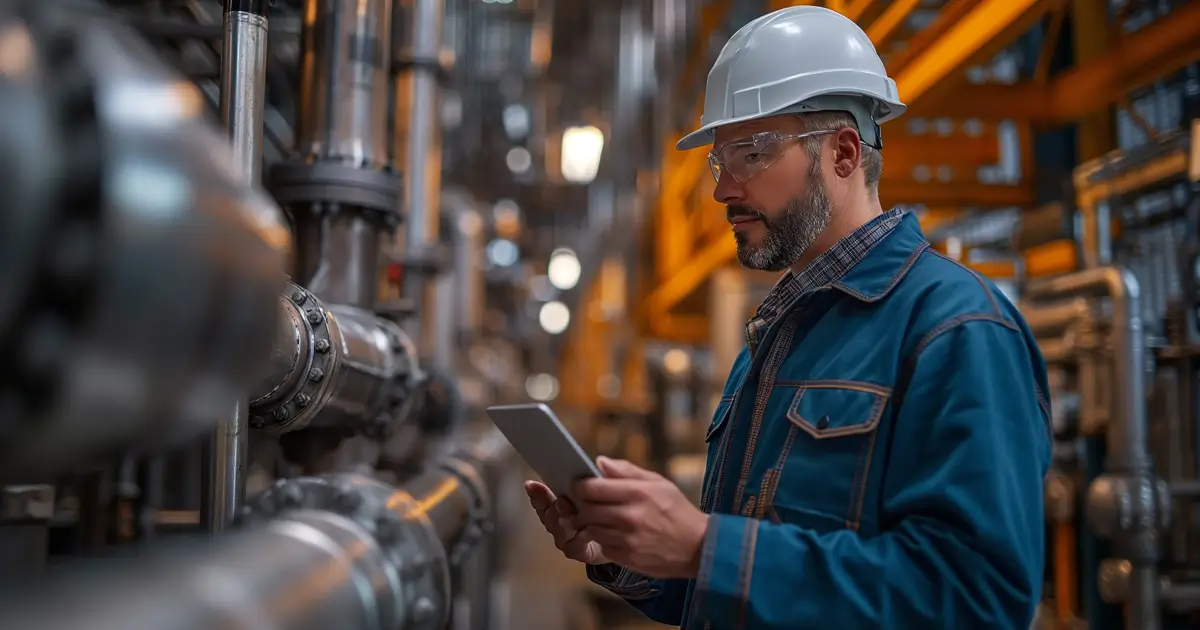
Mobile and digital operator rounds significantly enhance manufacturing activities by providing real-time data collection, analysis, and decision-making capabilities. Applying mobile technology and digitizing operator rounds connects and empowers manufacturing workers and organizations with improved operational efficiency, equipment uptime, and drives continuous improvement initiatives, ultimately leading to greater operational excellence.

mobile operator rounds in digital manufacturing

Operator rounds in manufacturing refer to a systematic process where operators or technicians conduct routine inspections and checks on various equipment, machinery, and systems within a manufacturing facility. During operator rounds, operators inspect equipment, check for leaks, listen for unusual sounds, monitor gauges and indicators, and perform basic tests or measurements to ensure that equipment is operating as intended, identify potential problems or maintenance needs early on, and prevent unexpected downtime or failures that could disrupt production.

Operator rounds are an essential part of a preventative maintenance strategy, helping to improve equipment reliability, extend asset lifespan, and optimize overall manufacturing operations. They also provide operators with the opportunity to become more familiar with the equipment they are responsible for and to detect and address any safety concerns.

Read below to learn more about digital and mobile operator rounds, the benefits they offer versus traditional paper-based operator rounds, key aspects to include in an operator round checklist, and how AI-driven insights and connected frontline worker technology transforms the operator round process for enhanced results.

Paper-based Operator Rounds vs. Mobile and Digital Operator Rounds

According to Forbes, the average manufacturer encounters 800 hours of equipment downtime per year — more than 15 hours per week, with an estimated total cost of $50 billion per year. Further studies found that human procedural error contributed to 405 fatalities, 2,163 injuries, and over $150 billion in losses for manufacturers.


So why do many plant operators still use paper-based checklists and forms when conducting critical inspections?


In many cases, it is simply a matter of tradition, and when given the opportunity to make the process easier and more efficient with digital solutions, operators and manufacturers alike are eager to embrace the change.

Comparing paper-based operator rounds with mobile and digital operator rounds in manufacturing highlights several key differences in terms of efficiency, effectiveness, and overall impact on operational excellence.

Paper-based operator rounds in manufacturing can be boiled down to 4 main steps:

  1. Managers or supervisors create an operator round checklist/form
  2. The operator executes the round and writes the observations on a paper sheet
  3. In the instance of any uncertainties or issues workers need to stop the round and ask for assistance or guidance
  4. The worker then delivers the completed checklist to their manager, who incorporates it into an ERP system or other management tool

Compliance is difficult when using paper spreadsheets and word processor documents. Routes or routines that still use paper checklists must be manually entered into a spreadsheet or database. This not only creates double work, but issues such as:

  • Decreased visibility into facility-wide inspection activities
  • Inconsistent records
  • Lower anomaly detection and slower response
  • Remedial and follow-up procedures are not automatic
  • No access to immediate guidance or key information
  • Lack of operational context in potentially hazardous environments

mobile operator rounds maintenance

Mobile operator rounds and digital operator rounds, however, enable manufacturers and technicians to accelerate inspections, improve accuracy and compliance, and enhance operational excellence and efficiency through:

  • Real-time data collection
  • Immediate access to expert guidance or critical information
  • Automated alerts or notifications
  • Optimized processes and inspections
  • Remote collaboration
  • Enhanced compliance and digitized documentation

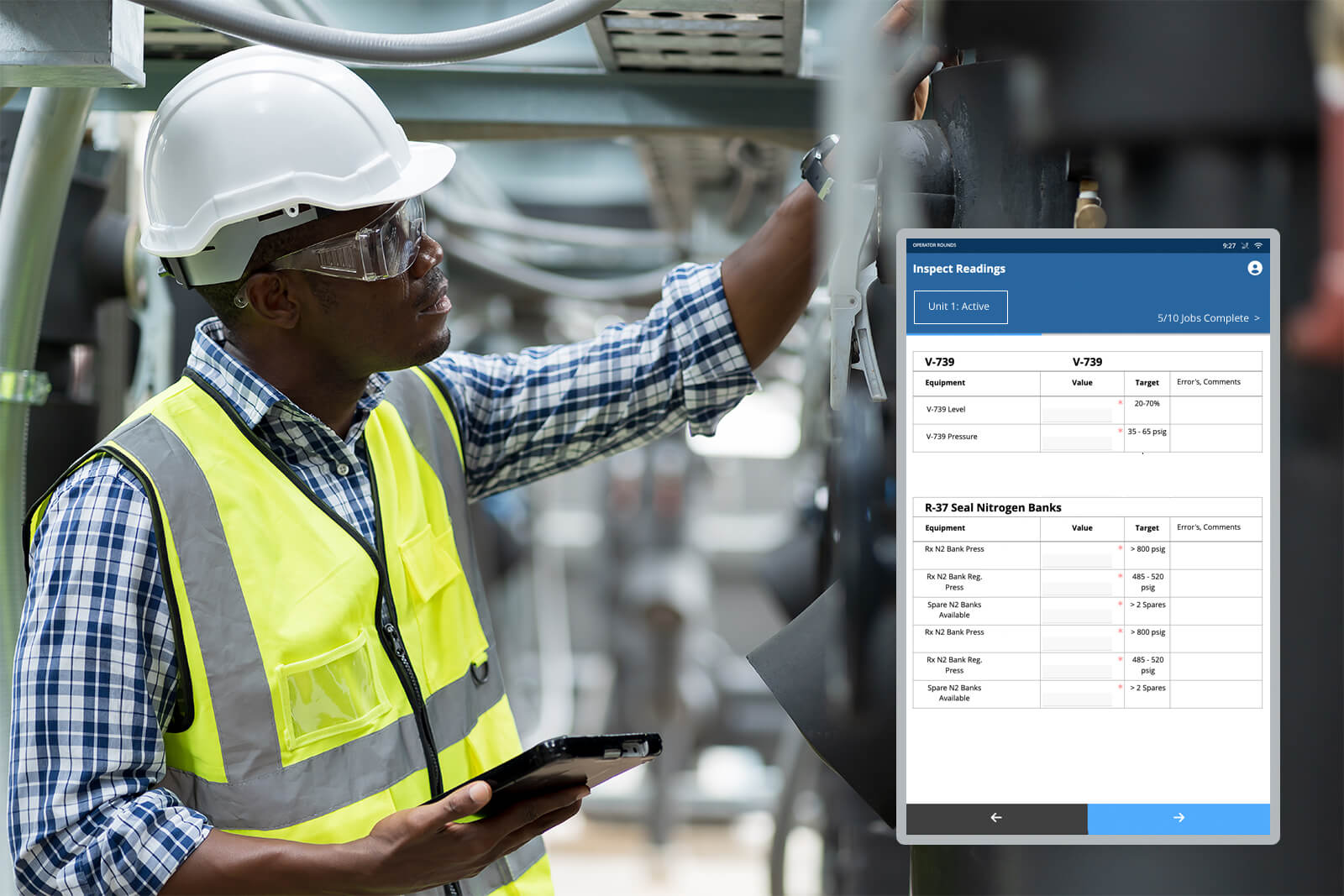
Connected devices enable operators to capture data, such as equipment readings, inspection results, and maintenance activities, directly at the point of operation. This eliminates the need for manual paperwork, reduces the risk of errors, and ensures that data is captured promptly and accurately. Additionally, digital operator rounds allow operators to access equipment manuals, schematics, and historical data instantly via mobile devices. This enables them to troubleshoot issues more effectively, follow proper procedures, and make informed decisions without delay.

Digital operator rounds systems can even streamline task assignment, tracking, and completion. Supervisors can assign tasks to operators, monitor progress in real-time, and prioritize work based on criticality and resource availability. This ensures that maintenance activities are performed efficiently and promptly. Overall, mobile and digital operator rounds empower manufacturing organizations to improve operational efficiency, maximize equipment uptime, and drive continuous improvement initiatives, ultimately leading to greater operational excellence.

Key Aspects of an Operator Round Checklist

An operator round checklist in manufacturing serves as a structured guide for operators to systematically inspect equipment, monitor performance, and identify potential issues during routine rounds. Here are key aspects to include in an operator round checklist:

  • Inspection Identification: Clearly list the equipment, machinery, or systems that need to be inspected during the rounds.
  • Visual Inspection: Include visual inspection items such as looking for leaks, cracks, signs of wear or damage, loose connections, abnormal vibrations, or any other visible abnormalities.
  • Safety Features: Verify the functionality of safety features and emergency shutdown systems to ensure compliance with safety regulations and protocols.
  • Functional Checks: Include functional checks to ensure that equipment is operating as intended. This may involve verifying that motors, pumps, valves, sensors, and other components are functioning properly.
  • Process Measurements and Readings: Include items that require measurements or readings, such as temperature, pressure, flow rates, voltage, current, or any other relevant parameters.
  • Quality Assurance: Ensure that quality checks are performed at each stage of the process and that products meet the quality parameters for each section.
  • Training and Qualifications: Ensure that operators conducting the rounds are adequately trained and qualified to perform the inspections and understand the importance of their role in equipment maintenance and reliability.
  • Special Instructions or Procedures: Include any special instructions, procedures, or precautions to be followed during the inspection, such as lockout/tagout procedures, safety protocols, or specific operating instructions.
  • Comments, Feedback, and Continuous Improvement: Encourage operators to provide feedback on the checklist and suggest improvements based on their observations and experiences during the rounds. Regularly review and update the checklist to incorporate lessons learned and optimize inspection processes.

Additionally, consider breaking down the inspection into specific points or components to be checked on each piece of equipment. This may include mechanical components, electrical systems, fluid levels, safety features, etc. Other potential aspects that can be considered or included are documentation requirements, reporting and communication specifications, and inspection schedule and frequency. By including these key aspects in an operator round checklist, manufacturing organizations can ensure thorough and consistent inspections, identify issues early, prevent unplanned downtime, and maintain equipment reliability and operational excellence.

Transforming Operator Rounds with AI-powered Connected Worker Technology

AI and smart connected worker technology are revolutionizing a wide range of manufacturing operational processes, including operator rounds. By introducing advanced capabilities for data analysis, frontline worker augmentation, and better connectivity, these emerging technologies are transforming traditional operator rounds allowing for enhanced predictive maintenance, remote guidance and support through Generative AI assistants, workflow optimization, and improved safety compliance.

With AI and smart connected worker technology, manufacturing organizations can optimize operator rounds, maximize equipment uptime, minimize maintenance costs, and achieve operational excellence in an increasingly digital and data-driven environment. Augmentir’s connected worker solution, for example, offers tailored solutions for improving a wide range of operational processes, including operator rounds.

Using Augmentir’s No-Code workflow builder, companies can quickly convert paper-based instructions and checklists to a digital format and tailor those digital instructions to meet the needs of individual operators with inline training, built-in collaboration, and troubleshooting support. Additionally, Augmentir has internal PaaS services to run connectors that we build and support for popular enterprise applications like SAP, Salesforce, ETQ, Oracle, IBM Maximo, and more. Allowing our system to easily, bi-directionally, and securely integrate the enterprise systems of record to create closed-loop processes involving the frontline workforce.

Schedule a demo to learn more about our AI-powered connected worker solutions and how they dramatically improve manufacturing operational processes like operator rounds through digital and mobile technology, enable personalized skills management and training, and optimize manufacturing activities.

See Augmentir in Action
Get in Touch for a Personalized Demo

Learn how manufacturers combat the manufacturing skilled labor shortage and close skills gaps with an Augmented Connected Workforce (ACWF).

An Augmented Connected Workforce (ACWF) offers manufacturing and other industrial organizations a powerful solution to combat the ever-worsening skilled labor shortage and skills gap. According to a report by Deloitte and the Manufacturing Institute, an estimated 2.1 million manufacturing jobs could go unfilled by 2030 and the cost of those missing jobs could potentially total $1 trillion in 2030 alone.

augmented connected workforce acwf manufacturing

By integrating advanced technologies like artificial intelligence (AI), connected worker platforms, and other emerging solutions manufacturers can enhance the capabilities of their existing workforce and bridge skill gaps. Connected worker tools offer real-time monitoring of your frontline workforce, ensuring seamless operations. Moreover, connectivity enables remote collaboration, allowing experts to assist frontline workers from anywhere in the world. This interconnected ecosystem empowers workers with the tools they need to succeed and attracts new talent by showcasing a commitment to innovation and technology-driven growth.

Through an ACWF, manufacturers can effectively combat the manufacturing skilled labor shortage and close the skills gap while driving productivity, innovation, and remaining competitive. Read more about ACWF in manufacturing below:

Implementing an ACWF in Manufacturing

A critical element of transitioning from a traditional workforce to an Augmented Connected Workforce (ACWF) is implementing and adopting new technologies and processes. Here are a few steps that can help with the adoption of ACWF technologies and smooth transitions in industrial settings:

  • Step 1: Assess Current Processes – Organizations must understand existing workflows and identify areas where AI, connected worker platforms, and other ACWF technology can replace paper-based and manual processes to enhance efficiency and productivity.
  • Step 2: Invest in Technology – Procure  AI-driven analytics platforms, mobile technology, and wearable technology to enable real-time data collection and remote collaboration.
  • Step 3: Training and Onboarding – Provide comprehensive training programs to familiarize workers with new technologies and workflows. Emphasize the importance of safety protocols and data privacy.
  • Step 4: Pilot Programs – Start with small-scale pilot programs to test the effectiveness of the implemented technologies in real-world manufacturing environments. Target high-value use cases that can benefit from a transition from paper to digital.
  • Step 5: Continuous Improvement – Gather feedback from workers and supervisors during pilot programs and adapt implementation initiatives based on their input. Continuously optimize processes and technologies for maximum effectiveness.

By following these steps, manufacturers can smooth the transition from a traditional manufacturing workforce to an ACWF, empowering their frontline workers with improved capabilities, skills, and overall operational excellence.

Supporting Learning in the Flow of Work

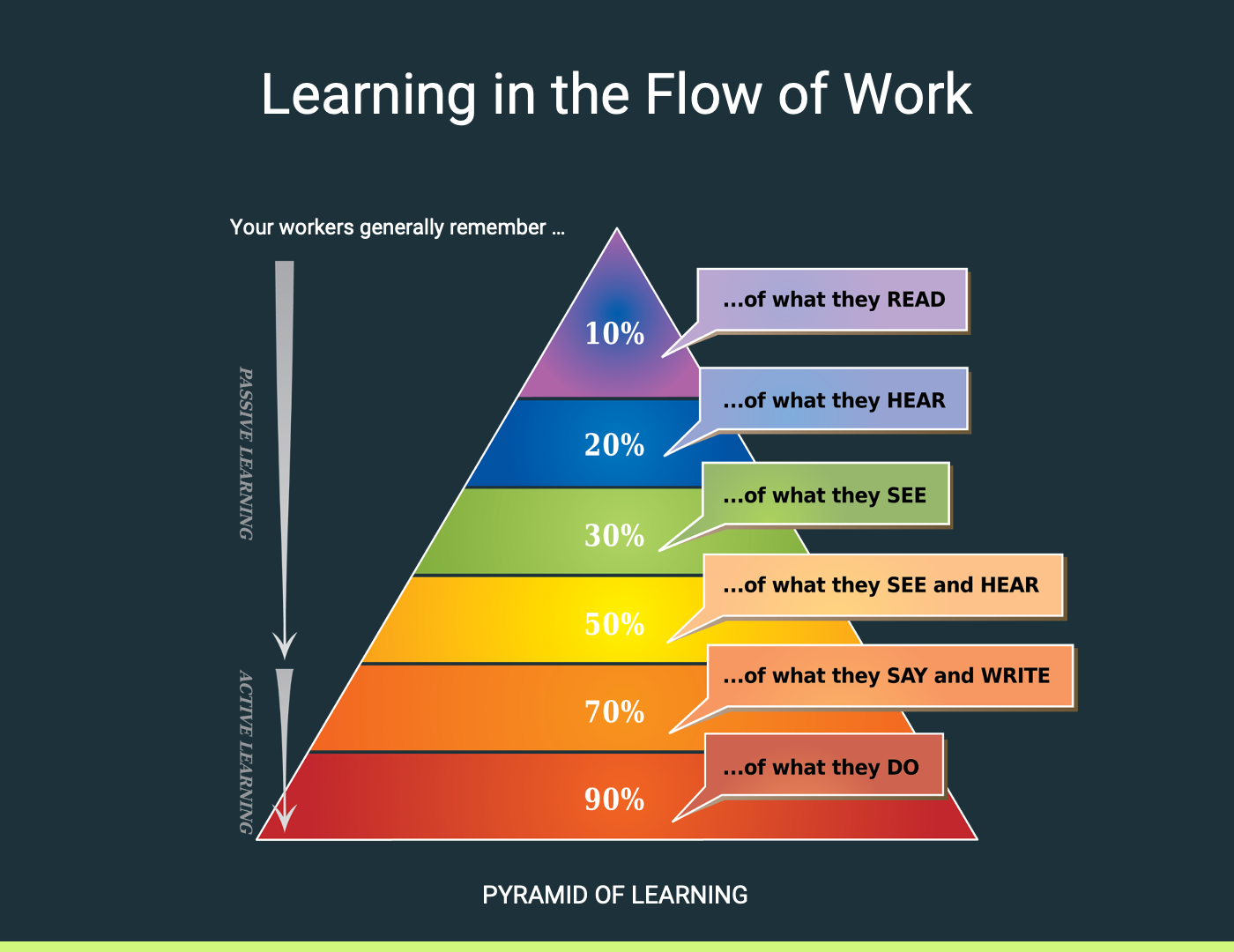
Augmented Connected Workforce (ACWF) technologies allow for increased frontline support and for new processes around learning and training to strategically upskill and reskill, reduce time to competency for new workers, and to combat the skilled labor shortage in manufacturing and more. Connected worker tools, such as wearable devices and IoT sensors, enable real-time monitoring of worker performance and environmental conditions, ensuring safety and efficiency on the factory floor.

pyramid of learning

An ACWF also allows for improved workflow learning capabilities giving frontline workers access to expert guidance, remote assistance and collaboration, microlearning, and other learning in the flow of work options regardless of the worker’s location.

ACWF tools further enhance frontline activities through:

  • Digital work instructions and guidance: Smart, connected worker platforms provide digital work instructions, procedures, and visual guidance easily accessible to workers on mobile devices.
  • Digital mentors and training: Some ACWFs incorporate “digital mentors” – GenAI-powered industrial assistants that can provide step-by-step guidance to workers, especially new hires.
  • Knowledge capture and sharing: Connected frontline worker applications serve as knowledge sharing platforms, capturing data and insights from frontline workers, which can then be analyzed by AI software and used to improve processes, update work instructions, and share knowledge across the organization
  • Performance monitoring and feedback: ACWF solutions provide visibility into worker performance, allowing managers to identify areas where additional training or support is needed.

augmented connected workforce in manufacturing

In summary, ACWF initiatives empower frontline workers with the digital tools, knowledge, and support they need to learn and improve their skills directly within their daily workflows, rather than relying solely on formal training programs. This helps close skills gaps and drive continuous improvement.

Future-proofing Manufacturing Operations with an ACWF

Adopting an Augmented Connected Workforce (ACWF) approach centered around augmenting frontline workers with mobile technology, immersive training, collaborative decision-making, and continuous improvement, allows manufacturers to future-proof their operations and gain a sustainable competitive advantage. This concept empowers employees with powerful tools that augment and enhance their capabilities, productivity, and overall business processes by accessing critical information and fostering collaboration

AI-powered software can analyze vast amounts of data to optimize production processes and predict workforce development needs. At the same time, connected frontline worker solutions enable the integration of mobile and wearable technologies and provide real-time data insights, aiding in optimizing factory operations and adapting to evolving industry trends.

For an Augmented Connected Workforce, integrating AI and connected worker technologies serves as a vital strategy for manufacturers navigating the skilled labor crisis. Augmentir encourages organizations to embrace ACWF transformations and expedites adoption through a comprehensive connected worker platform leveraging the combined benefits of connected worker and AI technologies.

With Augmentir, frontline workers can access critical information, real-time data and insights, and expert advice and guidance all in the flow of work preventing lost time and improving both efficiency and productivity. Schedule a live demo to learn more about how an Augmented Connected Workforce future-proofs manufacturing operations and enhances frontline activities.


See Augmentir in Action
Get in Touch for a Personalized Demo

AI is playing a key role in changing the manufacturing landscape, augmenting workers and empowering them with improved, optimized processes, better data, and personalized instruction.

Deloitte recently published an article with the Wall Street Journal covering how AI is revolutionizing how humans work and its transformative impact. They emphasized that AI is not merely a resource or tool, but, that it serves almost as a co-worker, enhancing work processes and efficiency. This article discussed how the evolving form of intelligence augments human thinking and emphasized this as a catalyst for accelerated innovation.

Manufacturing is uniquely situated to benefit from AI to improve operations and empower their frontline workforces. The skilled labor gap has reached critical levels, and the market is under tremendous stress to keep up with growing consumer demand while staying compliant with quality and safety standards. Manufacturing workers are crucial to the success of operations – maintenance, quality control and assurance, and more – manufacturers rely upon their workforce to ensure production proceeds smoothly and successfully.

AI is playing a key role in changing the manufacturing landscape, augmenting workers and empowering them with improved, optimized processes, better data for informed decision-making, troubleshooting, personalized instructions and training, and improved quality assurance and control. According to the World Economic Forum, an estimated 87% of manufacturing companies have accelerated their digitalization over the past year, the IDC states 40% of digital transformations will be supported by AI, and a recent study from LNS Research found that 52% of industrial transformation (IX) leaders are deploying connected worker applications to help their frontline workforces. Not only that, AI technology is expected to create nearly 12 million more jobs in the manufacturing industry.

Integrating AI into manufacturing not only enhances productivity, but also opens the door to new possibilities for worker safety, training, and innovative new manufacturing practices. Here are some ways AI is transforming manufacturing operations:

  • AI-based Workforce Analytics: Collecting, analyzing, and using frontline worker data to assess individual and team performance, optimize upskilling and reskilling opportunities, increase engagement, reduce burnout, and boost productivity.
  • Personalized Training in the Flow of Work: With AI and connected worker solutions, manufacturers can identify and supply training at the time of need that is personalized to each individual and the task at hand.
  • Personalized Work Instructions: AI enables manufacturers to offer customized digital work instructions mapped to their skill levels and intelligently assign work based on each individual’s capabilities.
  • Digital Performance Support and Troubleshooting Guide: Generative AI assistants and bot-based AI virtual assistants offer support and guidance to manufacturing operators, enabling access to collaborative technologies and knowledge bases to ensure the correct actions and processes are taken.
  • Optimize Maintenance Programs: AI algorithms analyze data from sensors on machinery and other connected solutions to predict when equipment is likely to fail. This enables proactive maintenance, minimizing downtime and reducing maintenance costs. Additionally, with AI technologies, manufacturers can implement autonomous maintenance processes through a combination of digital work instructions and real-time collaboration tools. This allows operators to independently complete maintenance tasks at peak performance.
  • Improve Quality Control: AI-powered solutions can improve inspection accuracy and optimize quality control and assurance processes to identify defects faster. With connected worker solutions, manufacturers can effectively turn their frontline workforce into human sensors supplying quality data and enhancing assurance processes.
  • Ensure Worker Safety: AI-driven safety systems coupled with connected worker technologies monitor the work environment, supplying real-time data and identifying potential hazards to ensure a safer workplace for employees.

connected enterprise

As AI continues to advance, the manufacturing industry is poised for even greater transformation, improving both the quality of products and the working conditions for employees. AI is revolutionizing the way humans work and how the manufacturing industry approaches nearly every process across operations, augmenting work interactions, productivity, efficiency, and boosting innovation.

Explore top use cases for generative AI in manufacturing, how GenAI copilots and digital assistants work, and benefits for frontline workers.

Generative AI in manufacturing refers to the application of generative models and artificial intelligence techniques to optimize and enhance various aspects of the manufacturing process.

While traditional AI focuses on data analysis, pattern recognition, and decision-making, generative AI creates new content and synthetic data, enabling innovative solutions. This involves using AI algorithms to generate new product designs, optimize production workflows, predict maintenance needs, and improve production efficiency within frontline operations.
generative ai in manufacturing

According to McKinsey, nearly 75% of generative AI’s major value lies in use cases across four areas: manufacturing, customer operations, marketing and sales, and supply chain management. Manufacturers are uniquely situated to benefit from generative AI and it is already a transformative force for some. Generative AI is driving innovation and efficiency across the manufacturing sector, enabling advanced digital solutions and competitive advantages. A recent Deloitte study found that 79% of organizations expect generative AI to transform their operations within three years, and 56% of them are already using generative AI solutions to improve efficiency and productivity.

Manufacturing is rapidly evolving and by integrating cutting-edge technologies like Generative AI, manufacturers can better support, augment, and enhance their frontline workforces with improved decision-making, collaboration, and data insights. Gen AI is being adopted as a modern alternative to traditional methods, surpassing manual inspections and basic automation to deliver greater operational improvements.

Join us below as we dive into generative AI in manufacturing exploring how it works, the benefits and risks, and some of the top use cases that generative AI, specifically generative ai digital assistants, can provide for manufacturing operations:

What is Generative AI in Manufacturing

Generative AI refers to artificial intelligence systems designed to create new content, such as text, images, or music, by learning patterns from existing data. In manufacturing, this includes the ability to generate new product designs and create synthetic data, such as realistic images, videos, or text, to support manufacturing innovation and AI training. The use of Large Language Models (LLMs) and Natural Language Processing (NLP) enables these systems to analyze vast amounts of data, leveraging advanced algorithms and machine learning algorithms to improve prediction accuracy and operational efficiency, simulate different scenarios, and generate innovative solutions that can impact a wide range of manufacturing processes.
generative ai in manufacturing with LLMs and NLP

Large Language Models

Large Language Models (LLMs) are a type of generative artificial intelligence model that have been trained on a large volume – sometimes referred to as a corpus – of text data. They are capable of understanding and generating human-like text and have been used in a wide range of applications, including natural language processing, machine translation, and text generation.

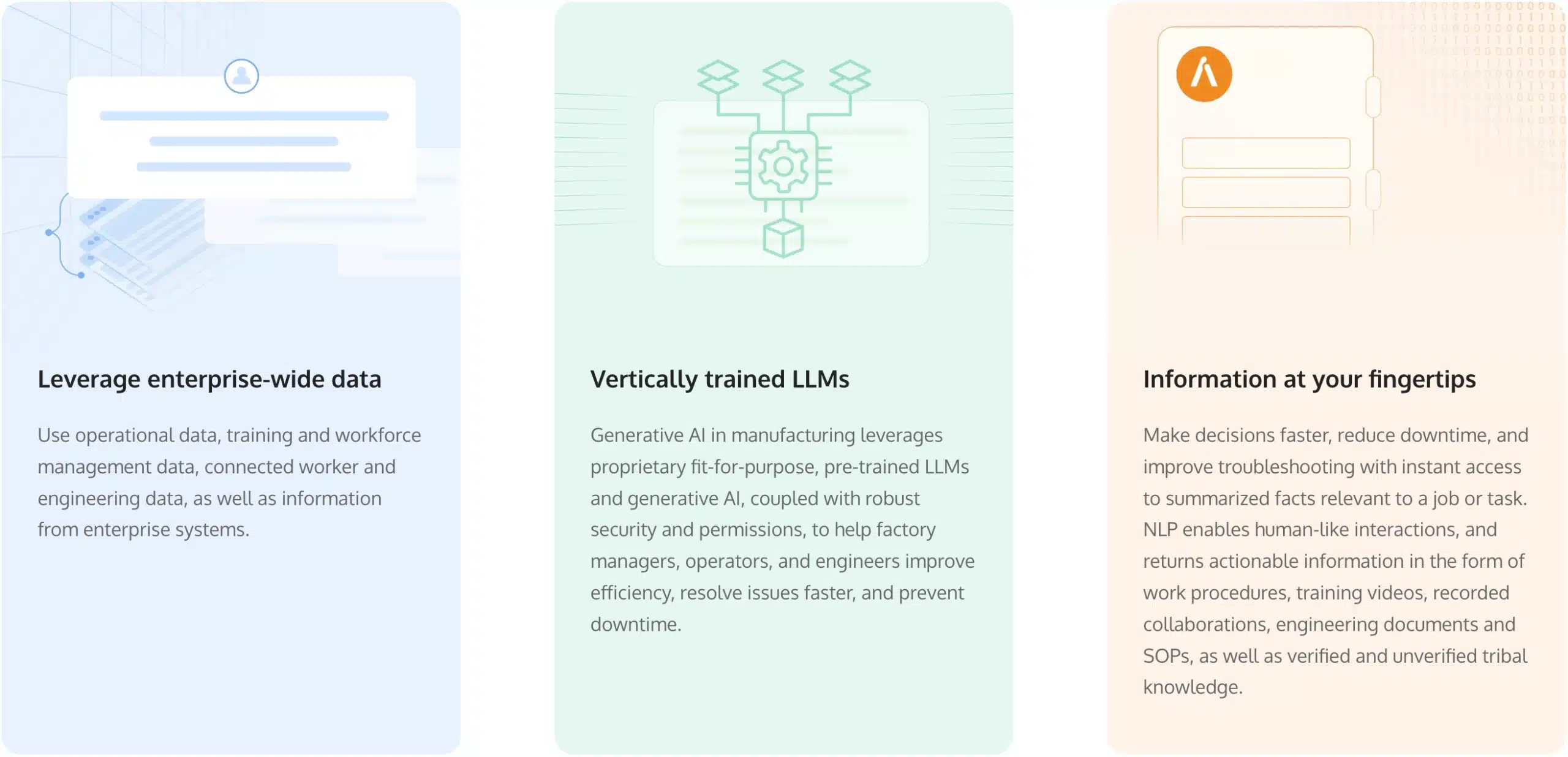
In manufacturing, generative AI solutions should leverage proprietary fit-for-purpose, pre-trained LLMs, coupled with robust security and permissions.  Industrial LLMs use operational data, training and workforce management data, connected worker and engineering data, as well as information from enterprise systems. LLMs can also enhance document search by efficiently finding, extracting, and summarizing information from technical manuals, reports, and operational records.

Natural Language Processing

Natural Language Processing (NLP) is a branch of artificial intelligence that focuses on the interaction between computers and humans using natural language. It involves the development of algorithms and models that enable computers to understand, interpret, and respond to human language in a way that is both meaningful and useful.

For generative AI, NLP is a key technology that enables the assistants to understand and generate human-like text, providing seamless conversational user experiences and valuable assistance to frontline workers, engineers, and managers in manufacturing and industrial settings.

NLPs allow the AI to process and interpret natural language inputs, enabling it to engage in human-like interactions, understand user queries, and provide relevant and accurate responses. This is essential for common manufacturing tasks such as real-time assistance, documentation review, predictive maintenance, and quality control.

By combining large language models and natural language processing, generative AI can produce coherent and contextually relevant text for tasks like writing, summarization, translation, and conversation, mimicking human language proficiency. NLP also enables interactive learning experiences, allowing employees to engage with training content, receive immediate feedback, and clarify doubts in real time.

Benefits of Leveraging Generative AI in the Manufacturing Industry

Generative AI and solutions that leverage them offer several benefits for manufacturing operations, including:

  • Operational/Production Optimization and Forecasting: GenAI technology offers a significant boost to manufacturing processes by monitoring and analyzing in real-time, spotting problems quickly, and providing predictive insights and personalized assistance to boost efficiency for manufacturing workers. Through process optimization and enhancing efficiency with real-time data analysis and automation, manufacturers can streamline operations, reduce downtime, and improve productivity. Additionally, AI assistants empower manufacturers to explore multiple control strategies within their process, identifying potential bottlenecks and failure points.
  • Proactive Problem-Solving: Generative AI-powered tools provide real-time monitoring and risk analysis of manufacturing operations, enabling the quick identification and resolution of issues to optimize production and efficiency. They can spot events as they happen, providing valuable insights and recommendations to help operators and engineers rapidly identify and resolve problems before they escalate. Predictive analytics and improved quality control help reduce waste and support continuous improvement in manufacturing processes.
  • Reduce Unplanned Downtime: Generative AI solutions can analyze vast datasets to predict equipment maintenance needs before issues arise, allowing manufacturers to schedule maintenance proactively, minimizing unplanned disruptions. Generative AI can also optimize maintenance schedules and delivery schedules to further reduce downtime and improve supply chain reliability. This not only improves downtime but also contributes to the overall operational resilience of mission-critical equipment.
  • Personalized Support and On-the-job Guidance: Generative AI tools can be tailored to diverse roles within the manufacturing plant, offering personalized assistance to operators, engineers, and managers. It can provide role-based, personalized assistance, and proactive insights to understand past events, current statuses, and potential future happenings, enabling workers to perform their tasks more effectively and make better, more informed decisions. GenAI solutions and applications involved implementing generative AI provide optimized parameters for operators and help manage inventory more effectively.

These benefits demonstrate the significant impact of generative AI on frontline manufacturing activities, improving overall operational efficiency, adjusting processes where needed, and driving operational excellence.

Pro Tip

Generative AI assistants can take these benefits one step further by incorporating skills and training data to measure training effectiveness, identify skills gaps, and suggest solutions to prevent any skilled labor issues. This guarantees that frontline workers have the essential skills to perform tasks safely and efficiently, while also establishing personalized career development paths for manufacturing employees that continuously enhance their knowledge and abilities.

A

Risks of Generative AI in Manufacturing

Generative AI in manufacturing presents several risks, including data security, intellectual property concerns, and potential bias in AI models. The reliance on vast amounts of data raises the risk of data breaches and cyberattacks, potentially exposing sensitive information. Intellectual property issues may arise if AI-generated designs or processes inadvertently infringe on existing patents or proprietary technologies. Additionally, biases in training data can lead to suboptimal or unfair outcomes, affecting the quality and equity of AI-driven decisions. There is also the risk of over-reliance on AI, which may reduce human oversight and lead to errors if the AI models make incorrect predictions or generate flawed designs. Ensuring proper validation, transparency, and human intervention is crucial to mitigating these risks.

The use of any genAI tool in manufacturing requires careful consideration of ethical, data privacy, and security risks, as well as potential impacts on employment.

Top Use Cases for Generative AI Manufacturing Assistants

Generative AI assistants and frontline copilots are AI-powered tools designed to provide valuable assistance and insights in industrial settings, particularly in manufacturing. These assistants are a type of generative AI that are used in manufacturing operations to enhance human-machine collaboration, streamline workflows, and offer proactive insights to optimize performance and productivity for frontline workers. The manufacturing sector is being transformed by these advanced AI applications, which are driving efficiency, innovation, and better decision-making across the industry.

What makes frontline AI assistants unique among other generative AI copilots is the enhanced human-like interaction beyond standard data analytics and analysis to understand the context around a process or issue; including what happened and why, as well as anticipate future events.

Generative AI assistants work via specialized large language models (LLMs) and generative AI, providing contextual intelligence for superior operations, productivity, and uptime in industrial settings. Additionally, they typically involve natural language processing for understanding human language, pattern recognition to identify trends or behaviors, and decision-making algorithms to offer real-time assistance. This, combined with machine learning techniques, allows them to understand user inputs, provide informed suggestions, and automate tasks. AI and machine learning are used together in manufacturing to automate defect detection and optimize supply chains, further enhancing operational efficiency.

Here are 6 of the top use cases for generative AI in manufacturing:

1. Troubleshooting

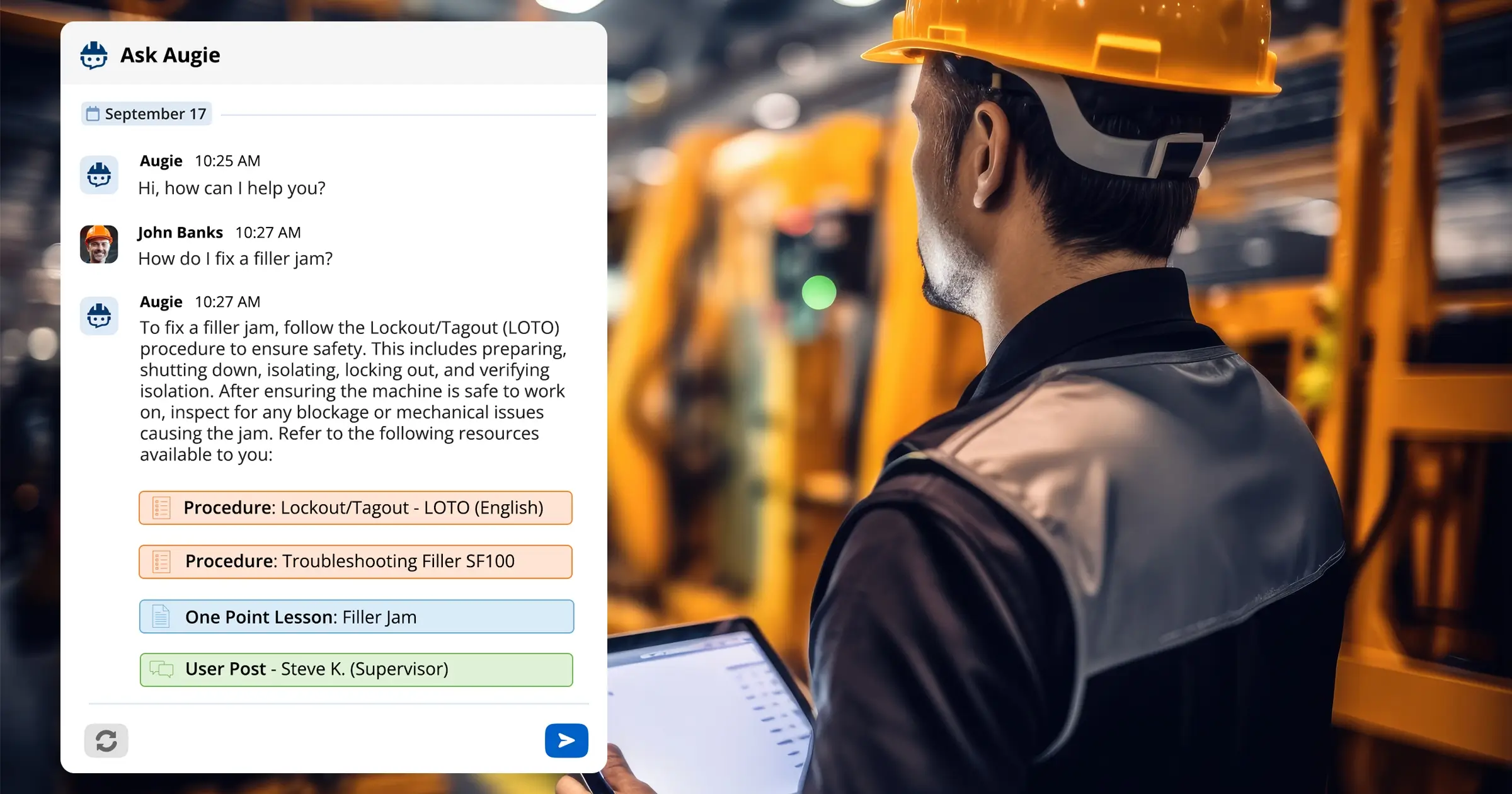
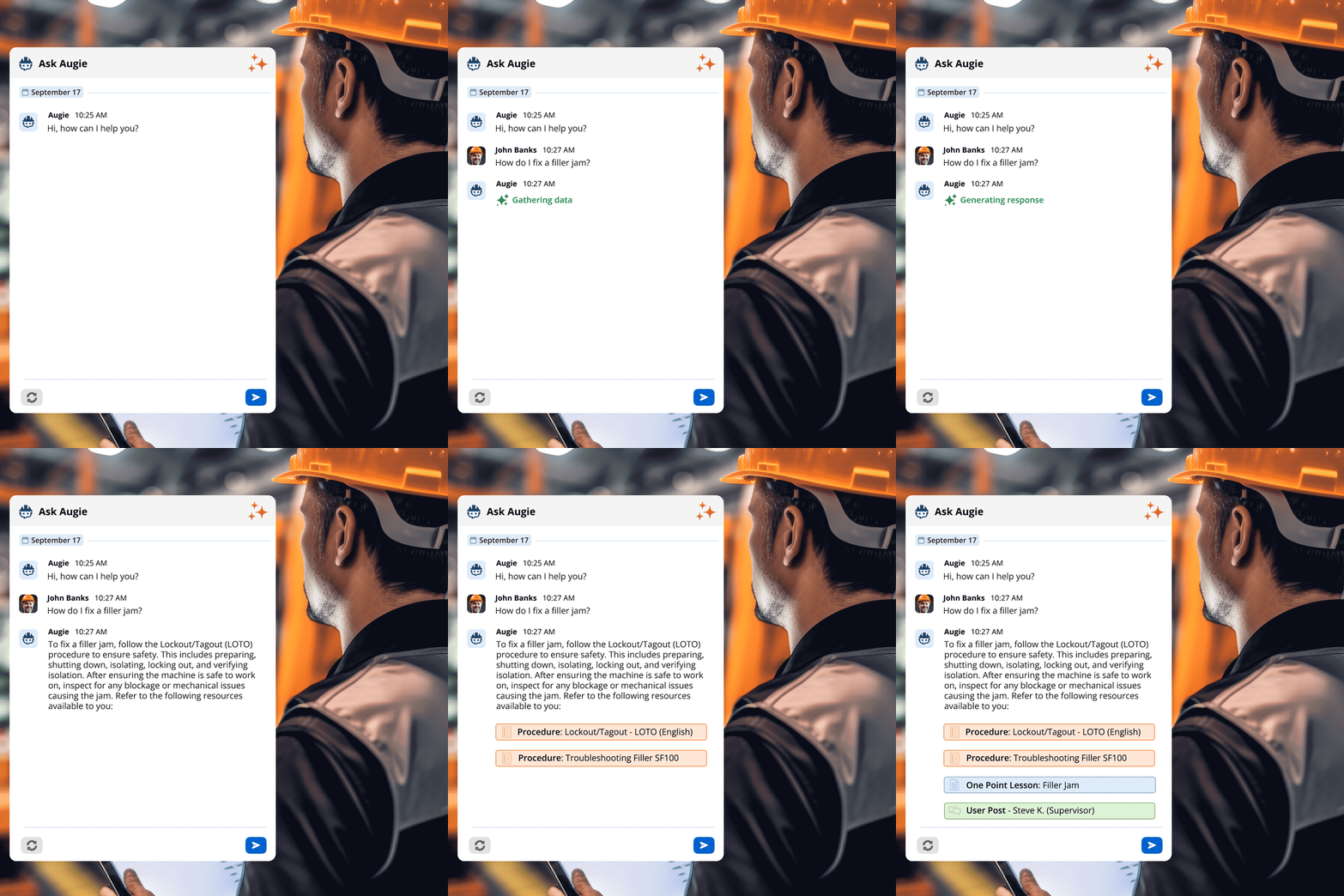
Troubleshooting is such a critical use case in manufacturing. With today’s skilled labor shortage, frontline workers are often times in situations where they don’t have the decades of tribal knowledge required to quickly troubleshoot and resolve issues on the shop floor. AI assistants can help these workers make decisions faster and reduce production downtime by providing instant access to summarized facts relevant to a job or tasks, this could come from procedures, troubleshooting guides, captured tribal knowledge, or OEM manuals.
generative ai in manufacturing use case - troubleshooting

2. Personalized Training & Support

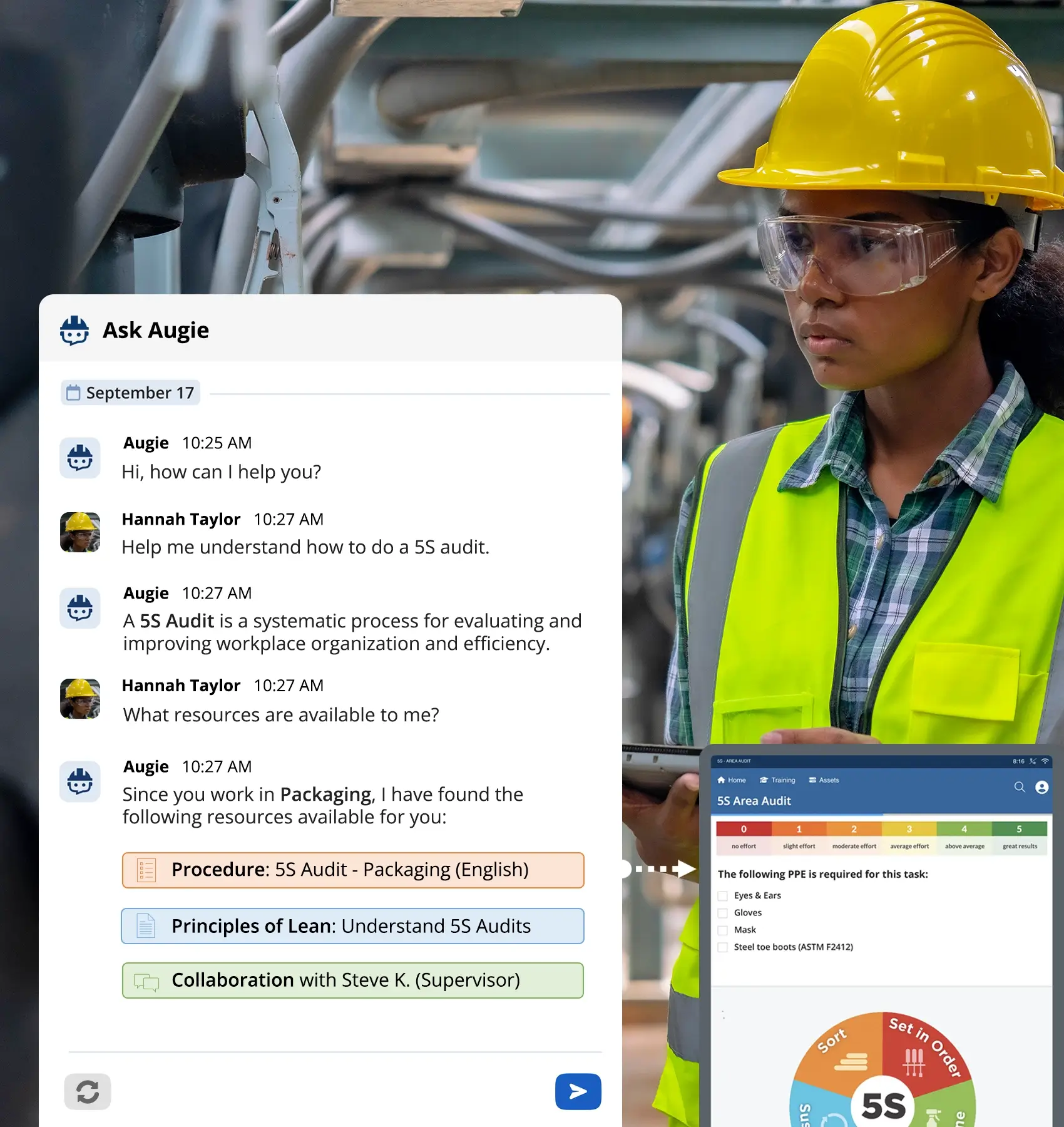
With GenAI assistants, manufacturers can instantly close skills and experience gaps with information personalized, context-aware to the individual worker. This could include: on the job training materials, one point lessons (OPLs), or peer/user generated content such as comments and conversations.
generative ai in manufacturing use case - training and work assistant

3. Leader Standard Work

With Generative AI assistants, operations leaders can assess and understand the effectiveness of standard work within their manufacturing environment, and identify where there are areas of risk or opportunities for improvement.

4. Converting Tribal Knowledge

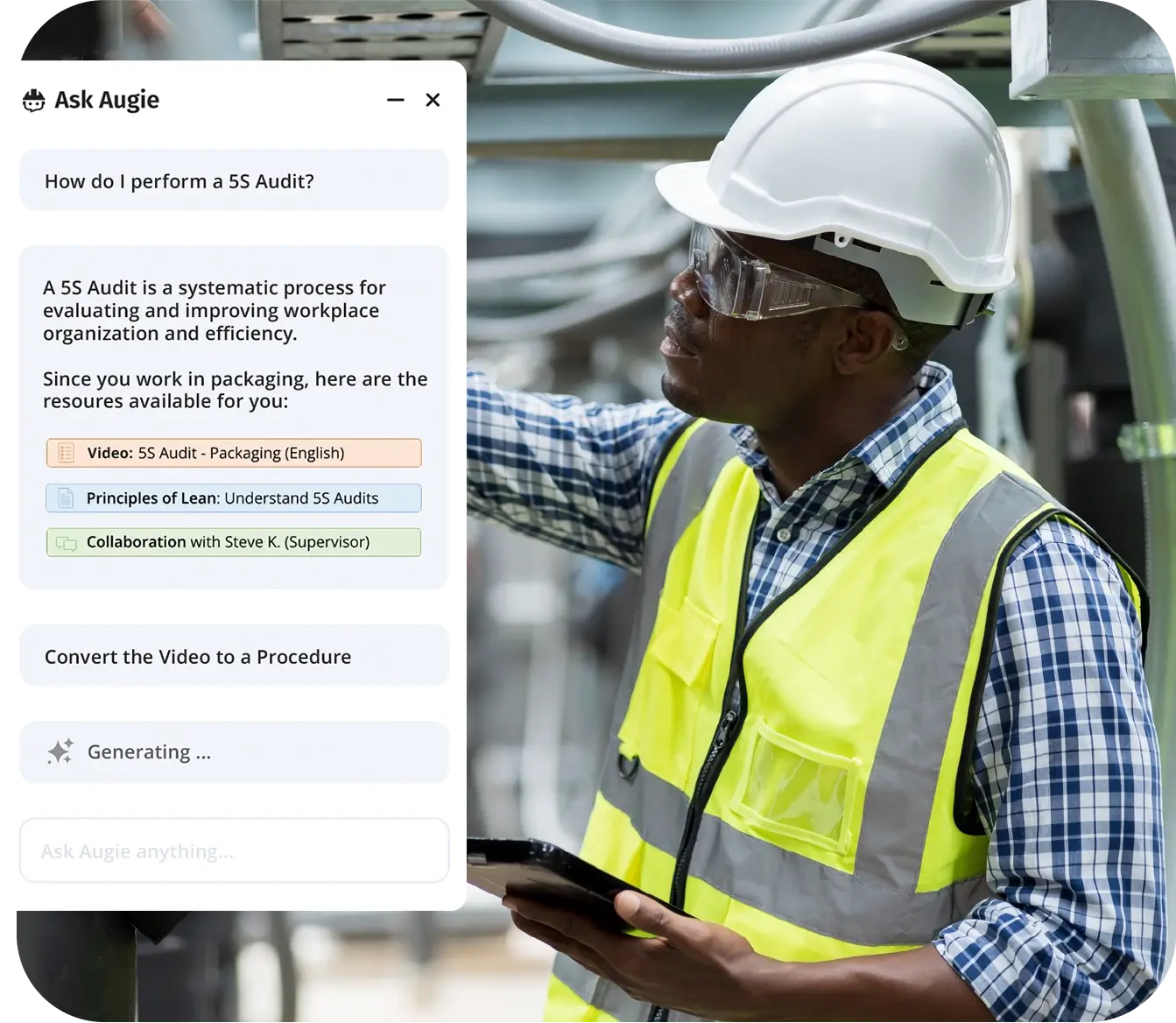
One of the more pressing priorities that many manufacturers face is the task of capturing and converting tribal knowledge into digital corporate assets that can be shared across the organization. With connected worker technology that utilizes Generative AI, manufacturing companies can now summarize the exchange of tribal knowledge via collaboration and convert these to scalable, curated digital assets that can be shared instantly across your organization.
generative ai in manufacturing use case - convert tribal knowledge

5. Continuous Improvement

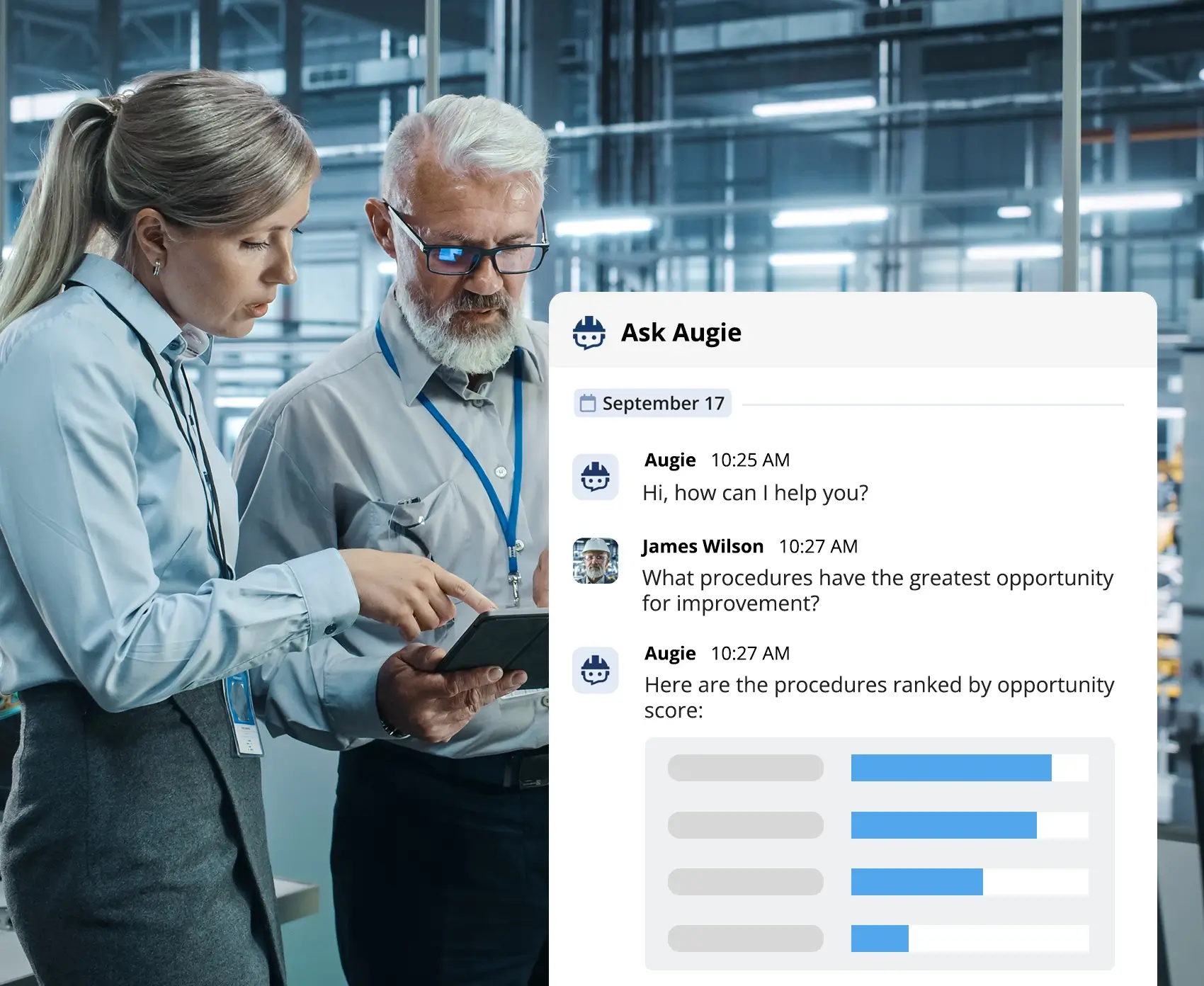
AI and GenAI assistants can help us identify areas for content improvement, and make those improvements, measure training effectiveness, and measure and improve workforce effectiveness.
generative ai in manufacturing use case - continuous improvement

6. Operational Analysis

Generative AI assistants can also provide value when it comes to operational improvements. GenAI assistants can use employee attendance data to help shift managers or line leaders determine where the risks are, and potentially offset any resource issues before they become truly problematic. An organization’s skills matrix, presence data, and production schedules all can feed into a fit-for-purpose, pre-trained LLM – giving you information that manufacturing leaders need to keep their operations running.
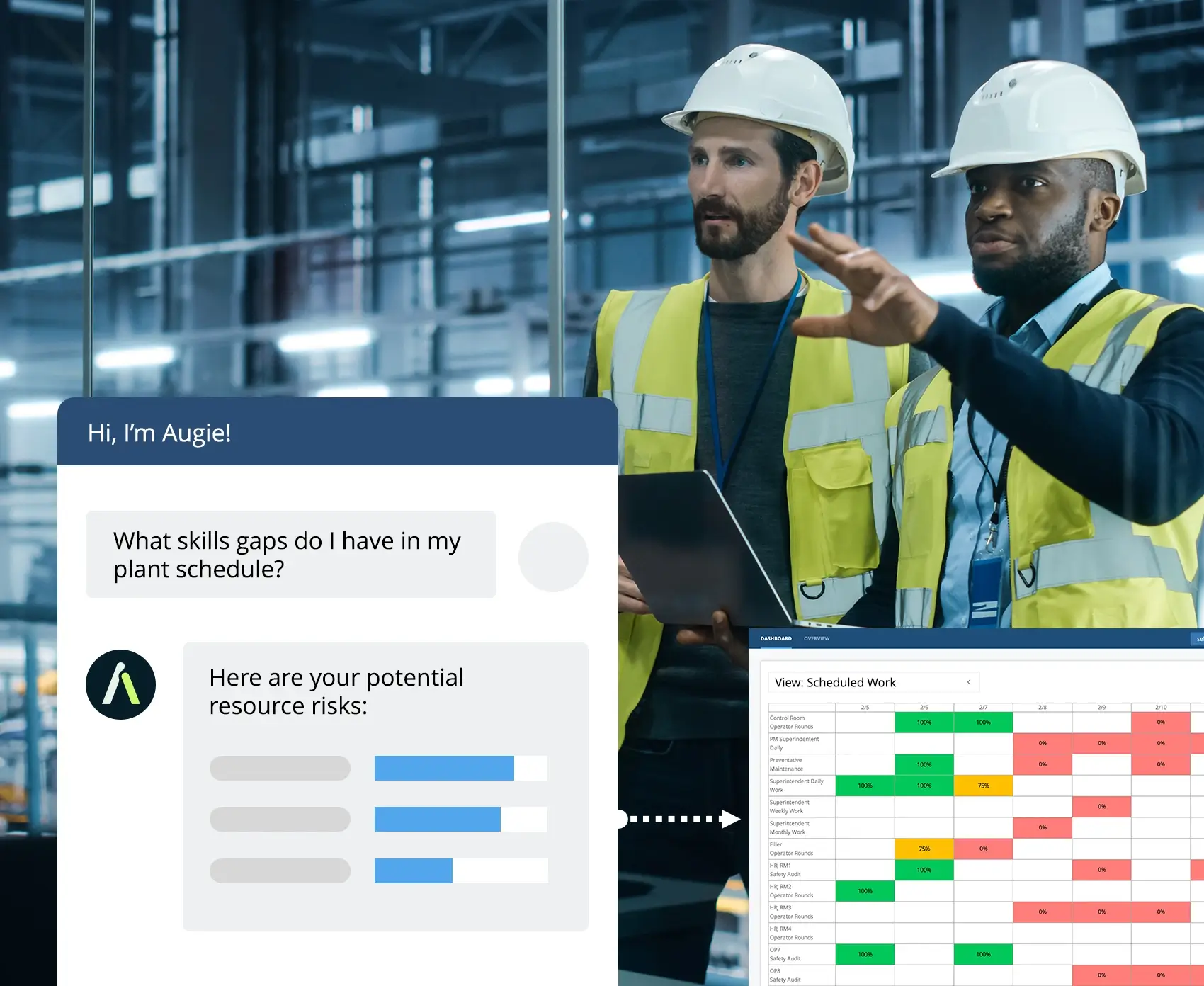
generative ai in manufacturing use case - operational analysis

Generative AI and other AI-powered solutions are leveling up manufacturing operations, analyzing data to predict equipment maintenance needs before issues arise, allowing for proactive maintenance scheduling, and minimizing unplanned disruptions. With these tools manufacturers can empower frontline workers with improved collaboration and provide real-time assistance with contextual information, ensuring relevant and timely support during critical decision-making processes.

Overall, generative AI is transforming a wide array of manufacturing and industrial activities, connecting workers in ways that were previously thought impossible, and making frontline tasks and processes safer and more efficient for workers everywhere.

Future-proofing Manufacturing Operations with Augie™

Augie™, Augmentir’s generative AI assistant for frontline work, represents the next generation of generative AI solutions, purpose-built to help manufacturing companies future-proof their operations. By harnessing the power of artificial intelligence and machine learning, Augie enables manufacturers to optimize production processes, improve quality control, and reduce maintenance costs—all while adapting to rapidly changing market demands.
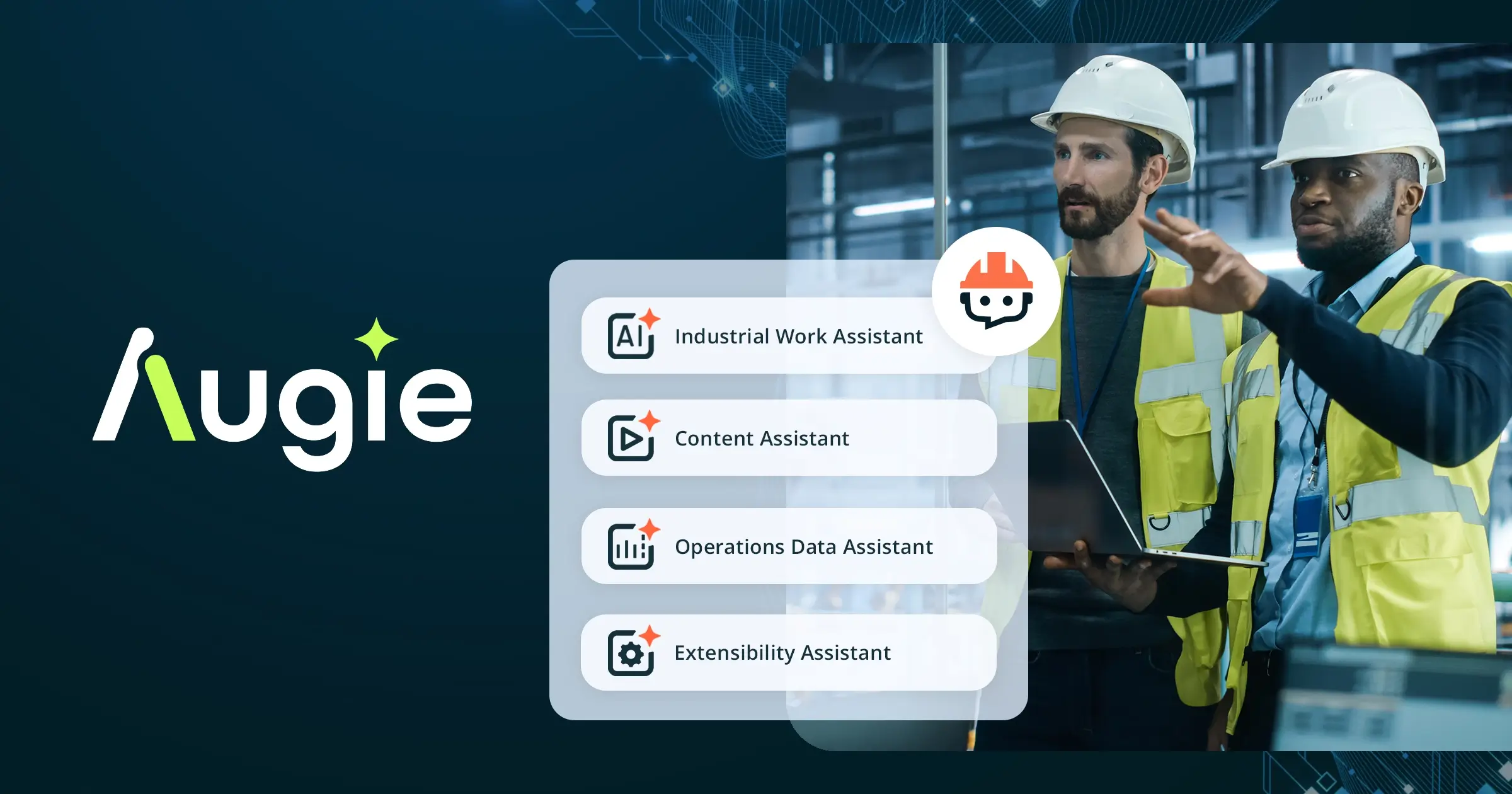
paperless shop floor with augie industrial generative ai suite

With Augie, manufacturers can analyze vast amounts of data from diverse sources, including machine data, sensor data, and historical data, to identify patterns and make predictive, data-driven decisions. This advanced platform delivers real-time insights into production processes, allowing manufacturers to quickly respond to shifts in demand, supply chain disruptions, or operational anomalies. Augie also features sophisticated algorithms for demand forecasting, inventory management, and supply chain optimization, helping companies minimize environmental impact and maximize operational efficiency.

Augie pulls in skill capabilities, workforce development information, and training data in addition to MES and ERP data. It offers contextual, proactive insights and automated workflows to optimize production and prevent bottlenecks, contributing to manufacturing efficiency, uptime, quality, and decision-making.

Additionally, Augie ties together operational data, training and workforce management data, engineering data, and knowledge/information from various disparate enterprise systems to empower frontline workers, streamline workflows, and increase manufacturing performance.

By integrating Augie into their operations, manufacturers can boost productivity, reduce unplanned downtime, and achieve significant cost savings. The platform’s AI-driven quality control ensures improved product quality, while its customer service automation capabilities enhance responsiveness and satisfaction. Ultimately, Augie empowers manufacturing companies to stay ahead of the competition, adapt to evolving industry trends, and secure a sustainable, competitive advantage in the global marketplace.

Augmentir is trusted by manufacturing leaders as a digital transformation partner delivering measurable results across operations. Schedule a live demo today to learn more.


See Augmentir in Action
Get in Touch for a Personalized Demo

Augmentir’s Chris Kuntz explores how food and beverage manufacturers are moving from traditional Lean to Digital Lean using connected worker technology and real-time data to shift from reactive to proactive operations.

Augmentir’s VP of Strategic Operations, Chris Kuntz, recently published an article in Food Industry Executive outlining how the food and beverage industry is moving beyond traditional Lean manufacturing and what that shift looks like on the plant floor. Here’s a look at the key themes and why they matter for manufacturers navigating today’s operational pressures.

Why Traditional Lean Is Reaching Its Limits

For decades, Lean manufacturing has been the backbone of operational efficiency in food and beverage, built around principles like waste elimination, continuous improvement, and standardized work. And it has delivered real results. But the operating environment has changed significantly.

Today’s food and beverage manufacturers face a much more complex landscape: consumers are demanding more SKUs, shorter product runs, seasonal varieties, and cleaner labels — all at the same time. Regulatory scrutiny around traceability and food safety has intensified. Supply chains are more volatile. And the workforce itself is shifting, with experienced operators retiring and taking decades of institutional knowledge with them.

Against this backdrop, the traditional tools of Lean — paper logs, manual audits, clipboard-based checklists, and end-of-shift reports — are showing their age. By the time data gets reviewed and decisions get made, the opportunity to intervene has often already passed. The problem isn’t the Lean philosophy itself; it’s the infrastructure it’s been running on.

What Is Digital Lean?

Digital Lean takes the core principles of waste reduction, continuous improvement, and standardized work and adds a layer of real-time data, connected worker technology, and AI-driven intelligence that makes those principles far more actionable.

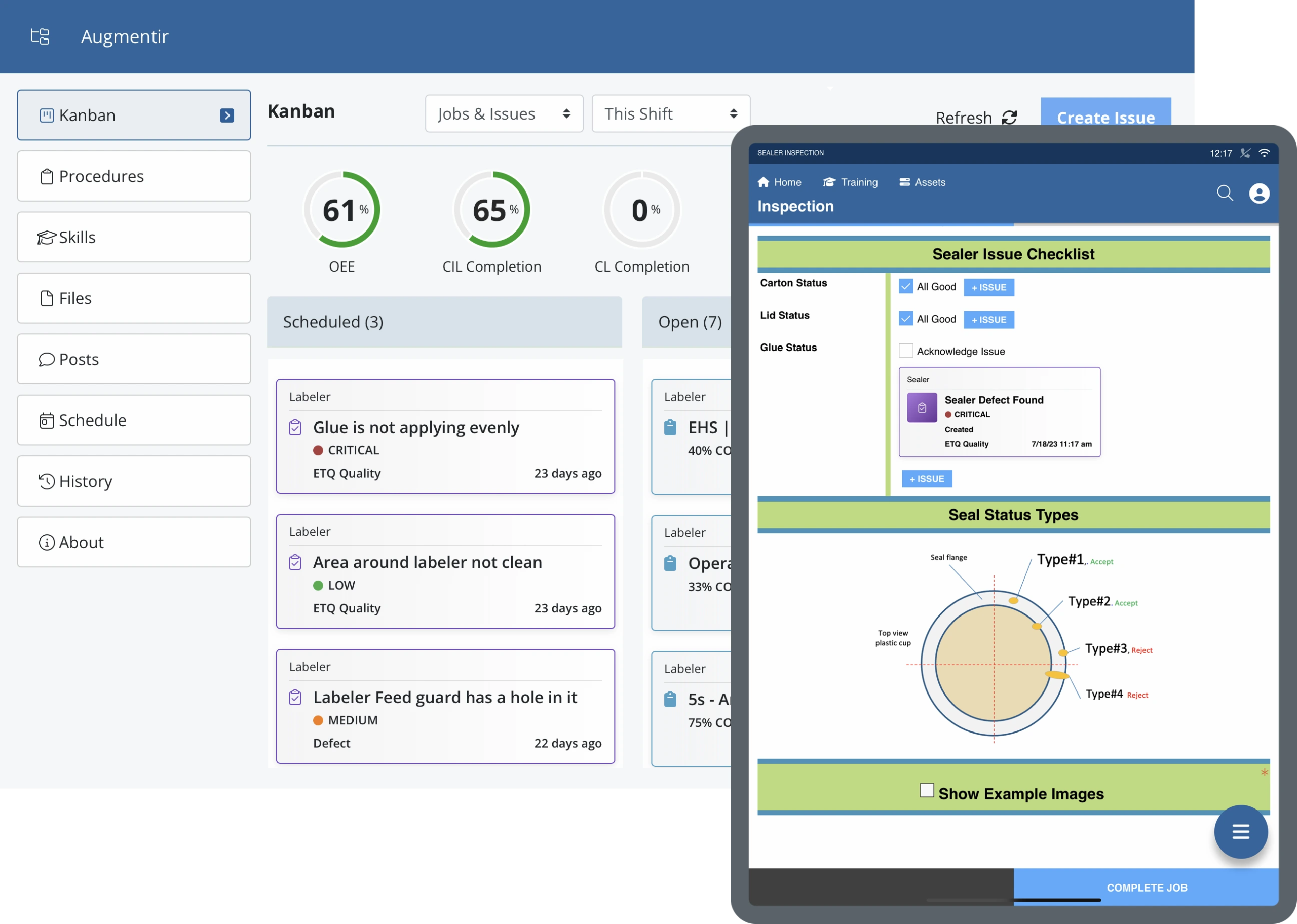
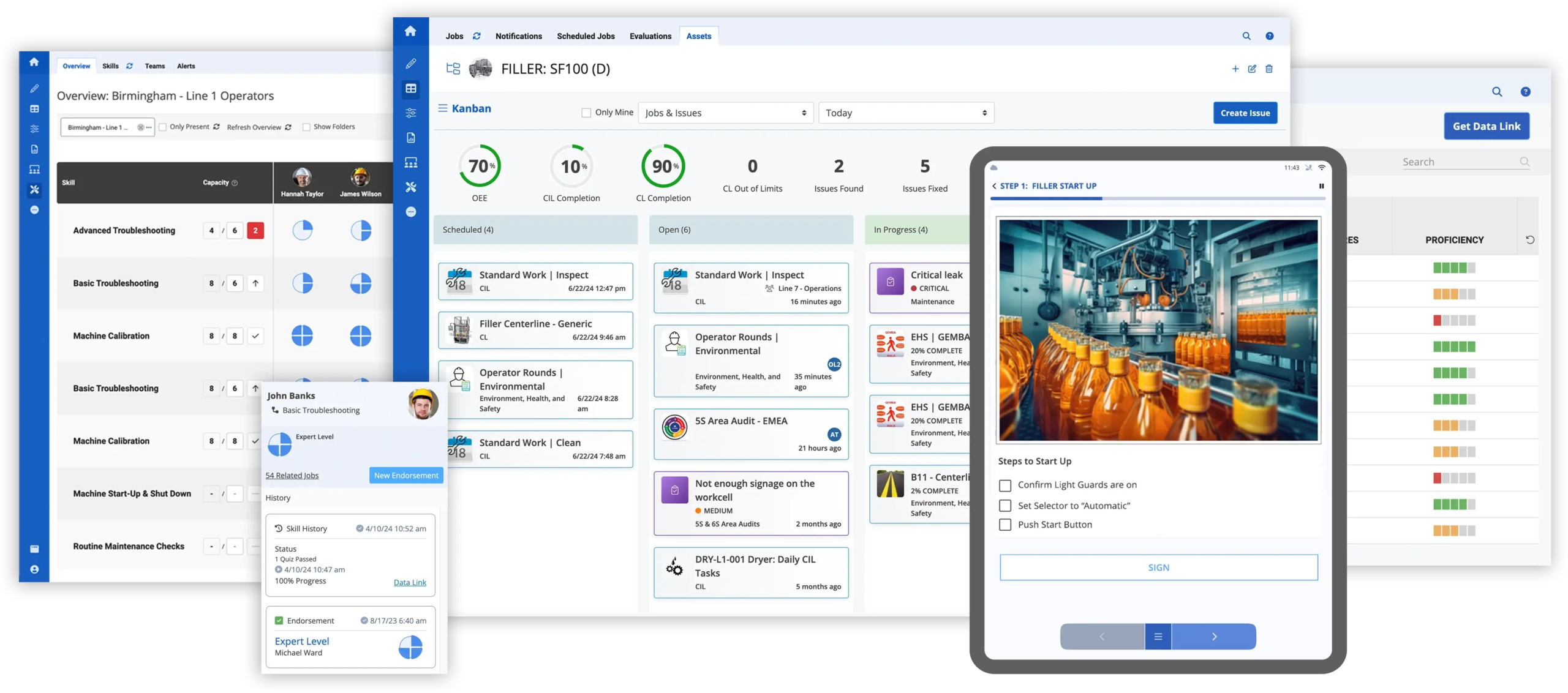
example of digital lean manufacturing software from augmentir

The shift is from retrospective to real-time. Instead of analyzing what went wrong after a shift ends, Digital Lean systems surface problems as they happen and put the right information in front of the right person to act immediately. Instead of relying on the most experienced person on the floor to carry critical process knowledge in their head, adaptive digital work instructions make that knowledge accessible to everyone.

At the center of this model is what Chris Kuntz describes as a “Single Pane of Glass” — a mobile-first, unified platform that integrates with enterprise systems like ERP, breaking down the data silos that have historically separated shop floor operations from business leadership. Frontline workers, supervisors, and executives all gain real-time visibility into the same operational picture, enabling faster, more informed decisions at every level of the organization.

Connected Worker Technology and AI Agents

The technology enabling Digital Lean is a significant departure from legacy systems. Rather than bolt-on software that requires workers to leave the floor to log data, modern connected worker platforms are designed for the frontline. Workers access live data, receive contextual guidance, and log information directly from mobile devices on the line — reducing friction and increasing the accuracy and timeliness of data capture.

AI agents are taking this a step further by acting as always-available digital assistants on the factory floor. These agents can assist workers with troubleshooting equipment issues, surfacing relevant procedures, analyzing real-time operational data, and even supporting autonomous operations in some contexts. The practical effect is that workers, including newer, less experienced employees, can perform at a higher level because they have intelligent support at their fingertips.

Where Digital Lean Makes an Immediate Impact

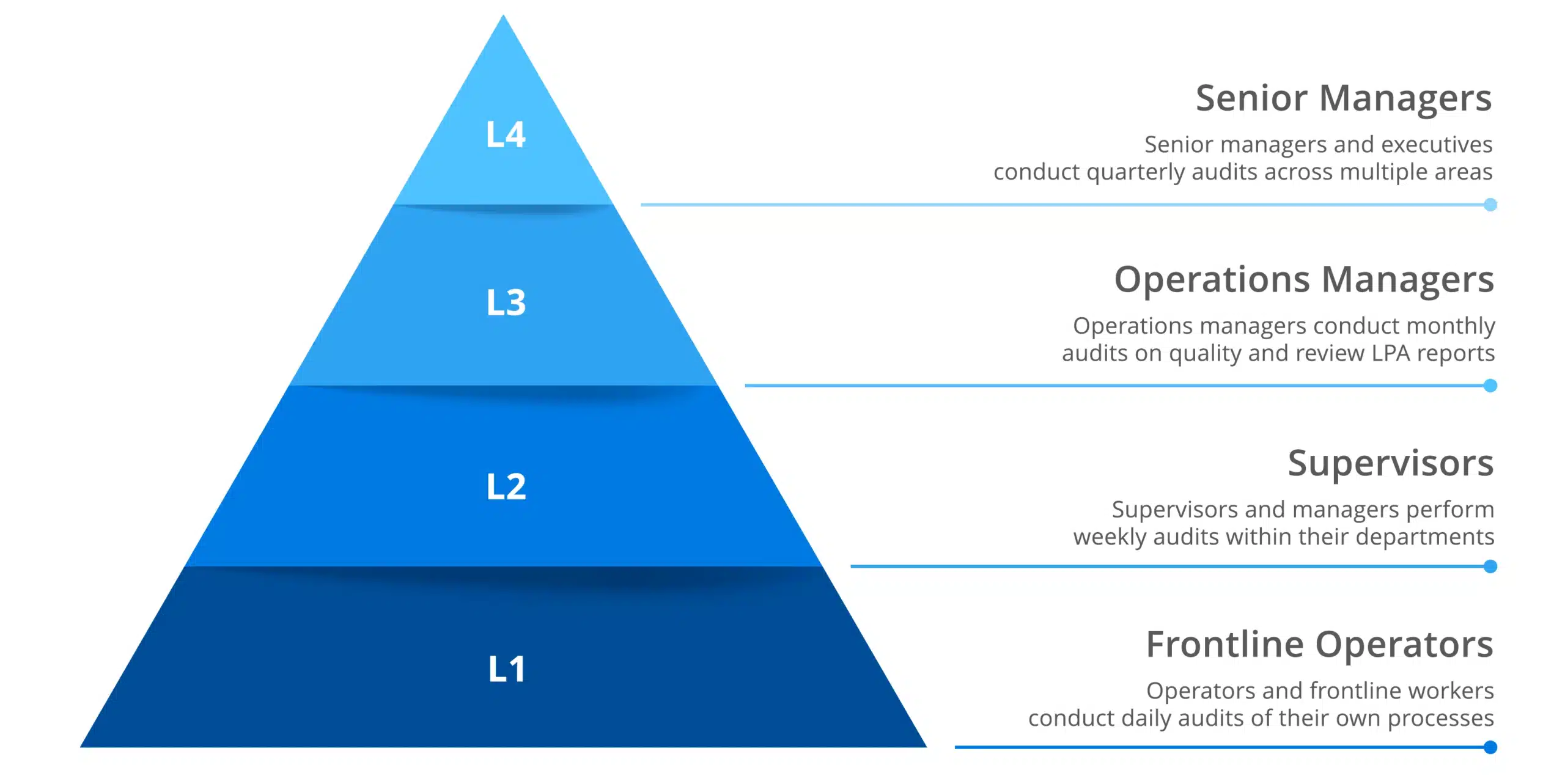
Quality and compliance: Food manufacturers operate in one of the most heavily regulated industries in the world, where quality deviations can lead to costly recalls, brand damage, and serious public health consequences. Digital Lean replaces many manual quality checks with automated validation and continuous line monitoring. If a pasteurization temperature drifts out of range or a label misaligns, the system triggers an alert or stops the line — before a defective product moves further down the line. Digital checklists built around Lean initiatives like 5S audits, Gemba walks, and centerline management ensure these processes happen consistently, with a complete digital audit trail that makes regulatory inspections far less stressful.

Equipment maintenance and uptime: Unplanned downtime is one of the most expensive problems in food manufacturing, and it’s often made worse by reactive maintenance practices. Digital Lean enables a more proactive approach through autonomous maintenance workflows, AI-assisted troubleshooting, and real-time equipment monitoring. When an issue is detected, workers have immediate access to the right diagnostic information and repair procedures, reducing the time from problem identification to resolution. Over time, the data captured through these workflows also supports better predictive maintenance — moving from “fix it when it breaks” to “fix it before it breaks.”

Changeover agility: High-mix production environments, where manufacturers run dozens of different SKUs and must execute frequent changeovers, are among the most challenging to manage with traditional Lean tools. A changeover that takes 45 minutes instead of 30 doesn’t just waste time; it compounds across hundreds of runs per year. Digital frameworks address this through skills-based, adaptive work instructions that guide operators through complex changeover procedures step by step, adjusting guidance based on the product being run and the operator’s experience level. This reduces errors, speeds up execution, and critically, decouples performance from tribal knowledge.

The Human Element: Empowering the Frontline

One of the most important, yet sometimes overlooked, aspects of Digital Lean is its impact on frontline workers themselves. Digital transformation in manufacturing often gets framed as a story about technology replacing people. Digital Lean tells a different story.

When operators have mobile access to real-time operational data, they become active participants in continuous improvement rather than passive executors of fixed procedures. Real-time metrics let them spot and respond to issues without waiting for a supervisor. Unified communication tools reduce the frustration of trying to escalate problems through disconnected channels. Workers gain a clearer sense of how their actions affect outcomes, which builds accountability and engagement.

Workforce intelligence capabilities extend this further by identifying where individual workers have skills gaps and where upskilling or reskilling opportunities exist. As the workforce evolves, with more younger, digitally native workers entering the floor alongside veterans, these tools help ensure the organization’s collective capability keeps pace with its operational complexity.

Perhaps most importantly, Digital Lean platforms help capture and institutionalize tribal knowledge. When an experienced operator retires after 25 years, the process insights they’ve accumulated don’t have to leave with them. Digital work instructions, captured troubleshooting guides, and documented best practices turn individual expertise into shared organizational assets.

How Augmentir Enables Digital Lean

For food and beverage manufacturers looking to make the transition from traditional Lean to Digital Lean, Augmentir provides the infrastructure to make it real —  on the plant floor.

Augmentir’s platform connects workers, processes, and operational data in one unified system, giving manufacturers the “Single Pane of Glass” visibility that Digital Lean requires. Frontline workers get mobile-first access to digital work instructions, real-time quality checklists, and AI-powered guidance all tailored to the individual based on their skills, experience, and the task at hand. Supervisors and leadership gain live dashboards showing exactly what’s happening on the floor, with the ability to identify and act on issues as they emerge rather than after the fact.

Key capabilities that support the Digital Lean journey include:

AI-powered work instructions: Augmentir’s adaptive, skills-based digital work instructions evolve with each worker. New operators get more detailed step-by-step guidance; experienced workers get streamlined views. This reduces errors during changeovers, onboarding, and complex maintenance tasks, without requiring a Lean expert on every shift.

Connected quality and compliance: Digital checklists and inspection workflows replace paper-based processes with automated, audit-ready documentation. Augmentir supports 5S audits, Gemba walks, centerline management, and other Lean quality initiatives, with built-in validation logic and real-time alerts that keep quality from slipping through the cracks.

AI agents on the factory floor: Augmentir’s AI agents act as on-demand digital coworkers, helping frontline staff troubleshoot equipment issues, surface relevant procedures, and capture operational data in real time. This accelerates issue resolution, reduces reliance on scarce expert knowledge, and keeps lines running.

Workforce intelligence: Augmentir tracks individual worker performance and skill development over time, giving operations leaders the visibility to proactively close capability gaps, optimize labor assignments, and build a more resilient workforce. Tribal knowledge gets captured systematically and turned into shared organizational assets rather than lost when tenured employees leave.

Food and beverage manufacturers working with Augmentir are able to move faster on their Digital Lean initiatives because the platform is designed specifically for manufacturing frontlines.

The Competitive Standard Is Shifting

The food and beverage manufacturers that are pulling ahead aren’t just running leaner operations — they’re running smarter ones. By building on modern connected worker infrastructure, they’re closing the gap between what’s happening on the floor and what leadership can see and act on. They’re responding to market shifts faster, managing quality more consistently, and developing a workforce that improves continuously rather than just maintaining the status quo.

The shift to Digital Lean isn’t about replacing the foundational principles that have made Lean effective for decades. It’s about giving those principles the infrastructure they need to deliver at the speed and scale modern food manufacturing demands.


Read the full article on Food Industry Executive. 


See Augmentir in Action
Get in Touch for a Personalized Demo

 

Frequently Asked Questions (FAQ)

  • What is Digital Lean Manufacturing and how is it different from traditional Lean?

    Digital Lean Manufacturing combines Lean principles with real-time data, AI, and connected worker technology. Unlike traditional Lean, which relies on paper-based processes and manual reporting, Digital Lean enables real-time visibility, faster decision-making, and continuous improvement on the factory floor.

  • How can connected worker technology reduce downtime in food manufacturing?

    Connected worker technology, like Augmentir, reduces downtime by giving operators instant access to AI-guided troubleshooting, digital maintenance procedures, and real-time equipment information. This helps teams resolve issues faster and supports predictive maintenance efforts.

  • How does Augmentir support Lean manufacturing in food and beverage?

    Augmentir helps food and beverage manufacturers digitize Lean processes such as 5S audits, Gemba walks, centerline management, and changeovers. Its AI-powered connected worker platform provides digital work instructions, automated quality checks, and real-time operational insights to improve efficiency and consistency.

  • How does Augmentir help food and beverage manufacturers retain triball knowledge?

    Augmentir captures tribal knowledge through digital work instructions, troubleshooting workflows, and standardized best practices. This helps manufacturers reduce training time, improve workforce consistency, and preserve critical operational expertise as experienced workers retire.