As Covid-19 changes the nature of work for manufacturing and services companies changes possibly forever, using innovations such as Artificial Intelligence (AI), augmented reality (AR), and connected worker technology to transform the enterprise has become more relevant than ever. For industrial companies, improving the safety and productivity of frontline workers in the COVID-19 era and […]

As Covid-19 changes the nature of work for manufacturing and services companies changes possibly forever, using innovations such as Artificial Intelligence (AI), augmented reality (AR), and connected worker technology to transform the enterprise has become more relevant than ever.

For industrial companies, improving the safety and productivity of frontline workers in the COVID-19 era and beyond through connected worker technology will be critical to business success and continuity. Tools like remote assistance, augmented work instructions, and knowledge sharing will be crucial to helping these companies transform their operations and continue to support their customers.

COVID-19 is forcing manufacturers to change how they operate
The industrial frontline workforce – skilled technicians, associates and engineers that are performing hands-on jobs in manufacturing, installation, and service – are facing unprecedented times. Already challenged by an aging and retiring workforce and increasing skills gap, a new set of challenges has emerged during this recent pandemic.

While manufacturers aren’t stopping operations because of COVID-19, they are running into major issues as a result of it, including:

  • The need for social distancing
  • Travel limitations and restrictions
  • Disruptions in workforce due to quarantining and shelter in place

You could look at these challenges as temporary, but one of the things that manufacturing and service companies have always relied on is face-to-face visits, in-person training, and “over the shoulder” problem solving to get the job done. However, we may never go back to the day where we can rely on face-to-face interactions to keep operations running.

While temporary measures like social distancing will eventually be lifted, some changes, like remote assistance and instant-skilling, will remain because they enable employees to perform their jobs independently, without requiring in-person assistance. This also cuts down on travel and allows workers to access information they need when and how they need it. Moving forward, industrial companies must focus on:

  • Enabling workers to perform jobs independently
  • Using remote assistance the standard, not face-to-face
  • Being able to instant skill any worker in the workforce to perform any job at any time

The Promise of Industrial AR/MR
Fortunately, manufacturers are turning to emerging digital technologies such as mobile and wearable devices and augmented and mixed reality (AR/MR) that are helping to connect a new generation of workers and allow organizations to proactively deliver the right level of support and guidance. There are several areas where these technologies are changing the manufacturing industry:

  • Training: instead of the classic classroom training, using AR to provide guided assistance to technicians as they work through a manufacturing process
  • Remote Expert Support: helps teach technicians new concepts, hands-on learning and training
  • Complex Assembly: using electronic work instructions and digital overlays to help guide workers through complex assembly procedures – ensuring quality and standardization
  • QA: use digital, AR-generated overlays to verify technicians work and help determine pass/fail on manufactured parts
  • Safety: providing not just safety training but guidance to newer workers as they are performing new tasks, operating new machines, etc.
  • Equipment Maintenance: used to help streamline factory equipment maintenance, repair, and service

But rates of adoptions for these types of technologies are low due to high cost, cumbersome tools, and lack of continuous improvement opportunities. This has resulted in many early adopters stuck in pilot purgatory, unable to scale beyond an initial proof-of-concept, especially during the recent pandemic.

Enter AI
By using artificial intelligence combined with connected worker technology, manufacturers can improve the safety, quality, and productivity of their workforce both during the COVID-19 crisis and beyond. At Augmentir, our vision is to use AI to empower each worker to continually do their best work and provide each worker exactly what they need, when they need it, and how they need it to close skills gaps at the moment of need.

Our vision at Augmentir is to transform connected worker technology with AI …

So, what exactly can you do with an AI-powered connected worker platform?

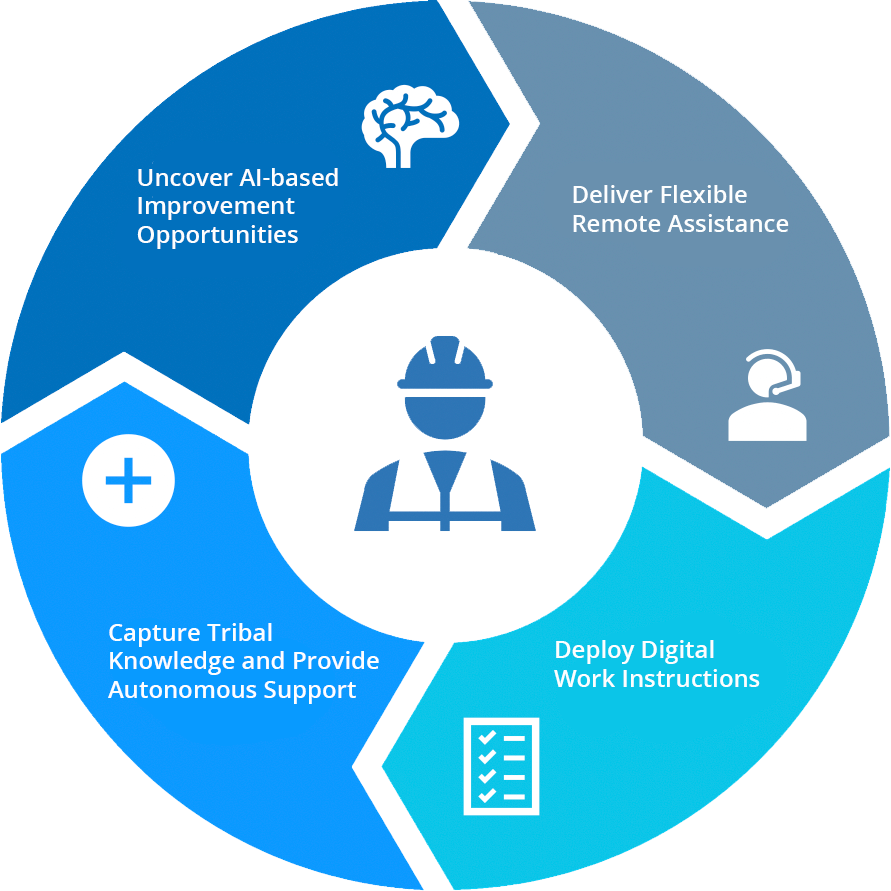
  • Enable independent work – empower your workforce to perform jobs more independently through step-by-step, augmented work instructions
  • “Instant skill” your workforce – use AI-based personalized work instructions that are tailored to each workers proficiency level to help them complete jobs at peak quality and performance
  • On-demand virtual support – Remote expert assistance and collaboration tools that enable remote support and guidance, amplified with AI-bots that accumulate and make available tribal knowledge for real-time virtual assistance.
  • Delivers hands-free operations – Augmentir on industrial smart glasses
  • Use AI to uncover True Opportunity™ – AI Separates “True” from “Raw” Opportunity to help identify areas where the largest improvements can be made

AI is uniquely suited to identifying capturable opportunities from the massive, noisy data set generated by frontline workers, and because of that, it can serve as the foundation for a company’s continuous improvement initiatives.

Another area where AI adds value is in using AI for continuous improvement around training and skilling-up of the workforce.

For instance, AI can identify specific individuals that would benefit from targeted training on a specific tool or procedure as well as improvements to content and instructions directed at the author.

And if you think about it – the possibilities are endless. There are a variety of areas that can be targeted for continuous improvement including the ecosystem of content authors, frontline workers, subject matter experts, operations managers, quality specialists, etc. Along with that, you’ll find dozens of opportunities to continually address the skills gap, improve quality, and improve overall performance.

Judging by the plethora of images we see in the media of individuals wearing Augmented Reality (AR) sets in all aspects of their work-life, one could assume that Enterprise AR has been widely adopted amongst many companies. However, the reality of Enterprise AR is that most industrial companies have had difficulty creating sustainable value when […]

Enterprise AR

Judging by the plethora of images we see in the media of individuals wearing Augmented Reality (AR) sets in all aspects of their work-life, one could assume that Enterprise AR has been widely adopted amongst many companies. However, the reality of Enterprise AR is that most industrial companies have had difficulty creating sustainable value when attempting to implement the technology. One reason being is that most early AR vendors were overly focused on delivering information and digital work instructions to industrial workers via wearable devices, which has not produced the expected efficiency benefits.

Since many of the early adopters of AR solutions failed to justify cost and complexity compared to the minimal gains in efficiency, they got stuck in “pilot purgatory” where they weren’t able to successfully emerge from an initial proof-of-concept initiative.

First Wave of AR Solutions Failed to Find Widespread Adoption

But why is it, that a technology that promised to generate overall success and savings in resources, costs and time has failed to deliver? If we take a step back and examine the first wave of enterprise AR, we can pinpoint some of the reasons why Enterprise AR alone has been unable to provide the value that manufacturers are looking for causing a lack of widespread adoption:

  • Early AR solutions are characterized by high costs and long implementation cycles, which made them accessible only to the largest manufacturing enterprises that have high innovation budgets and significant resources.
  • Solutions were not tailored to small and mid-market manufacturing companies. 
  • Poorly implemented software solutions and early hardware that didn’t perform to the comfort, safety, and reliability expected by the users
  • Existing solutions only deliver information to frontline workers and with that have not been able to provide value beyond the initial one-time gain in productivity. 

Most importantly though, once the solutions were finally deployed, it became obvious that the software failed to provide value beyond the initial one-time gain in productivity, which was  frequently seen in use-cases where hands-free operation was the real source of the benefits derived.

Expanding the Value Proposition of Enterprise AR by Focusing on the Connected Worker

But just because the first wave of AR implementations have mostly failed, doesn’t mean that the technology doesn’t have the potential to generate great efficiency gains for industrial companies. We simply need to take a new approach. 

What’s been overlooked so far is the potential derived from collecting data about the work from this newfound connectivity to the worker via connected worker solutions

If you could envision workers as a new source of information to improve your processes, and if you used AI to analyze that data to create insights into every aspect of their productivity and training, you could benefit the entire organization.


The current COVID-19 crisis has impacted almost every industry worldwide, forcing businesses to implement work from home strategies, discontinue travel, and scale back on operations. Industrial and manufacturing businesses have been particularly affected by this due to reduced frontline worker availability, supply chain issues and the need to create social distancing workplaces for the health […]

The current COVID-19 crisis has impacted almost every industry worldwide, forcing businesses to implement work from home strategies, discontinue travel, and scale back on operations. Industrial and manufacturing businesses have been particularly affected by this due to reduced frontline worker availability, supply chain issues and the need to create social distancing workplaces for the health and safety of workers while also keeping them connected.

But in an industry that relies on the bulk of its operations to be carried out on-site, how can manufacturing businesses remain at capacity and keep frontline workers engaged during a time of remote working and travel restrictions?

According to Forbes, many leading manufacturing businesses are looking to Connected Worker technology to help manage these issues and keep up with operations. Through the use of augmented reality (AR) combined with artificial intelligence and machine learning (AI/ML), a connected worker platform allows manufacturers to take advantage of digital information to carry out tasks on site and complete jobs. Here are 3 major ways connected worker technology is helping keep manufacturing businesses stay afloat during COVID-19:


  1. Flexible work arrangements that support social distancing
    As a result of COVID-19, manufacturers have initiated policies that encourage remote working, eliminate non-essential travel and instruct employees who are sick to stay home until they are better. This directly impacts the progression of operations that typically take place when multiple workers collaborate onsite. With on-demand remote expert functionality, onsite workers can quickly pull in an offsite colleague when their expertise is required. Procedures, videos, real-time data and more are readily available to intelligently guide and help workers on the job.

  2. Reduced complexity and downtime
    Manufacturers can expect a learning curve as they assess strategies and implement new ways to work more at home and less on the shop floors. Using a connected worker platform allows companies to pivot quickly in order to retain the workforce and reduce downtime during learning periods. Frontline workers are able to receive fully augmented, guided instructions on any device to improve productivity, quality and customer satisfaction.

  3. Gather insightful data to track progress during the crisis with AI
    It’s critical for manufacturers to monitor processes and track progress during this time so that they can make quick adjustments to ensure overall optimization. Incorporating AI into an AR strategy goes one step further by enabling true organizational optimization using the rich stream of activity data to recommend improvement actions to frontline workers, continuous improvement specialists, trainers, manufacturing engineers, and operation and service managers.

As this pandemic crisis continues to spread worldwide, manufacturers will likely continue to face challenges and look to connected worker technology to keep their workers safe and their businesses operating. It’s also important to recognize this as a major turning point in the way frontline workers interact and perform daily operations in the future. 

Field Service News, a leading online journal dedicated to the Field Service industry, recently posted an article featuring Augmentir as one of their top three picks for best new solution providers in the Field Service Sector for Enterprise Augmented Reality (AR) powered by AI. Field Service News spoke with field service management professionals and field […]

enterprise augmented reality

Field Service News, a leading online journal dedicated to the Field Service industry, recently posted an article featuring Augmentir as one of their top three picks for best new solution providers in the Field Service Sector for Enterprise Augmented Reality (AR) powered by AI. Field Service News spoke with field service management professionals and field service solution providers across the globe over a 12 month period to cherry-pick the top three solutions that meet their needs.

What landed Augmentir on this notable list?

1.) Strong Leadership Team
The first reason is the strong leadership team with founding efforts at Wonderware, Lighthammer, and ThingWorx. The Augmentir team has a proven track record delivering industry-leading solutions in the industrial and manufacturing sectors.

2.) AI Powered Approach
In addition, Field Service Now calls out Augmentir for being different from the many Enterprise Augmented Reality providers that have suddenly noticed the potential in the field service industry and says, “the really interesting thing about Augmentir is that they’ve gone far beyond the initial approach that many of their peers are offering when it comes to Augmented Reality (AR) and dived straight into an Artificial Intelligence (AI) powered approach. In their own words, they position themselves as the first software platform built on Artificial Intelligence in the world of the augmented or connected worker.”

3.) Powerful Platform with an Easy-to-Use Interface
Finally, taking an AI approach is important when it comes to the use of AR in Field Service, because when leveraged alongside AI, AR becomes much more useful and powerful. Augmentir is a 100% AI-first company and understands that AR is the interface that makes the most sense for modern field service operations.

About Augmentir

Augmentir is the world’s only Smart Connected Worker Suite. Augmentir is being used by manufacturing and service companies to empower their frontline workers to perform at their best and deliver improvements in safety, quality, and productivity consistently, year-over-year.

Request a live demo today to learn more about why leading manufacturers are choosing our solutions to improve their manufacturing processes.

This post by Augmentir CEO Russ Fadel was originally published on Medium. I have been a fan of Marc Andreessen since the Netscape days — he has consistently predicted the macro changes in numerous marketscapes before virtually anyone else. Recently, I was watching Marc on Youtube “Why You Should Be Optimistic About the Future” and […]

Artificial Intelligene

This post by Augmentir CEO Russ Fadel was originally published on Medium.

I have been a fan of Marc Andreessen since the Netscape days — he has consistently predicted the macro changes in numerous marketscapes before virtually anyone else. Recently, I was watching Marc on Youtube “Why You Should Be Optimistic About the Future” and found his discussion on Artificial Intelligence (AI) particularly enlightening, and in complete alignment with Augmentir’s journey. The entire video is worth watching, but the discussion on AI runs from between the 7:00 to 9:00 minute mark.

Some of the most insightful (paraphrased) quotes include:

  • “There is a more fundamental question — is artificial intelligence a feature or an architecture?”
  • “A16z sees this with most start-up pitches now — ‘here are the 5 things my product does…and oh yeah, AI is always bullet number 6.’ Number 6 because it was the bullet they added after they created the deck”
  • “If AI is a feature, then this is correct, where every product will have AI sprinkled on it.”
  • “We (a16z) believe AI is an Architecture, and if it is, everything above this will need to be rewritten.”
  • “Ultimately, the goal of AI is to answer questions, even before the have been posed.”

At Augmentir we had to make a strategic decision at the time of company founding (late 2017), as to whether artificial intelligence was going to be a feature of our connected worker platform or, whether it was going to be the architecture that our connected worker functionality ran on. We didn’t frame the decision as elegantly as Marc did, but we nevertheless asked, “will AI be a feature of our product or will it be pervasive?”

Even though no one in our space had chosen this path, we decided AI would be pervasive. We postulated that the purpose of a connected worker platform wasn’t to deliver instructions and remote support to a frontline worker, but rather to optimize the performance of the connected worker ecosystem. We knew that AI was uniquely able to address the fundamental macrotrends of growing skills gaps and the loss of tribal knowledge. With an ecosystem of content authors, frontline workers, subject matter experts, operations managers, continuous improvement engineers, and quality specialists, we predicted that there were dozens of opportunities to improve performance.

By building our connected worker platform on an AI architecture, all data is automatically pipelined, labelled, and cleansed, and is immediately available to start generating insights and recommendations. On this journey, the scope of what we can use AI for has even surprised us. Our initial thoughts were on personalizing instructions and content to make each frontline worker perform this current task safely and as quickly as they can, given their current proficiency. This immediately expanded to a generalized True Opportunity™ system that uses AI to stack rank where an organization has the largest capturable opportunities across all stakeholders. The range of this is astounding: which jobs have the largest monthly opportunity, which workers can benefit from targeted training, what is the optimum time to perform any given task, what inline training material can benefit from an update, what content/procedures would benefit the most from an update, etc.

The future looks even more fantastic — AI bots offer a realistic opportunity to capture tribal knowledge and convert it to a scalable corporate asset, and AI Diagnostic bots to make everyone an immediate expert.

This is only possible when you view AI as an architecture, not as a feature.

Augmentir CEO Russ Fadel outlines why the next wave of AR implementations in the service industry must also harness Artificial Intelligence. There has been a lot of advocacy for using Augmented Reality (AR) in the field service industry due to benefits from improved field technician performance to reductions in field service operating costs. However, what […]

artificial intelligence

Augmentir CEO Russ Fadel outlines why the next wave of AR implementations in the service industry must also harness Artificial Intelligence.

There has been a lot of advocacy for using Augmented Reality (AR) in the field service industry due to benefits from improved field technician performance to reductions in field service operating costs. However, what these early success stories don’t mention is how companies have been slow to adopt this technology and have struggled to move beyond the pilot phase.

It was believed early on that wearable technology would be the core of Enterprise AR by 2018 and thus, vendors were overly focused on getting work instructions on a variety of wearables. Many also heavily invested in using AR to present information to technicians with rich content and 3D CAD overlays. Since then, it’s become clear that these investments haven’t delivered enough value to the enterprise due to a lack of adoption.

What has been overlooked is the opportunity to create sustainable value throughout the entire organization by connecting to service workers not only by delivering personalized information, but also using artificial intelligence and machine learning to augment the intelligence of the organization.

This is the beginning of a new era, an era not of Enterprise Augmented Reality, but of Augmented Operations where AR is but one of many ways to present data, support, and guide field workers. This transformation is driven by the combination of two key technology trends – Enterprise AR and Artificial Intelligence/Machine Learning.

Why is Artificial Intelligence and Machine Learning Important?

Historically, Artificial Intelligence and Machine Learning (AI/ML) has been applied against external data sets. A recent trend however, is to embed AI in software platforms, having it act on the internal data, eliminating the estimated 80% of AI/ML project efforts around labelling and cleansing external data. This is frequently being applied to solutions focused on improving business processes where the human worker is at the center.

At Augmentir, we use our AI engine to identify patterns in noisy data generated by technicians and highlight areas that can improve overall worker performance and also provide personalized procedures based on the proficiency of each worker in real-time.

The AI engine is able to continually deliver insights and recommendations based on that human worker data which is valuable intelligence that can be used to help drive continuous improvement across the entire organization – from operations to training to quality.

  • AI helps each worker perform at their peak by changing the instruction to one that optimizes for speed, while meeting quality and safety targets.
  • AI understands the patterns and outliers in the vast instruction/job execution data to identify the largest opportunities in the areas of: productivity, worker effectiveness, training materials effectiveness, and instruction effectiveness. Insights and recommendations are made on how to capture these opportunities and drive continuous improvement on a year-over-year basis.
  • With AI, companies can capture tribal knowledge through interactions between experts and frontline workers, making the expertise a scalable corporate asset over time.

With this concept of Augmented Operations (using AI/ML to deliver intelligence across the organization from your augmented workforce), we are seeing a change in how organizations are making informed decisions, empowering workers, and improving the productivity of humans in the workplace.

Augmenting the Service Workforce of the Future

Despite some early momentum, Enterprise AR alone isn’t enough to deliver sustainable value in the field service sector.

What has been ignored is a real opportunity to create sustainable value throughout the organization – not only giving workers the ability to consume information and apply knowledge, but also augmenting the intelligence of the organization relative to how it engages empowers, and continually improves its human workforce. At Augmentir, we are calling this Augmented Operations, and we believe that this will transform the service workforce of the future.

To learn more about how Augmentir’s platform leverages AR and AI to continually improve the productivity of your frontline workforce download our free white paper, “Rise of the Augmented Worker.”


There have been countless changes in technology over the past couple of decades: Machine Learning, Cloud Computing, Internet of Things, Artificial intelligence, and Augmented Reality (to name a few). But with all of these advances in technology, the 350 million workers in manufacturing are being asked to perform increasingly complex jobs using technology that has […]

digital transformation strategy

There have been countless changes in technology over the past couple of decades: Machine Learning, Cloud Computing, Internet of Things, Artificial intelligence, and Augmented Reality (to name a few). But with all of these advances in technology, the 350 million workers in manufacturing are being asked to perform increasingly complex jobs using technology that has remained relatively unchanged for 20 years, and, according to Deloitte, manufacturing is already looking at a potential skilled labor shortage of 2.4 million workers in the next decade. Whether this is because enterprise software solutions are expensive, technically complex, difficult to implement, or lack continuous improvement opportunities, these users and processes have been underserved and require a well-planned digital transformation strategy to keep them competitive.

Although there has been a recent trend towards a digital transformation that looks at applying new technologies to improve operational processes, the workers who actually perform these processes are not being considered. Because of this, the frontline worker is largely disconnected from the digital thread of the business, and improvement in productivity seems stagnant.

Key Challenges Manufacturers Face Today

As with any transformational change, adopting a digital transformation strategy is no easy undertaking. We currently see 4 key challenges industrial organizations face when adopting a digital transformation strategy:

1.) Tribal Knowledge and the “Skills Gap”
Senior production workers and subject matter experts have accumulated valuable experience and knowledge, which has been typically hard to capture and convert into an asset that is able to be easily shared and used by others. The younger workforce that is entering the manufacturing sector does not have the knowledge that their senior peers have, but are expected to perform the same jobs, at the same level of productivity and quality.

2.) Lack of Insight
Lack of insight into how workers are performing their jobs on a day-to-day basis is also an issue. There is no fine-grained detail regarding worker activity – how are workers performing vs. benchmarks, are they having trouble on certain steps, what are they doing well, do they have feedback on operational procedures that could help the rest of the workforce? This lack of data and insight has made it extremely difficult to improve the performance of frontline workers. As a result, there is little or no basis for making decisions for improvement across the organization.

3.) Lack of Guidance and Accurate Information
Organizations are struggling with the quality of human-centric processes, as they often suffer from inaccurate, outdated paper-based work instructions. In many cases productivity is also an issue because workers are not equipped with the right tools or instrumented with the appropriate guidance that would help them perform their jobs at peak productivity.

4.) Workers are Disconnected
And lastly, frontline workers are not integrated with their work environment. The human-centric and job-specific workflows are not digitally integrated into the overall business environment and enterprise systems (ERP, CRM) that are critical to the business. The reality of today’s frontline workforce in manufacturing is that workers are not connected to the digital fabric of the business.

Bridging the Digital-Reality Gap

The good news is that there are a number of new strategies and technologies that manufacturing organizations are implementing to solve these problems. In particular, the rise of Enterprise Augmented Reality has lead to a major shift in improving the productivity of the frontline workforce of manufacturing organizations.

Although this is a great first step, Enterprise Augmented Reality alone isn’t enough to deliver sustainable value in manufacturing. In order to see true transformational results, it is key to have a combination of the following:

  • Enterprise AR: Delivers initial improvements in productivity and quality for the frontline workforce.
  • Consumerization of Software: Enables ease-of-use and ubiquity across the manufacturing landscape.
  • Artificial Intelligence: Drives continuous improvement throughout the organization.

Only when these three elements are combined will you see continuous improvements in the productivity of your frontline workforce.

To learn how Enterprise Augmented Reality, Artificial Intelligence, and the Consumerization of Software are delivering transformational value in manufacturing download our white paper, “The Rise of the Augmented Worker.”


“There is an increasing pressure on the sector to make the most out of every field service technician.” “The impact of lost knowledge and customer relationships built over the years and decades by retiring technicians is keeping service leaders up at night.” “Many companies have not been able to capture their ‘tribal knowledge’ in a […]

field service

“There is an increasing pressure on the sector to make the most out of every field service technician.”

“The impact of lost knowledge and customer relationships built over the years and decades by retiring technicians is keeping service leaders up at night.”

“Many companies have not been able to capture their ‘tribal knowledge’ in a systematic way, risking the loss of valuable insight into service operations.”

These quotes come from “The Future of Field Service”, a February 2018 article in Field Technologies Online. Of course, they also could have been quotes from a 2008 or even earlier version of the article. Why is it that these problems that have been considered significant issues by Field Service executives are not solved and still considered problems year after year? Are they simply intractable problems that have no solution? Perhaps the answer to these questions is hidden in another quote from the article:

“The core of field service, the technician’s visit, is the aspect least addressed by field service management solutions.”

To date, everything before and after a site visit is digitized and chronicled to great extent, but much of what goes on during the visit is still very much a “black box”. Sure, there are now Remote Expert video based collaboration tools that may allow recording of a session, but what if the person on site IS the expert and doesn’t need to make that call? In addition, these solutions don’t capture what went on before or after the the call. What did the tech do that lead up to the call? Without that information we (a) put the expert at a disadvantage because they have no context to help solve the problem and (b) fail to capture the tribal knowledge of what NOT to do, or understand the common mistakes that might lead to difficulties in the field.

From my early days working on Internet based Remote Service, first with Questra and then with ThingWorx, I have seen many companies that have tried to address the Tribal Knowledge issue in many ways. Knowledge Management systems, social networking tools, video chat sessions, etc. have all been moderately successful at best, and usually at very high cost. The reason for this is that they largely relied on “after the fact” documentation. Asking the tech to remember everything that happened while on-site (while they are rushing off to the next job) is often a lesson in futility.

So, what is the answer? How do we break open that black-box? To quote from the article once again:

“It seems so paradoxical that so few field service management solutions focus on these aspects of field service”

Some folks have seen IIoT as a solution, letting the equipment itself collect and send data. While this is certainly helpful, it doesn’t reveal the true story of what the tech is experiencing onsite. Others have said that the aforementioned video collaboration tools are the answer, but again, there is the critical before and after the call information that is missing. And mixing Social Networking and people heading towards retirement is almost never a good idea(!).

So what is the answer? Are we destined to forever be wandering around the darkened room of the customer site visit with a blindfold on? At Augmentir we think perhaps not. But much more on that later…