
Industrial AI doesn’t have a data problem—it has a context problem. Learn why execution intelligence is the missing link between AI insights and real manufacturing outcomes.
Nearly every industrial technology conversation today revolves around AI. Manufacturers are evaluating copilots, autonomous agents, industrial knowledge graphs, digital workers, and generative AI. Software vendors are racing to demonstrate how AI can automate decisions, improve productivity, and streamline operations.
Yet amid all of the excitement, one critical question often goes unanswered: What data is this AI actually using to using to make decisions?
For many industrial AI initiatives, the answer is familiar—machine telemetry, ERP transactions, MES records, CMMS work orders, quality systems, and historian data. These systems provide valuable operational information, but they only tell part of the story. Manufacturing performance depends not only on machines and processes, but also on how people execute work.
Every maintenance task, inspection, changeover, startup, quality check, and standard operating procedure depends on frontline workers making thousands of decisions every day. Those decisions generate an enormous amount of execution data, yet that information has historically been difficult to capture, structure, and analyze at scale.
Without understanding how work is actually performed, AI has an incomplete view of operations. It may have data, but it lacks context—and in manufacturing, context is what transforms AI from simply generating answers into driving the right actions.
Context is What Separates AI from Action
Today’s large language models (LLMs) are remarkably capable. They can summarize documents, generate procedures, answer questions, and analyze massive amounts of information. But LLMs don’t inherently understand manufacturing operations. They rely on rich operational context to reason effectively, enabling AI agents to make informed decisions and take meaningful action. Without that context, even the most advanced models are limited.
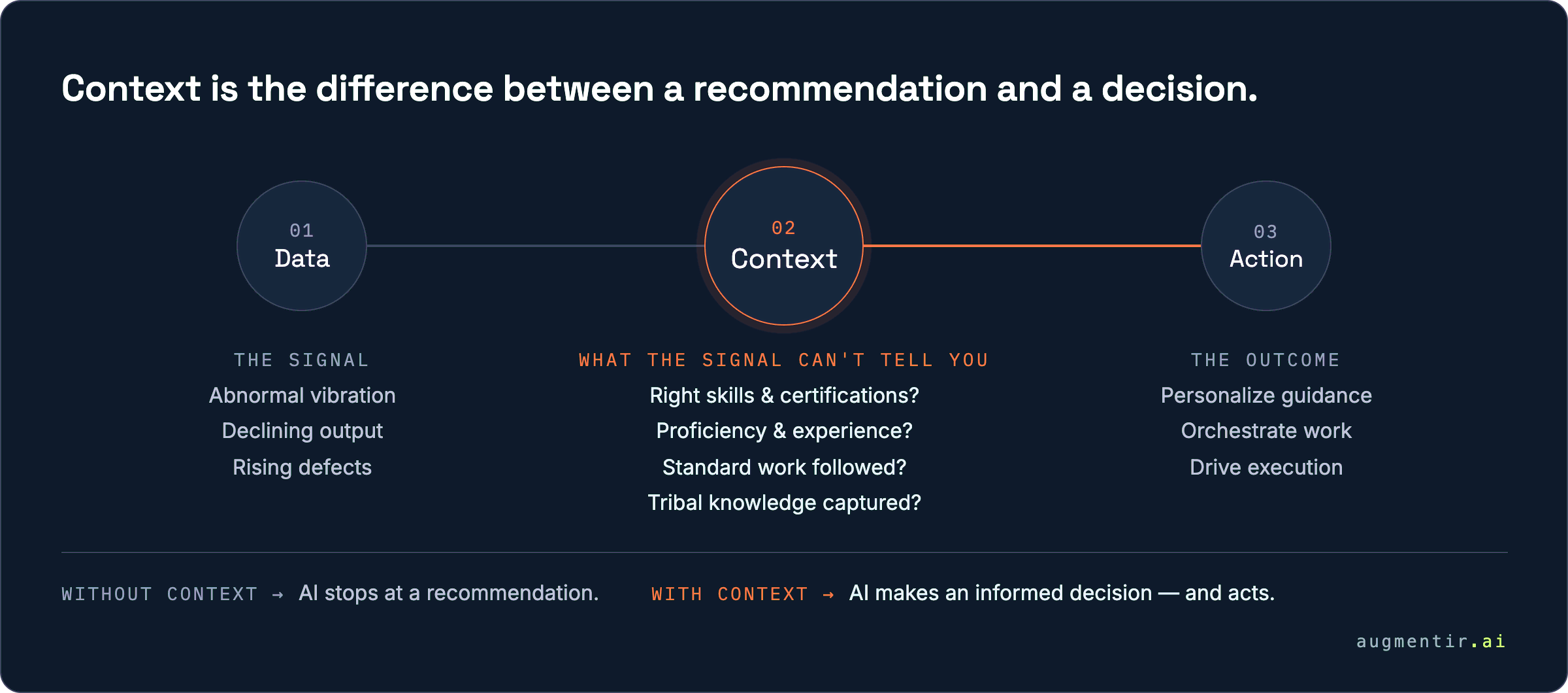
An AI agent may receive a signal from an IoT sensor indicating abnormal equipment vibration, recognize declining production output from MES data, or identify an increase in quality defects from a QMS. What it often cannot determine is whether the technician assigned to the work has the right skills, certifications, proficiency level, and experience to perform the repair, whether they’ve successfully completed similar work in the past, whether the operator has recently completed training, if standard work is actually being followed, or what tribal knowledge experienced workers have developed that never made it into the SOP.
Without this context, AI can generate recommendations. With it, AI can make informed decisions, personalize guidance, orchestrate work, and drive execution.
As AI moves beyond answering questions to initiating actions, governance becomes just as important as context. Manufacturers need confidence that AI agents operate within defined permissions, business rules, security policies, and human approval workflows. Context enables AI to make better decisions; governance ensures those decisions are safe, transparent, auditable, and aligned with operational and regulatory requirements.
Building a System of Context
Manufacturers have spent decades investing in systems that collect operational data. ERP platforms manage business transactions, MES platforms manage production, CMMS platforms manage maintenance, QMS platforms manage quality, and historians collect equipment and process information.
That investment is only accelerating. Deloitte’s 2025 Smart Manufacturing and Operations Survey found that 92% of manufacturers believe smart manufacturing will be the primary driver of competitiveness over the next three years. As manufacturers continue investing in AI and connected technologies, they’re generating more operational data than ever before—but more data alone doesn’t create better AI. It must be transformed into context.
A system of context isn’t built by integrating enterprise systems alone. It is built by continuously capturing how work is actually performed across the factory.
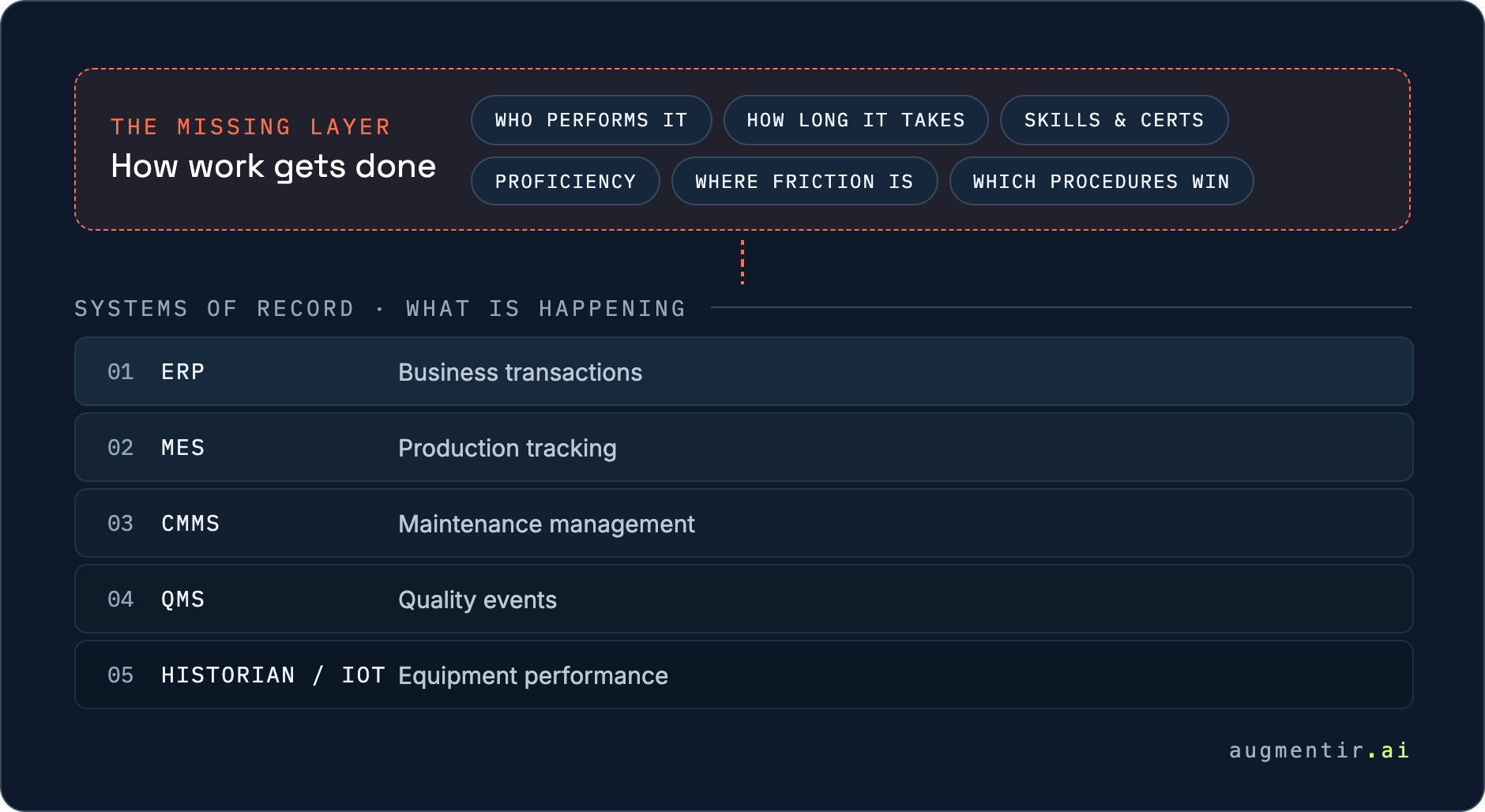
ERP systems manage business transactions. MES tracks production. CMMS manages maintenance. QMS captures quality events. Historians and IoT platforms monitor equipment performance. Together, these systems describe what is happening across the operation.
The missing layer is how work gets done.
This is where AI-native connected worker platforms fundamentally change the equation. Unlike traditional software that simply digitizes work, an AI-native platform continuously captures the execution of work itself—how tasks are performed, who performs them, how long they take, where workers encounter friction, when assistance is required, which procedures produce the best outcomes, and how worker skills, proficiency, and experience influence operational performance.
Every completed procedure, inspection, maintenance activity, changeover, quality check, and guided workflow becomes another source of execution intelligence.
Unlike static operational data that simply records what happened at a point in time, execution intelligence compounds with every task performed. Each new execution expands the platform’s understanding of workforce performance, creating an ever-growing foundation of operational knowledge.
Execution intelligence is the continuous measurement and AI-driven understanding of frontline work—capturing not only what workers do, but how effectively they perform, what drives performance variation, and where opportunities for improvement exist.
As millions of frontline work activities are captured, AI continuously structures, cleans, and normalizes the data, distinguishing normal variation from true performance opportunities. Over time, it builds an increasingly rich understanding of how work is performed, how well it is performed, and the factors that consistently drive better operational outcomes.
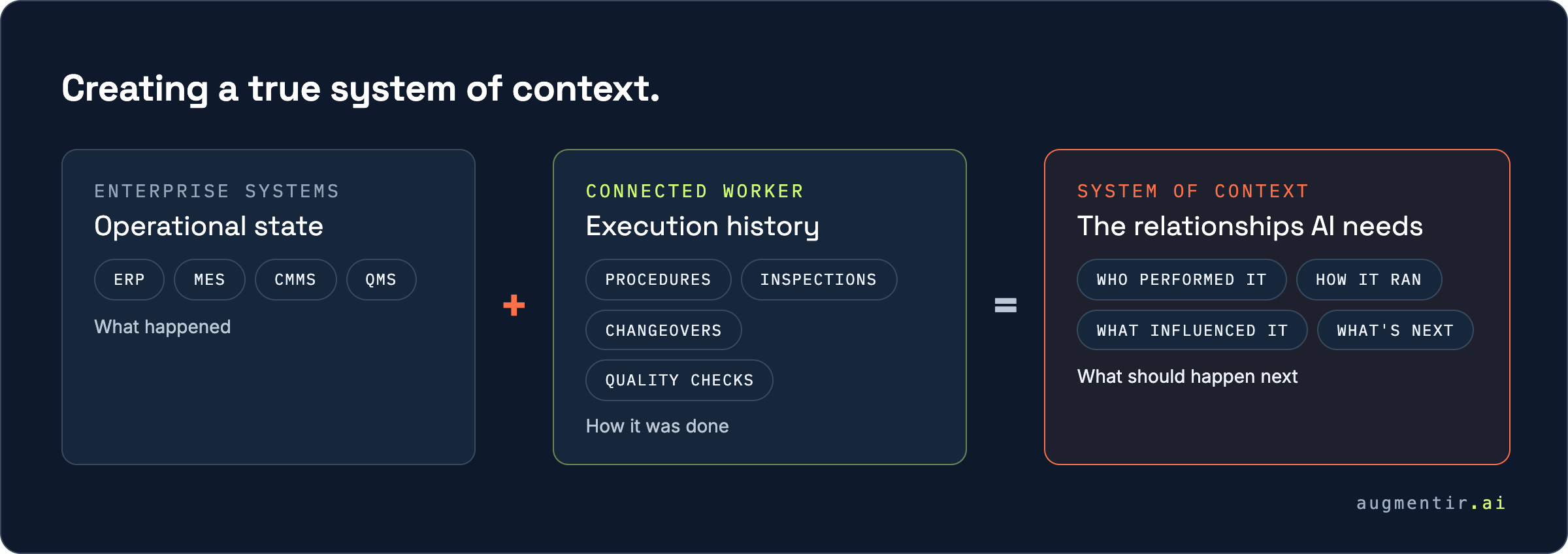
This is what creates a true system of context. Enterprise systems provide the operational state of the factory. Connected worker platforms provide the execution history of the workforce. Together, they create the relationships AI needs to understand not only what happened, but who performed the work, how it was executed, what influenced the outcome, and what should happen next.
Technologies such as industrial knowledge graphs play an important role by organizing these relationships, but the graph is only as valuable as the context it contains. The real advantage comes from continuously generating new execution intelligence—not simply connecting existing records.
This is where AI-native platforms establish a durable data advantage. Every workflow completed, every task executed, and every AI-optimized time & motion study expands the platform’s understanding of how work is performed. After analyzing millions of real-world execution events, AI begins to understand not only what happened, but why it happened, which workers consistently achieve the best outcomes, what behaviors lead to success, and how those best practices can be replicated across the workforce.
Over time, this creates a proprietary foundation of workforce intelligence that becomes increasingly difficult to replicate. Rather than relying on static historical records, AI continuously learns from the daily execution of work itself—enabling AI agents to make better decisions, personalize guidance for every worker, orchestrate work across enterprise systems, and drive continuous operational improvement.
Closing the Context Gap
Industrial AI is advancing rapidly, but its long-term value won’t be determined by the size of the language model or the sophistication of the AI agent. It will be determined by the quality of the context those systems can reason over.
Manufacturers have spent decades digitizing machines, equipment, and enterprise processes. The next frontier is digitizing the execution of work itself—capturing not only what happens on the factory floor, but how work is performed, how performance varies, and why some workers, teams, and processes consistently achieve better outcomes than others.
This is where Augmentir takes a fundamentally different approach. From the beginning, the platform was designed as an AI-native connected worker platform—not simply to digitize frontline work, but to continuously learn from it. Every guided workflow, every completed procedure, every captured skill, and every AI-optimized time & motion study contributes to a growing foundation of execution intelligence that helps AI better understand the realities of manufacturing operations.
That continuously expanding understanding closes the context gap between enterprise data and frontline execution. It enables AI to move beyond answering questions or generating recommendations to delivering personalized guidance, orchestrating work, identifying improvement opportunities, and driving measurable operational outcomes.
As industrial AI continues to evolve, manufacturers won’t compete based solely on who has the most AI. They’ll compete based on who has the richest understanding of how work gets done. Because in manufacturing, context isn’t just another input to AI—it is the foundation that turns intelligence into action. Combined with strong governance, security, and human oversight, it also ensures that those actions are trustworthy, auditable, and aligned with the operational and safety requirements of modern manufacturing.
Frequently Asked Questions (FAQ)
What is execution-driven industrial AI in manufacturing?
Execution-driven industrial AI combines artificial intelligence with workforce intelligence and operational data to help manufacturers make better decisions and automate work on the factory floor. Instead of simply analyzing machine data, execution-driven AI understands how work is performed, who is performing it, and what actions should happen next. Augmentir's AI-native Connected Worker platform enables execution-driven industrial AI by connecting workers, work, and enterprise systems to continuously improve safety, quality, productivity, and operational performance.
Why do AI agents in manufacturing need workforce intelligence?
AI agents in manufacturing need workforce intelligence because machine and operational data alone do not provide enough context to make informed decisions. Workforce intelligence includes worker skills, certifications, proficiency, training history, and step-level execution data. Augmentir captures and analyzes this information to give AI agents the context they need to recommend actions, orchestrate workflows, personalize worker guidance, and continuously optimize manufacturing operations.
How does Augmentir use AI agents to improve manufacturing operations?
Augmentir uses AI agents to help manufacturers automate and optimize frontline operations. Built on an AI-native Connected Worker platform, Augmentir's AI agents leverage workforce intelligence, digital work instructions, and data from ERP, MES, CMMS, QMS, and historian systems to assist workers, coordinate multi-step workflows, support maintenance and quality processes, and drive continuous improvement across the factory.